


The contemporary political trajectory of the Indian National Congress presents one of the most intriguing paradoxes in modern Indian democracy. A party that once exercised an almost hegemonic influence across the subcontinent now finds itself navigating a deeply asymmetrical electoral geography—demonstrating resilience, adaptability, and occasional resurgence in the southern peninsula while simultaneously suffering strategic erosion and organizational decay across the Hindi-speaking heartland.
This divergence is neither accidental nor episodic. Rather, it reflects a profound transformation in the architecture of Indian electoral politics, voter psychology, ideological realignment, and the party’s own institutional evolution. While critics prematurely consigned Congress to political obsolescence, its performance in southern India has offered compelling evidence that the organization retains both relevance and strategic capacity when it aligns itself with regional realities, leadership autonomy, and calibrated alliance politics. Yet, the same cannot be said for the Hindi belt, where repeated failures have transformed episodic setbacks into a structural crisis.
The question, therefore, is not whether Congress can still win elections—it demonstrably can. The real question is whether it can reclaim its identity as a genuinely national political force.
The Southern Theatre: Congress’s Laboratory of Political Rehabilitation
Southern India has increasingly emerged as the most hospitable terrain for Congress’s contemporary political recovery. Unlike the binary ideological polarization that defines much of northern India, southern politics remains deeply influenced by regional identity, governance performance, coalition pragmatism, welfare politics, and state-specific leadership ecosystems. Congress has adapted to these conditions with varying degrees of sophistication.
Karnataka: The Architecture of Strategic Redemption
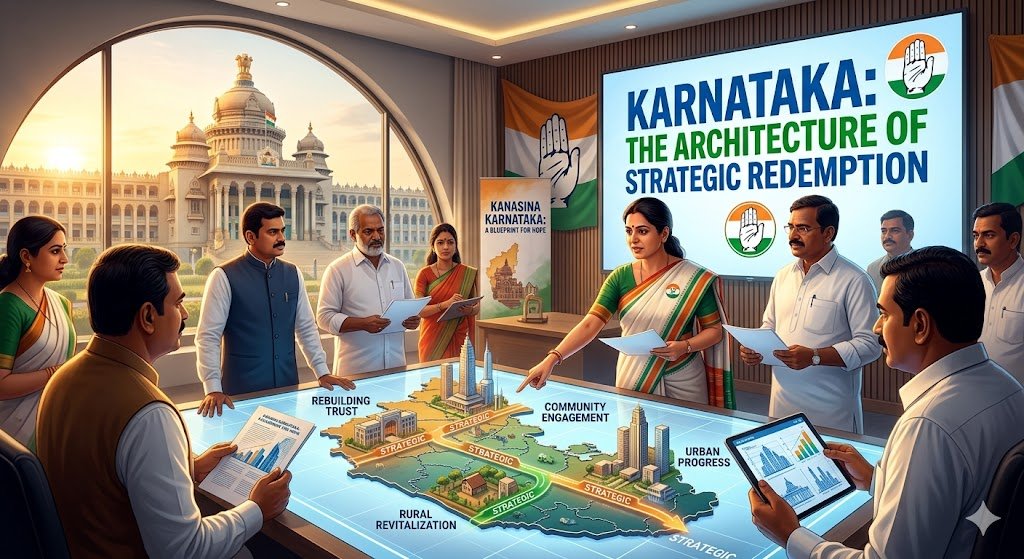
Congress’s emphatic triumph in Karnataka was not merely an electoral victory; it was an exhibition of disciplined political engineering.
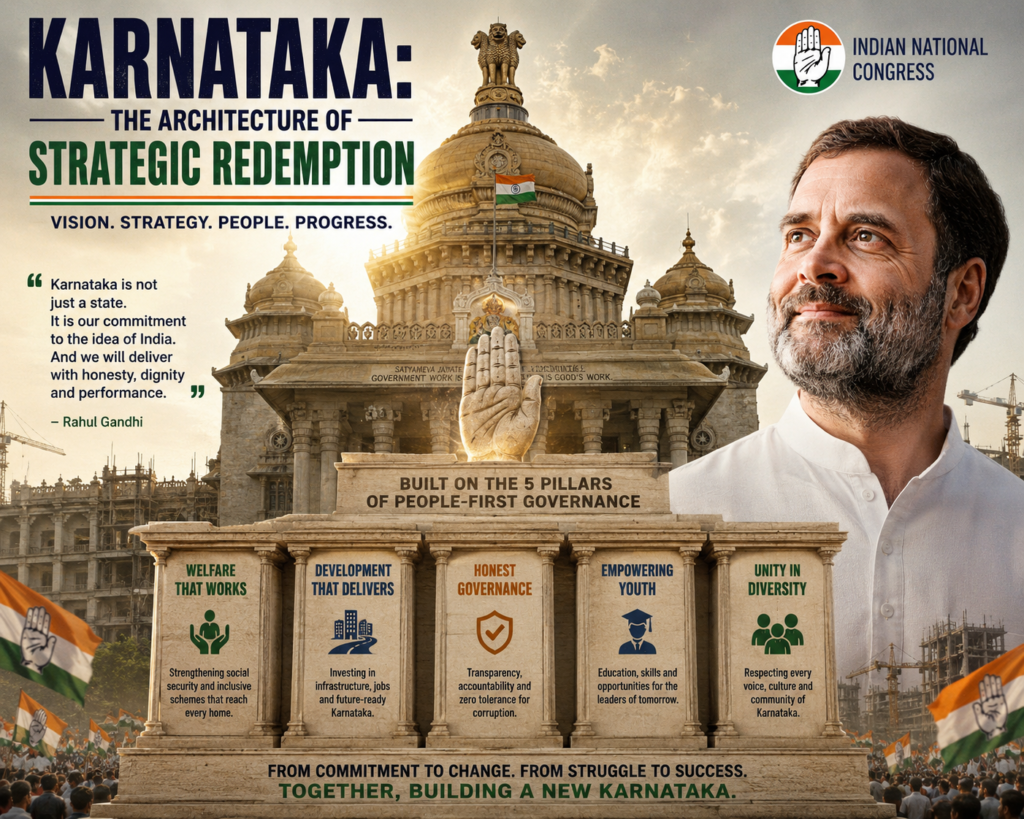
For a party frequently accused of strategic incoherence, Karnataka demonstrated remarkable clarity. Congress successfully transformed widespread anti-incumbency into electoral momentum while simultaneously articulating a governance-centric campaign rooted in material concerns rather than abstract ideological confrontation.
Its messaging was astutely calibrated toward:
- inflationary distress,
- unemployment anxieties,
- welfare assurances,
- women-centric policy guarantees,
- and governance dissatisfaction.
More significantly, Congress resisted the chronic temptation of excessive centralization. Instead of converting the election into a personality-centric national referendum, it empowered credible regional leadership structures.
This distinction matters enormously.
Indian voters, particularly in state elections, increasingly reward political formations that demonstrate familiarity, accountability, and local rootedness. Karnataka revealed that Congress remains electorally formidable when it behaves as a decentralized political organism rather than an over-managed national bureaucracy.
In many respects, Karnataka represented a revival of Congress’s classical electoral formula: social coalition construction, welfare pragmatism, and leadership localization.
Telangana: Persistence Rewarded
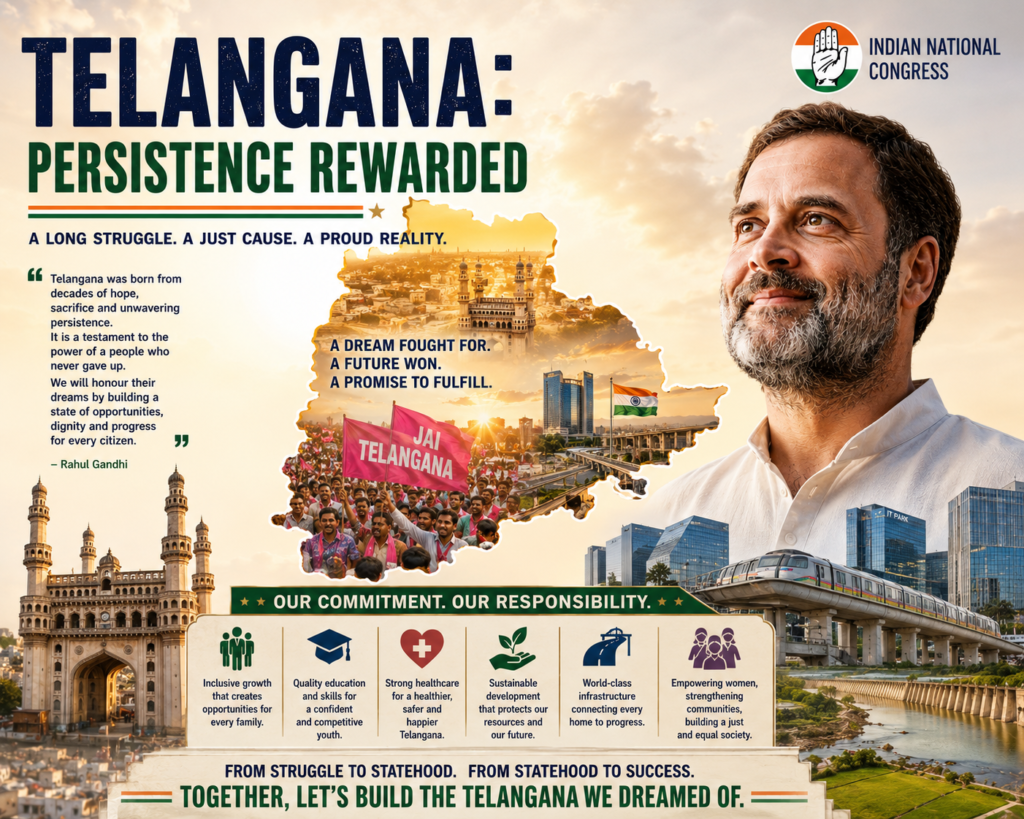
Telangana’s political transformation marked another consequential moment in Congress’s southern resurgence.
Defeating an entrenched regional incumbent is never a simple anti-incumbency exercise. It requires narrative construction, organizational patience, and strategic timing.
Congress succeeded because it demonstrated an understanding of political patience rarely associated with its recent national posture.
The party gradually positioned itself as the most credible alternative by:
- sustaining consistent political visibility,
- absorbing localized discontent,
- recruiting influential regional figures,
- and broadening its caste-community outreach.
This was not an accidental collapse of the incumbent regime; it was a deliberate conquest of political space.
Importantly, Telangana revealed Congress’s capacity to reinvent itself as a regional challenger rather than relying solely on historical legacy. That adaptability deserves recognition.
Tamil Nadu: Coalition Intelligence Over Political Vanity
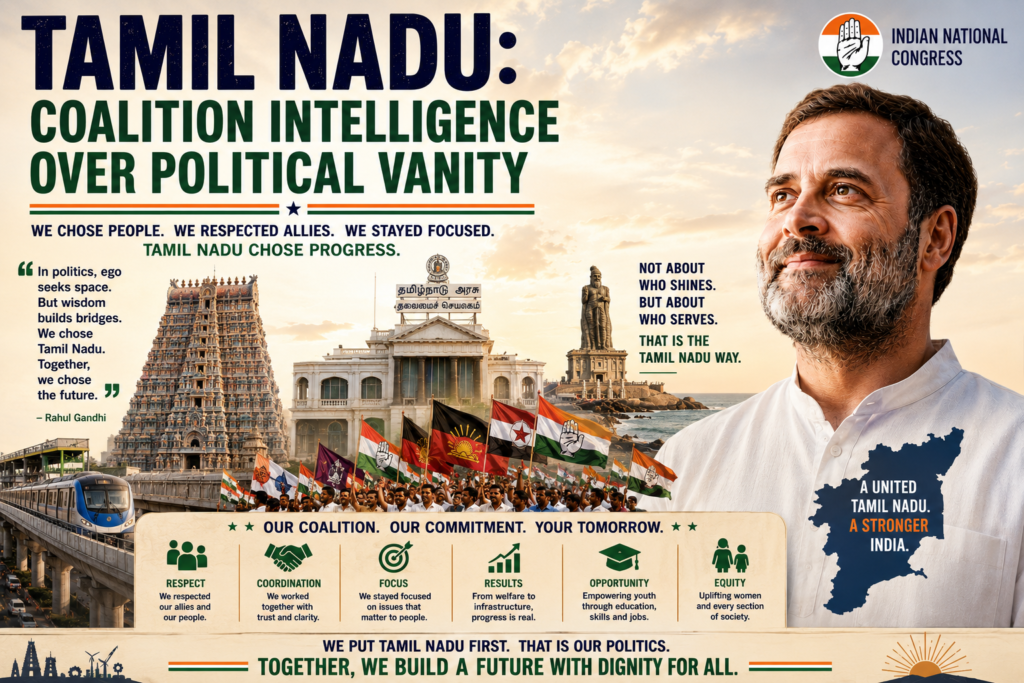
If Karnataka showcased independent strength and Telangana strategic persistence, Tamil Nadu exemplifies alliance realism.
Congress deserves considerable commendation for recognizing political arithmetic rather than succumbing to symbolic vanity.
Tamil Nadu’s political ecosystem is structurally dominated by regional Dravidian formations. Under such circumstances, insisting on unilateral revival would have been strategically delusional.
Instead, Congress adopted a mature coalition posture through its alignment with the DMK.
This alliance demonstrates several political virtues:
- strategic humility,
- coalition discipline,
- electoral realism,
- and a nuanced understanding of regional asymmetry.
Too often in politics, parties confuse visibility with relevance. Congress, in Tamil Nadu, understood that influence within a victorious coalition may be more valuable than isolated ideological purity.
Such political maturity is rare.
Kerala: Institutional Continuity Amid National Decline
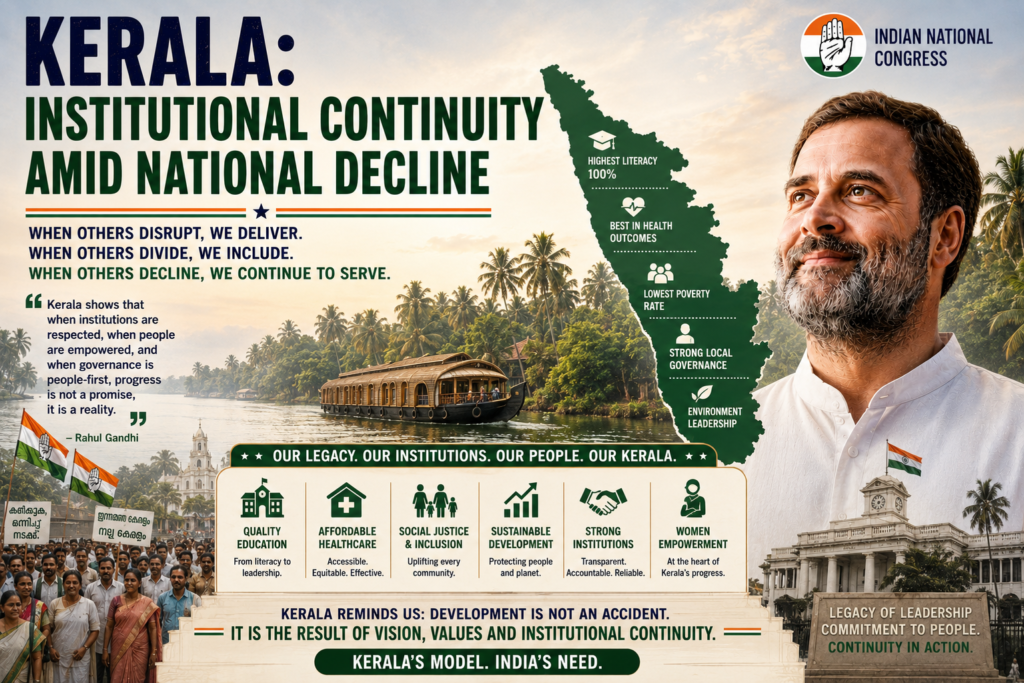
Kerala remains perhaps the most structurally resilient Congress ecosystem in India.
Unlike many northern states where the party apparatus has deteriorated into skeletal existence, Kerala’s Congress retains:
- organizational coherence,
- ideological recognizability,
- leadership depth,
- cadre continuity,
- and electoral competitiveness.
The bipolar nature of Kerala politics ensures Congress remains institutionally engaged rather than politically dormant.
This constant electoral competition prevents organizational atrophy—a lesson Congress would do well to internalize elsewhere.
Why the South Remains Hospitable to Congress
Congress’s southern relative success is not simply a function of luck or isolated circumstances. It reflects structural compatibility.
Leadership Federalism
Southern Congress units frequently possess leaders with authentic regional legitimacy.
This matters profoundly.
Modern Indian politics has become intensely localized. Voters increasingly distinguish between national rhetoric and state-level credibility.
Where Congress empowers regional leadership, it performs better.
Where it substitutes local architecture with centralized symbolism, it weakens.
Welfare Compatibility
Southern political culture is significantly governance-oriented.
Electoral discourse often revolves around:
- public services,
- education,
- healthcare,
- welfare guarantees,
- administrative delivery.
Congress’s ideological framework naturally aligns with such politics.
This compatibility creates fertile ground for recovery.
Alliance Pragmatism
Congress’s willingness to negotiate political space rather than monopolize it has strengthened its southern relevance.
Coalition politics requires humility, arithmetic intelligence, and strategic restraint.
In the South, Congress has often displayed these qualities.
Organizational Survival
Even after decline, Congress retained institutional remnants in southern states.
Organizational extinction rarely occurred completely.
That residual infrastructure made recovery possible.
The Hindi Belt Crisis: Congress’s Structural Catastrophe
If southern India offers evidence of recovery, the Hindi-speaking belt offers evidence of systemic collapse.
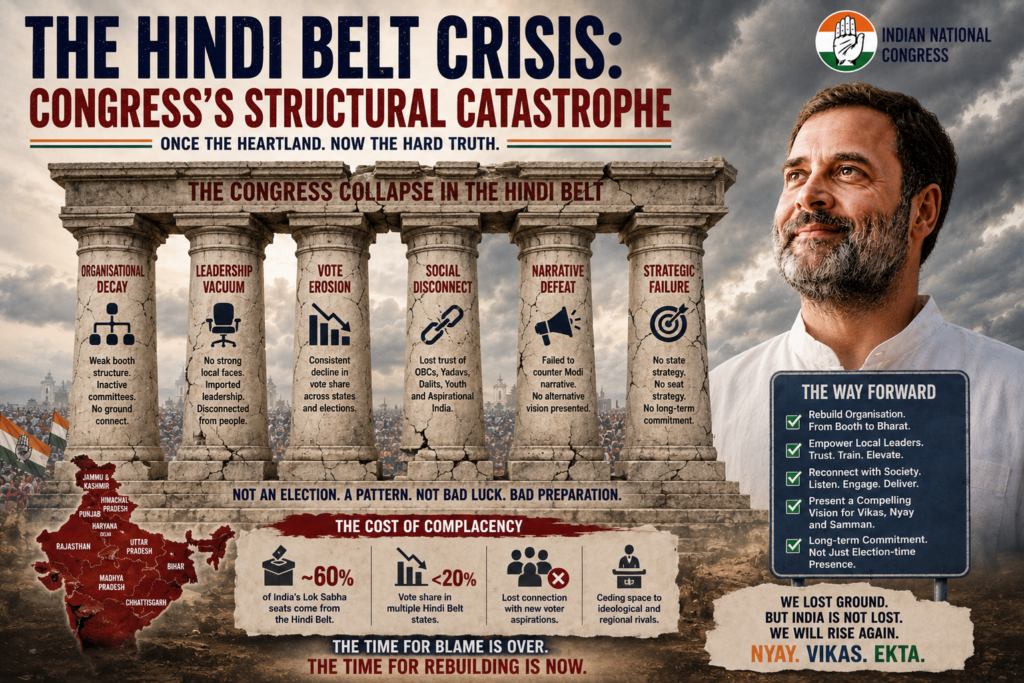
This region remains electorally decisive.
No party aspiring toward durable national dominance can remain structurally weak in:
- Uttar Pradesh,
- Bihar,
- Madhya Pradesh,
- Rajasthan,
- Chhattisgarh,
- Delhi,
- Haryana,
- Jharkhand (partially),
- Uttarakhand.
Congress’s failures here are not merely electoral disappointments.
They represent an institutional emergency.
Leadership Deficit
Perhaps the most glaring weakness is leadership invisibility.
In many Hindi belt states, voters struggle to identify compelling Congress faces capable of inspiring confidence.
Politics abhors anonymity.
A party cannot win major elections when its leadership proposition remains vague, fragmented, or reactive.
Meanwhile, competitors offer sharper leadership clarity.
Organizational Decomposition
The Congress machinery in much of the Hindi belt appears profoundly weakened.
Winning elections requires granular infrastructure:
- booth workers,
- ward coordinators,
- district managers,
- volunteer mobilization,
- voter data operations,
- rapid-response communication networks.
Many of these systems have eroded.
Electoral politics is not conducted solely through televised speeches.
It is fought through neighborhood organization.
Congress has neglected this truth.
Narrative Incoherence
A successful political party defines the conversation.
Congress too often merely responds to conversations defined by others.
This reactive posture creates ideological ambiguity.
Voters frequently ask:
What precisely does Congress represent in the Hindi belt today?
Economic justice?
Secular constitutionalism?
Welfare populism?
Institutional restoration?
Social coalition politics?
The messaging remains inconsistent.
Confusion rarely produces electoral enthusiasm.
Social Coalition Fragmentation
Congress once functioned as India’s broadest umbrella coalition.
Its coalition included:
- Dalits,
- minorities,
- upper castes,
- agrarian communities,
- urban liberals,
- backward classes.
That architecture has fractured.
Competing parties successfully appropriated segments of this social bloc through sharper identity targeting and sustained organizational work.
Congress has struggled to reconstruct a comparable coalition.
Perception of Political Passivity
Perception matters as much as policy.
Congress increasingly appears reactive rather than assertive.
Voters reward conviction—even when they disagree with specifics.
Ambiguity appears weak.
Strategic Prescriptions for Hindi Belt Revival
Congress’s northern decline is reversible—but only through structural reform, not rhetorical optimism.
Construct Durable Regional Leadership
National charisma cannot substitute for state leadership.
Congress must cultivate visible, credible, long-term regional figures.
This requires patience.
Leadership cannot be manufactured three months before elections.
Rebuild Ground Organization
Without booth-level architecture, revival is fantasy.
The party must:
- digitize operations,
- recruit youth,
- professionalize district management,
- incentivize grassroots workers,
- modernize campaign logistics.
This is tedious work—but indispensable.
Clarify Ideological Positioning
Ambiguity alienates voters.
Congress requires sharper articulation regarding:
- economic justice,
- employment,
- governance reform,
- institutional democracy,
- national development.
Its message must be coherent, repetitive, and emotionally resonant.
Modernize Communication
Political communication has transformed dramatically.
Congress cannot rely exclusively on legacy media logic.
It requires:
- digital ecosystems,
- regional-language messaging,
- rapid rebuttal structures,
- influencer outreach,
- narrative discipline.
Modern elections are partially communication wars.
Practice Intelligent Alliance Politics
Where independent recovery is implausible, alliances must be pursued pragmatically.
But alliances must appear strategic—not desperate.
Voters punish incoherence.
Candidate Renewal
Recycling politically exhausted candidates damages credibility.
Congress must identify:
- younger leaders,
- professional entrants,
- grassroots organizers,
- issue-based communicators.
Freshness matters.
Conclusion: Between Revival and Relevance
The Indian National Congress’s southern resilience disproves simplistic narratives of terminal decline.
Karnataka showcased strategic competence.
Telangana demonstrated persistence.
Tamil Nadu reflected coalition maturity.
Kerala preserved institutional continuity.
These are not insignificant achievements.
Indeed, they reveal that Congress remains capable of political adaptation, strategic recalibration, and electoral relevance.
Yet national politics is unforgiving.
Southern islands of competence cannot indefinitely compensate for northern structural collapse.
The Hindi belt remains the crucible in which national legitimacy is forged.
Unless Congress reconstructs leadership credibility, organizational architecture, ideological coherence, and social coalition breadth across this geography, its southern resurgence may remain regionally impressive but nationally insufficient.
Congress has not disappeared.
But survival and resurgence are not synonymous.
Its future depends not on nostalgia for its past—but on its willingness to reinvent itself where it has declined most profoundly.
