


SPECIAL REPORT | May 11, 2026 | Technology
From Nuclear Tests to Neural Networks — India’s 28th National Technology Day Marks a Nation Transformed
Every May 11, India pauses to remember the day in 1998 when the world heard a rumble from the Rajasthan desert and realised this country would never be the same again. Twenty-eight years after Pokhran, the rumble today comes from data centres, AI labs, and satellite launch pads.
Why May 11 Matters
National Technology Day is observed every year on May 11 in India, commemorating the successful Pokhran nuclear tests of 1998 and the first flight of the indigenous aircraft Hansa-3. It is a day to celebrate India’s scientific achievements and look ahead at the country’s technological ambitions — and in 2026, those ambitions are bigger than ever.
This year’s theme says it all: “Responsible Innovation for Inclusive Growth.” The spotlight is firmly on how technology can drive meaningful progress while remaining ethical, accessible, and sustainable — from artificial intelligence and cybersecurity to digital public infrastructure and deep-tech innovation.
India’s Stunning Innovation Report Card
The numbers released by the Department of Science and Technology for FY2025–26 tell a story few outside India expected:
India now ranks 38th in the Global Innovation Index among 139 economies, holds the 6th position globally in patent filing activity, is 3rd in scientific research publications worldwide, and has built the 3rd largest startup ecosystem on the planet — behind only the United States and China.
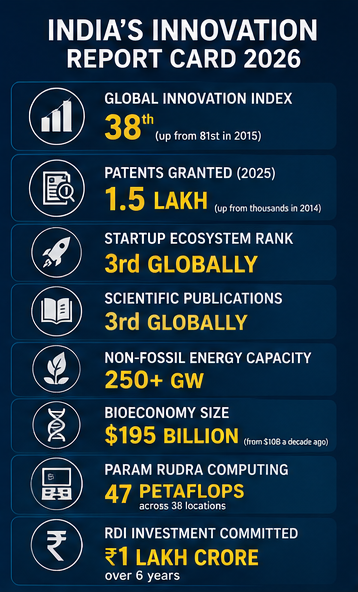
The number of patents granted in the country has increased from a few thousand in 2014–15 to around 1.5 lakh in 2025. India’s startup ecosystem has expanded to more than 1.5 lakh DPIIT-recognised startups across sectors, including nearly fifteen thousand working in emerging technology domains such as AI, robotics, and additive manufacturing.
BharatGen: India Builds Its Own AI
The headline announcement of Technology Day 2026 is one that could reshape how 1.4 billion Indians interact with technology forever.
BharatGen — the country’s sovereign Generative AI initiative — is being developed to understand and generate content across all 22 Indian languages. It is India’s direct answer to Western AI systems that were built largely without India’s 1.4 billion voices in mind.
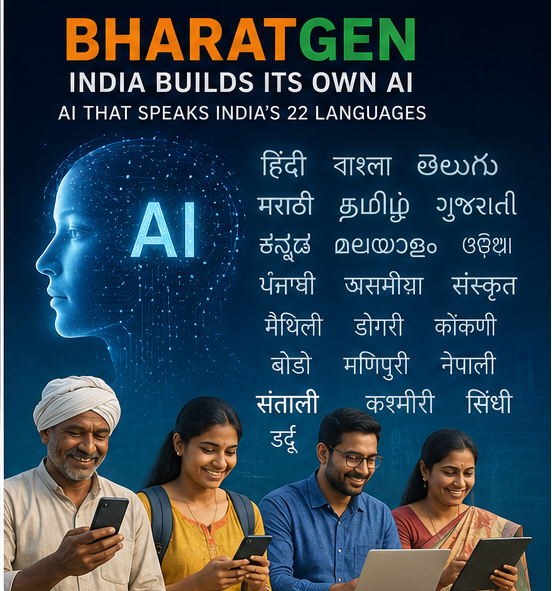
This is not just a technology project. It is a statement of digital sovereignty. For the first time, a farmer in Bihar, a teacher in Tamil Nadu, and a shopkeeper in Gujarat will be able to interact with AI in their own mother tongue — not in English, not in a language chosen by Silicon Valley.
PARAM Rudra: India’s Supercomputing Leap
The indigenously built PARAM Rudra — powered by C-DAC’s homegrown Rudra servers and manufactured entirely in India — was commissioned at IIT Bombay in January 2026, adding 3 Petaflops of computing power to India’s growing national grid that now totals 47 Petaflops across 38 locations.
India is no longer renting computing power from foreign clouds. It is building its own.
₹1 Lakh Crore for Research — The Biggest Science Bet in Indian History
The Union Cabinet approved the Research, Development and Innovation (RDI) Scheme on July 1, 2025, committing a staggering ₹1 lakh crore over six years to pull private sector companies into R&D — a scale of science investment India has never attempted before.

The Anusandhan National Research Foundation (ANRF) has been established as the central apex body to provide strategic direction for research, innovation, and entrepreneurship across India, with the aim of transitioning India into a knowledge-driven economy and a global leader in innovation.
Industry Speaks: AI Is Now Core Business Infrastructure
The Lenovo CIO Playbook 2026 reveals that 99% of Indian enterprises plan to increase their AI investments over the next 12 months, with budgets growing at the fastest pace across Asia Pacific. AI is no longer being piloted — it is being industrialised. Enterprises across manufacturing, retail, and other sectors are moving from experimentation to full-scale production, with nearly three dollars expected in return for every dollar invested.

Anku Jain, Managing Director of MediaTek India, said India’s technology landscape is rapidly transitioning from a cost-efficient IT services base to a high-value global innovation hub, with IT spending expected to exceed USD 176 billion. Democratising affordable and energy-efficient technologies across urban and rural India will play a key role in driving inclusive growth.
The Ethics Question
Speed without responsibility is a recipe for disaster. India’s tech leaders are acutely aware of this.
C P Gurnani, co-founder and vice chairman of AIonOS, said: “The true measure of technology lies in its impact on humanity. Responsible innovation today is about building trust as much as it is about building technology.” He added that enterprises must prioritise secure, ethical, and inclusive digital transformation as digital ecosystems continue to expand.
Industry leaders believe the next phase of technological advancement must prioritise people alongside profits — ensuring innovations empower communities, bridge digital divides, strengthen trust, and contribute to equitable growth.
350 Indigenous Technologies on Display Today
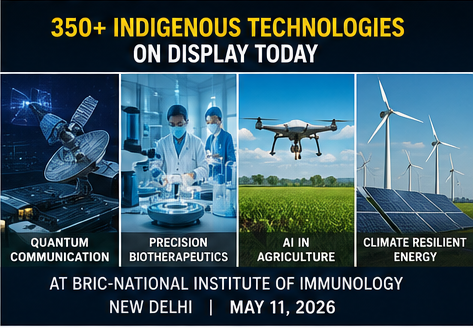
The national exhibition scheduled for May 11, 2026, at the BRIC-National Institute of Immunology in New Delhi showcases over 350 deep technologies developed indigenously by leading national research institutions and laboratories under 14 Ministries and Departments of the Government of India.
From quantum communication to precision biotherapeutics, from AI-enabled agriculture to climate-resilient energy systems — India’s scientific community is putting its best work on display for the world to see.
India’s Innovation Milestones at a Glance
| Indicator | Achievement |
|---|---|
| Global Innovation Index | 38th (up from 81st in 2015) |
| Patents Granted (2025) | 1.5 lakh (up from thousands in 2014) |
| Startup Ecosystem Rank | 3rd globally |
| Scientific Publications | 3rd globally |
| Non-Fossil Energy Capacity | 250+ GW |
| Bioeconomy Size | $195 billion (from $10B a decade ago) |
| PARAM Rudra Computing | 47 Petaflops across 38 locations |
| RDI Investment Committed | ₹1 lakh crore over 6 years |
The Road to Viksit Bharat 2047
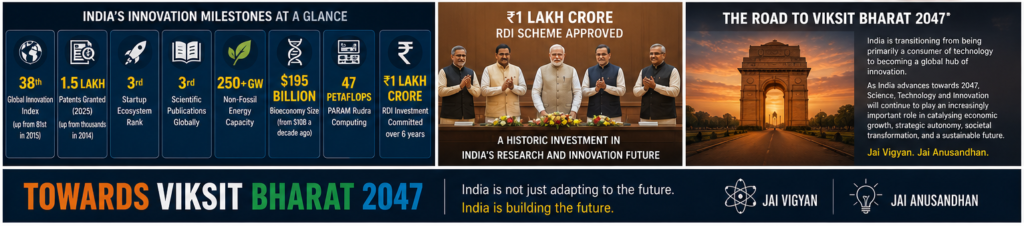
India is transitioning from being primarily a consumer of technology to becoming a global hub of innovation. As India advances towards 2047, Science, Technology and Innovation will continue to play an increasingly important role in catalysing economic growth, strategic autonomy, societal transformation, and a sustainable future.
Twenty-eight years ago, India proved it could build a nuclear bomb in secret. Today, it is building artificial intelligence in 22 languages — openly, ambitiously, and for 1.4 billion people. That is the story of National Technology Day 2026.
Jai Vigyan. Jai Anusandhan.
This article is published as part of Loktime’s National Technology Day 2026 special coverage. Data sourced from DST, Daily Pioneer, The Week, and ANI as of May 11, 2026.
