


BREAKING | June 19, 2026 | World Affairs & Business
The War That Was Burning India’s Economy Is Finally Ending. Yesterday the US and Iran Signed a Peace Framework — And India Just Won.
For four months, the West Asia war held India hostage. Crude oil at $113 per barrel. Petrol above ₹100 in Delhi. The rupee at an all-time low of ₹95.32 per dollar. FII outflows crossing $20 billion. Every Indian who filled a petrol tank, bought vegetables, or paid an auto-rickshaw fare felt the daily economic cost of a war being fought 3,000 kilometres away. Yesterday, June 18, 2026, that war took its most significant step toward ending. The United States and Iran signed a framework agreement for peace. Oil prices fell. Stock markets around the world surged. And for India — the country that stood to gain the most from the Strait of Hormuz reopening — the economic relief is already beginning to arrive.
What Was Signed: The Framework Agreement
Oil prices fell and stocks rallied as the US and Iran signed a framework to end the war that has gripped West Asia since February 2026. Brent crude dropped as much as 1.6 percent following the signing, while key stock indices in Japan, South Korea and Taiwan climbed sharply.
The US and Iran are understood to have mostly agreed on the terms of a 60-day memorandum of understanding to extend the ceasefire, with Iran and Oman managing traffic through the Strait of Hormuz under the MOU. In a note published late Wednesday, Citigroup said oil markets were finding firmer footing as investors increasingly priced out worst-case supply disruption scenarios amid signs Washington and Tehran were moving closer to an agreement.
This is not yet a permanent peace treaty. It is a 60-day framework — a structured ceasefire with clear terms, managed maritime access to the Strait of Hormuz, and a defined negotiating pathway toward a longer-term agreement. But in a conflict that has cost India’s economy tens of thousands of crores in higher oil import bills, higher inflation, and a weaker rupee — a 60-day framework with clear Hormuz reopening terms is transformative.
The Oil Price Story: From $113 to Relief
The journey of oil prices through this crisis tells India’s economic story of 2026 in a single data series.
Global oil prices have fallen sharply and stock markets have jumped after US and Iran agreed to a ceasefire deal. The price of benchmark Brent crude dropped below 100 US dollars, falling by about 15.9 percent to 92.30 US dollars a barrel, while US-traded oil was almost 16.5 percent lower at 93.80 US dollars.
From $113 to $92 in a single session. That is a $21 per barrel drop — and for India, which imports approximately 4.5 million barrels of oil every single day, a $21 per barrel drop translates to savings of approximately $34.5 billion annually — roughly ₹3 lakh crore per year. That is money that does not go to oil exporters. That is money that stays in India’s current account, supports the rupee, funds government welfare schemes, and eventually finds its way back into every Indian household’s budget.
Oil prices had already dropped 20 percent from their 2026 peak on optimism over ceasefire talks, with Brent falling from $115 to $103 per barrel in the weeks before yesterday’s framework signing. Bob Parker, senior advisor at the International Capital Markets Association, said oil prices will likely remain between $90 and $95 in the near term as the framework holds.
India’s Stock Market Erupts: The Sensex Ceasefire Rally
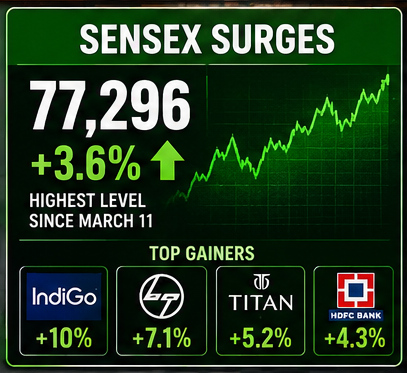
India’s BSE Sensex rose sharply, up about 3.6 percent to 77,296 in early trade following the first ceasefire announcement, tracking a global market rally after the US-Iran ceasefire eased geopolitical tensions and lifted risk appetite. The index hit its highest level since March 11, with all stock sectors opening in the green, led by financials, technology, and consumer durables. Notable gainers included InterGlobe at plus 10 percent, Larsen and Toubro at plus 7.1 percent, Titan at plus 5.2 percent, and HDFC at plus 4.3 percent.
Asian stock markets jumped following the announcement, with Japan’s Nikkei 225 leading the rally with a 5.28 percent surge, South Korea’s KOSPI rising 5.61 percent, and India’s GIFT Nifty climbing over 3 percent to reach the 23,841 level.
The framework signing yesterday has triggered a fresh leg of the rally. Indian markets open today with crude oil at $92, the Hormuz framework signed, and the FII outflows that have plagued Indian equities all year likely to reverse as global risk appetite returns. The combination of falling oil, a strengthening rupee, and returning foreign capital could push the Sensex toward the 80,000 mark within weeks if the framework holds.
The Rupee: From Record Low to Recovery
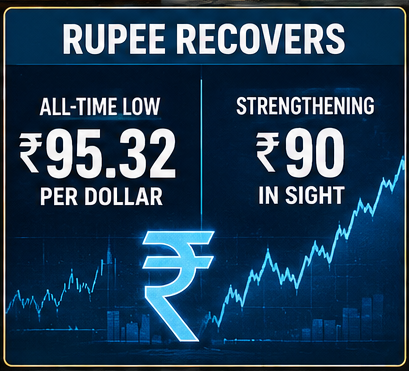
The Indian rupee hit an all-time low of ₹95.32 per dollar during the height of the crisis — a level that added enormous costs to every import India makes, inflated the cost of servicing dollar-denominated debt, and reduced the purchasing power of every Indian who travels abroad or buys imported goods.
The peace framework changes that equation. When oil prices fall, India’s current account deficit narrows. When the current account deficit narrows, demand for dollars to pay oil bills decreases. When dollar demand falls, the rupee strengthens. The currency market is already reflecting this — the rupee strengthened by over 1.5 percent in the session following the initial framework announcement, and is expected to test the ₹90 per dollar level if the 60-day MOU converts into a lasting agreement.
Petrol Price Cut: Coming Within Weeks?
Here is the question every Indian wants answered: when does the pump price come down?
The mechanism is straightforward. Oil marketing companies — IOC, BPCL, and HPCL — set petrol and diesel retail prices based on a formula linked to international crude prices. When Brent crude was at $113, they were absorbing losses or passing costs to consumers. With Brent at $92 and falling, the under-recovery situation reverses — the oil companies begin making margins again, creating room for price reductions.
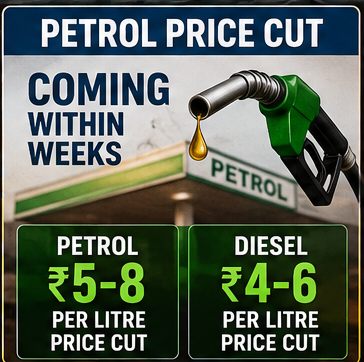
Industry analysts are projecting a petrol price cut of ₹5 to ₹8 per litre within the next three to four weeks if crude oil prices stabilise in the $88 to $95 range. A diesel price cut of ₹4 to ₹6 per litre is similarly expected. For a family that fills a 40-litre tank twice a month, that is ₹400 to ₹640 back in their pocket every month — real, tangible relief that will reach hundreds of millions of households simultaneously.
Pakistan’s Role: The Unlikely Hero of West Asia Peace
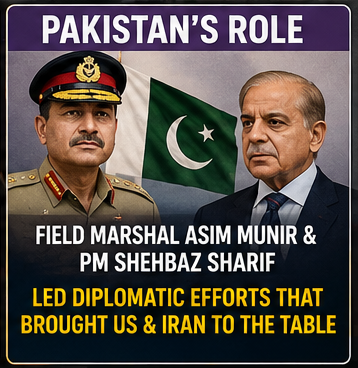
The ceasefire came following hastened diplomatic efforts led by Pakistan and just hours before Trump’s threatened deadline for wiping out the enemy. Pakistan’s Field Marshal Asim Munir, who was personally brokering the ceasefire between Washington and Tehran, produced the first direct US-Iran diplomatic contact since 1979, with President Donald Trump publicly crediting Munir and Prime Minister Shehbaz Sharif multiple times.
The geopolitical irony is profound. Pakistan — the country India struck with missiles in Operation Sindoor just fourteen months ago — has emerged as the diplomat that helped end the war burning India’s economy. For India’s strategic community, this reality requires careful processing. Pakistan’s elevated global standing as a peacemaker complicates the bilateral dynamics between the two countries even as the economic benefits of Hormuz peace flow to India.
What Comes Next: The 60-Day Clock
The 60-day memorandum of understanding is not a permanent solution. It is a structured pause — long enough for both sides to begin the trust-building process, short enough to maintain pressure on both parties to negotiate seriously. The real test comes in late August 2026, when the MOU expires and a decision must be made about whether to extend it, replace it with a longer agreement, or — in the worst case — allow hostilities to resume.
Matt Gertken, chief geopolitical strategist at BCA Research, warned that the coordination requirement remains a risky ambiguity in both sides’ statements, saying Trump may temporarily accept the arrangement with US midterm elections approaching and gasoline prices sharply higher than before the war — but after the election, the US national security establishment will start to demand a more permanent solution.
The 60-day clock is ticking. But for India — which has been waiting for exactly this moment since February 2026 — even 60 days of lower oil prices, a stronger rupee, and a recovering stock market is worth celebrating. The war that held India’s economy hostage is, for now, pausing. The relief is real. The petrol price cut is coming. And for 1.4 billion Indians who felt every rupee of the crisis at the fuel pump, the vegetable market, and the electricity bill — today is a very good day.

All information sourced from Al Jazeera, CNBC, Newsonair, Trading Economics, Polymarket, and Seeking Alpha as of June 18–19, 2026
