


INSPIRING INDIA | June 19, 2026 | Education
She Did Not Have Enough Classrooms. So She Made the Walls Her Classroom. And One Million Children Went to School.
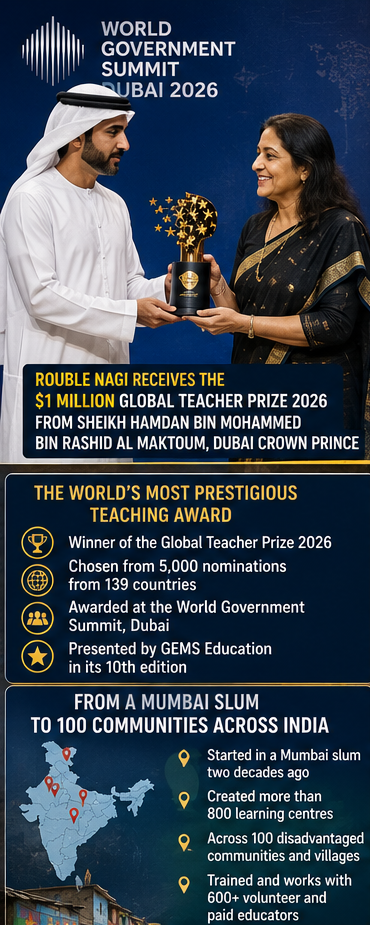
In February 2026, at the glittering World Government Summit in Dubai — a forum attended by heads of state, prime ministers, and the world’s most powerful CEOs — the most important award of the evening went to a woman from Mumbai who had spent twenty years painting the walls of India’s slums. Rouble Nagi, artist, educator, and social worker, walked up to receive the $1 million Global Teacher Prize from Sheikh Hamdan bin Mohammed bin Rashid Al Maktoum, Crown Prince of Dubai — and in doing so, told the whole world something India has always known: that the most powerful force for change in this country is not capital, not policy, not technology. It is a teacher with a paintbrush and an unshakeable belief that every child deserves to learn.
The Prize That Changed Everything
Indian teacher Rouble Nagi won the Global Teacher Prize 2026, receiving the one million dollar award at the World Government Summit in Dubai. The award, presented by GEMS Education in its tenth edition, was handed over by Dubai Crown Prince Sheikh Hamdan bin Mohammed bin Rashid Al Maktoum. Nagi was honoured for transforming neglected walls into interactive educational murals that teach reading, writing, arithmetic, as well as public health and environmental awareness. Over the past two decades, her work has helped integrate more than one million children into formal education using art as a learning tool. She was chosen from over 5,000 nominations from 139 countries.
Five thousand nominations. One hundred and thirty-nine countries. The world’s best teachers — from Finland to Colombia to Australia to the United States — all considered for the most prestigious teaching award on earth. And the prize went to a woman who started her journey in a Mumbai slum, painting letters on a broken wall, hoping a child would stop and look.
The Living Walls of Learning: How It All Began
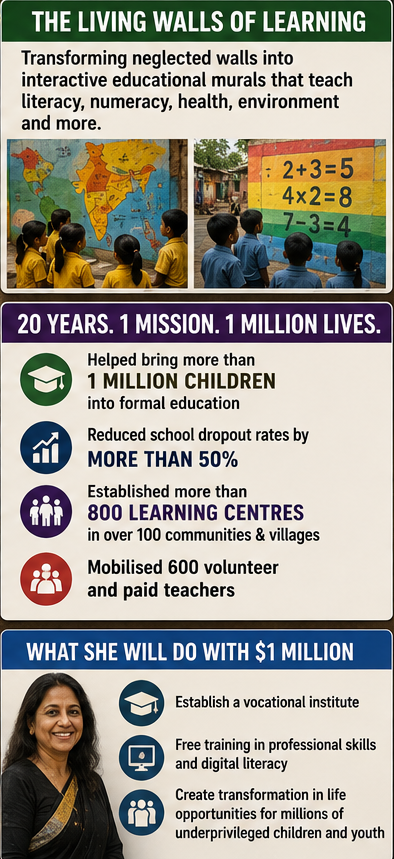
Nagi was recognised for her work bringing education to slums and rural communities across India through Misaal India and the Rouble Nagi Art Foundation — initiatives that use art as a gateway to learning. Over the last 20 years, her movement has set up more than 800 learning centres, mobilised 600 volunteers and paid teachers, and built a model that reaches children often excluded from formal education. Her classrooms don’t always have four walls. Nagi’s “Living Walls of Learning” murals turn neighbourhood lanes and courtyards into permanent textbooks — visible to entire communities.
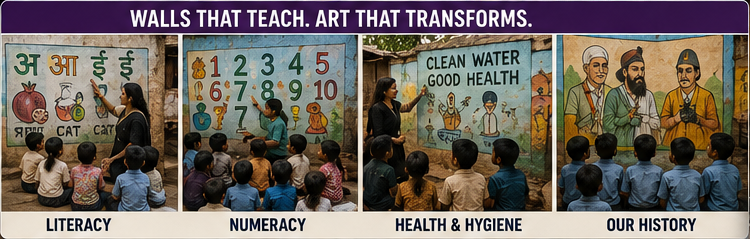
Imagine a lane in a Mumbai slum where every wall tells a story. One wall teaches the alphabet, illustrated with animals and colours so vivid they stop a child in their tracks. Another wall teaches hygiene — how to wash hands, why clean water matters, what to do when someone gets sick. A third wall traces India’s history in murals so detailed and so beautiful that children sit in front of them the way museum visitors sit before great paintings — not out of duty, but out of genuine fascination.
This is what Rouble Nagi builds. Not just classrooms. Entire learning environments that exist in the open air, free to enter, impossible to ignore, and available twenty-four hours a day to every child in the community.
Through the Rouble Nagi Art Foundation, she has established more than 800 learning centres in over 100 low-income communities and villages. These centres provide structured learning opportunities for children who had limited or no access to formal education. A key element of her work is transforming neglected walls into interactive educational murals, known as “living walls of learning”, that teach literacy, numeracy, public health, environmental awareness, and other subjects.
One Million Children. Twenty Years. One Woman.
The number that stops you is one million. Over the last two decades, Rouble has helped bring more than one million children into the formal education system through the use of art.
One million children who might not have learned to read. One million children who might have dropped out before reaching fifth grade. One million children who grew up in communities where school was expensive, far away, conducted in a language different from the one spoken at home, and dependent on parents being able to afford books and uniforms and fees they could not afford.
Rouble Nagi did not wait for the government to solve those problems. She picked up a brush and painted the solution on the nearest available wall.
Her programmes have succeeded in reducing school dropout rates by more than 50 percent and significantly improving long-term educational retention. Fifty percent fewer dropouts. In communities where dropout rates were the highest and the consequences of dropping out — child marriage, child labour, intergenerational poverty — were the most severe.
From a Mumbai Slum to 100 Communities Across India
Starting with a project in a Mumbai slum, over 2 decades Rouble has created more than 800 learning centres across 100 disadvantaged communities and villages. She travels across the country to work directly with children and mentor teachers, recruiting and training more than 600 volunteer and paid educators.
This is not a centralised programme run from an air-conditioned office in Mumbai. It is a movement — distributed, grassroots, powered by hundreds of teachers and volunteers who have been trained by Rouble personally, who carry her methodology into communities she has never even visited, who paint walls in villages in Bihar and Rajasthan and Odisha because they believe what she believes: that a child who sees something beautiful wants to understand it.
The jury said her work stood out for turning neglected neighbourhoods into vibrant learning spaces, where walls became tools to teach literacy, science, mathematics and history. An internationally acclaimed artist, Nagi has created more than 800 murals and held over 150 exhibitions across India and abroad.
What She Will Do With $1 Million
When the world gives a teacher a million dollars, the first question is always: what will she do with it?
Nagi plans to allocate the prize money to establish a vocational institute offering free training in professional skills and digital literacy, aiming to create transformation in life opportunities for millions of underprivileged children and youth.
Not a house. Not a car. Not a holiday. A vocational institute. Free training. Digital literacy. Because Rouble Nagi understands something that many education reformers miss: teaching a child to read is the beginning, not the end. The full promise of education is fulfilled only when that child can also earn a living, navigate a digital world, and build a life that is genuinely different from the one they were born into.
The million dollars will go back to the children. It always does, with teachers like this.
What India Should Take From This Moment
India has 1.5 million schools. It has millions of teachers. And it has one of the world’s most complex and challenging education systems — where the gap between a child in a top private school in South Delhi and a child in a one-room government school in rural Bihar is so vast it sometimes seems unbridgeable.
Rouble Nagi did not bridge that gap with technology, with policy, or with money. She bridged it with paint, with creativity, with the conviction that beauty and learning are not separate things — that a child who is moved by something will want to understand it, and a child who wants to understand something will learn.
She won the world’s most prestigious teaching prize by doing what the best teachers have always done: meeting children exactly where they are, on the walls of the lane where they live, and making the world slightly more comprehensible and slightly more beautiful for them, one brushstroke at a time.
India has 1.4 billion people. Somewhere in this country, right now, a child is standing in front of a painted wall in a slum lane in Mumbai, or a village in Bihar, or a colony in Rajasthan — and for the first time, that child is reading. That is Rouble Nagi’s legacy. And no prize is large enough to capture it fully.
All information sourced from Global Teacher Prize website, DD News, Gulf News, Drishti IAS, Newsonair, and Teacher Magazine as of February 6 — June 2026.
