


BREAKING | July 4, 2026 | Business & Economy
The first price cut has happened. More are expected. But India’s fuel price relief story in July 2026 is playing out in a way that is simultaneously encouraging and frustrating — because the first company to move has slashed petrol by ₹5 per litre and diesel by ₹3 per litre, but the three state-owned giants that control 90% of India’s fuel pumps have not yet followed. The story of petrol prices in India this month is a story of two different sets of calculations — and for India’s 1.4 billion consumers, the one that matters most is still awaiting its conclusion.
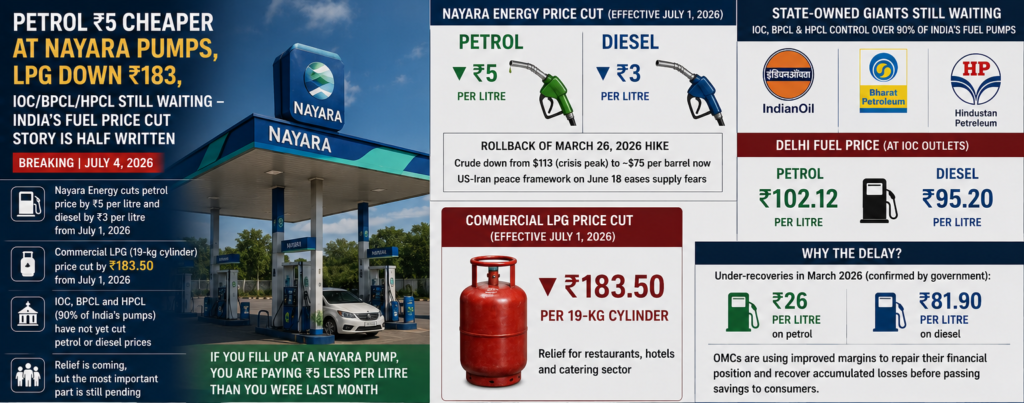
Nayara Energy, India’s largest private fuel retailer, cut petrol prices by ₹5 per litre and diesel prices by ₹3 per litre from July 1, 2026. This reduction effectively reverses the price increase Nayara itself had introduced on March 26, 2026, when rising global crude costs during the peak of the West Asia conflict had forced the company to raise prices. With Brent crude now hovering around $75 per barrel — down from the crisis peak of $113 — and the US-Iran peace framework signed on June 18 reducing supply disruption fears, Nayara has rolled back the entire increase. In practical terms: if you fill up at a Nayara pump, you are paying ₹5 less per litre than you were last month.
On the same day, the government-owned oil marketing companies reduced the price of 19-kg commercial LPG cylinders by ₹183.50 from July 1, 2026. This is significant for India’s restaurant, hotel, and catering sector — which runs almost entirely on commercial LPG — and it signals that the government is beginning to pass on crude oil savings in categories where prices are revised more regularly.
But here is the part that affects most ordinary Indians: outlets operated by Indian Oil Corporation, Bharat Petroleum Corporation, and Hindustan Petroleum Corporation — together controlling more than 90% of India’s fuel stations — have not yet announced a cut in petrol or diesel prices. In Delhi, petrol continues to be priced at ₹102.12 per litre and diesel at ₹95.20 per litre at IOC outlets.
The reason for the delay is not mysterious, and it is actually rational from the OMC’s perspective. In March 2026, the government confirmed that under-recoveries were running at approximately ₹26 per litre on petrol and ₹81.90 per litre on diesel. These are the losses the state-owned companies absorbed rather than passing entirely to consumers — effectively subsidising India’s fuel economy at enormous cost to their own balance sheets. Now that crude has fallen, the OMCs are first using the improved margins to repair their financial position and recover those accumulated losses before passing savings to consumers.
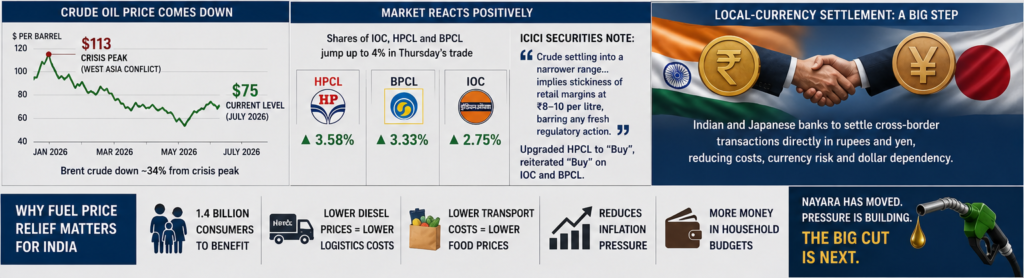
ICICI Securities noted: “Crude settling into a narrower range, potentially reducing absolute product prices while still keeping product spreads higher than pre-war levels, implies stickiness of retail margins at recent elevated levels of ₹8–10 per litre, barring any fresh regulatory action.” The brokerage upgraded HPCL to “Buy” and reiterated “Buy” on IOC and BPCL — reflecting the market’s view that lower crude is a major positive for OMC earnings even before a consumer price cut.
Shares of IOC, HPCL, and BPCL jumped up to 4% in Thursday’s trade, with HPCL gaining 3.58%, BPCL rising 3.33%, and IOC adding 2.75%. The market is already pricing in the expectation that a petrol and diesel price cut is coming — the question is when, not whether.
The commercial LPG cut is the most useful signal. When the government cuts commercial LPG prices by ₹183.50 in a single revision, it demonstrates that the political will and the financial space for fuel price relief both exist. Petrol and diesel — which affect household budgets, transport costs, food prices, and inflation simultaneously — are the bigger prize. Every rupee of reduction in diesel prices reduces logistics costs across India’s entire supply chain.
Nayara’s move has created competitive pressure on state-owned companies. If IOC, BPCL, and HPCL do not follow within the next two to three weeks, consumers will simply shift to Nayara pumps in markets where the private company operates. For Indian consumers who have been paying above ₹100 for petrol since May 2026, the relief is beginning to arrive — but the most important part of it has not yet been written.
After keeping fuel prices unchanged for nearly four years, government-owned oil companies had also increased petrol and diesel prices several times in May, citing higher crude oil costs caused by the Middle East conflict. All data sourced from BusinessToday, News24Online, and INDMoney as of July 1–4, 2026.
