

BREAKING | July 4, 2026 | Business & World Affairs
Prime Minister Narendra Modi called her his “younger sister.” Japanese Prime Minister Sanae Takaichi, on her first official visit to India since taking office in October 2025, smiled and said: “We are on the same page.” What followed their meeting at the 16th India-Japan Annual Summit in New Delhi was the largest single-visit investment announcement in the history of India-Japan bilateral relations — and a signal that Asia’s two great democratic economies have decided, firmly and publicly, that their future belongs together.
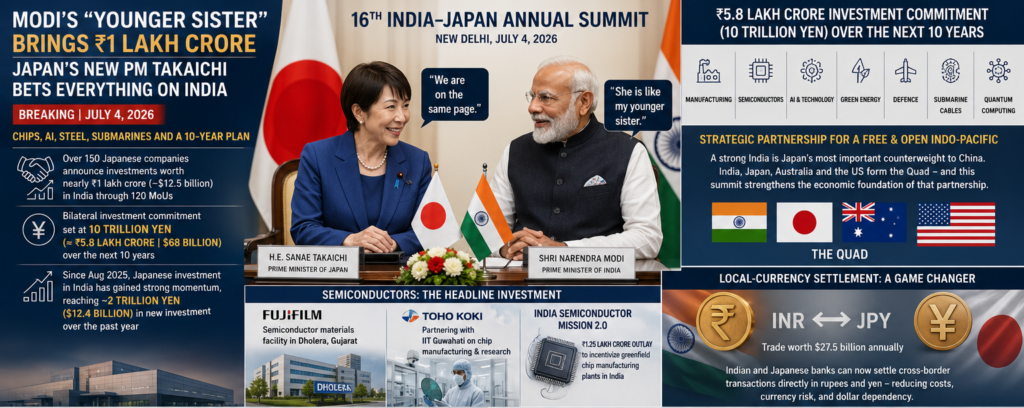
Over 150 Japanese companies announced investments worth nearly ₹1 lakh crore — approximately $12.5 billion — in India through 120 Memorandums of Understanding and cooperation agreements. The investments span manufacturing, semiconductors, artificial intelligence, green energy, defence technology, submarine cables, and quantum computing. The bilateral investment commitment has now been set at an astonishing 10 trillion yen — approximately ₹5.8 lakh crore or $68 billion — over the next ten years. Japan has explicitly doubled its previous India investment target, reflecting a fundamental strategic decision by Tokyo that India is its most important economic partner in the Indo-Pacific for the next decade.
Semiconductors are the headline. Over 100 Japanese companies are exploring opportunities in India’s semiconductor ecosystem, from manufacturing to R&D collaborations. Fujifilm — the company known globally for cameras and films but which is also one of the world’s largest suppliers of semiconductor materials — is establishing a semiconductor materials facility in Gujarat’s Dholera, the greenfield industrial city that the Modi government has been building as India’s answer to Taiwan’s Hsinchu Science Park. Toho Koki and IIT Guwahati are partnering on chip manufacturing and research. The India Semiconductor Mission 2.0, with a ₹1.25 lakh crore outlay, will provide incentives to Japanese companies setting up greenfield chip manufacturing plants in India.
The industrial commitments go far beyond chips. Toyota is setting up a new manufacturing facility in Bidkin, Maharashtra, with an annual production capacity of one lakh vehicles and 2,800 new jobs. Suzuki is investing in new manufacturing plants and research facilities. JFE Steel, in partnership with JSW Steel, is committing approximately ₹160 billion to an integrated steelworks project. Daikin is establishing an R&D centre in Haryana for its air conditioning and HVAC products.
In technology, NTT Data and Persistent Systems are working together on next-generation telecom. Mitsubishi Electric is partnering on AI, quantum technologies, and security applications. NTT Data is investing in submarine cable infrastructure connecting Japan and India — the digital backbone of a partnership that will increasingly move data, not just goods, between the two countries.
The most strategically significant financial development from the summit is the proposed local-currency settlement mechanism under which Indian and Japanese banks will be able to settle cross-border transactions directly in rupees and yen, without routing through the US dollar. For a bilateral relationship worth $27.5 billion in trade annually, eliminating dollar dependency in settlement reduces transaction costs, reduces currency risk, and deepens financial integration in ways that will compound over decades.
Japan’s motivation is clear and honest. Tokyo is watching China’s growing economic and military assertiveness with deep concern. The Belt and Road Initiative has extended Chinese infrastructure into South Asia, Southeast Asia, and the Pacific. Japan’s alternative — a Free and Open Indo-Pacific built on investment in democratic partner economies — requires India as its anchor. A strong India, in Japan’s strategic calculus, is the single most important counterweight to Chinese dominance of the Indo-Pacific region. India, Japan, Australia, and the US form the Quad — and this summit is the bilateral economic underpinning of that strategic grouping made real and specific in rupees, yen, and steel.
For India, the summit delivers the semiconductor expertise, the manufacturing investment, and the clean energy technology that will power its next decade of industrial growth. The combined India-Japan economy, if the investment targets are met, will be a force that reshapes supply chains from the Bay of Bengal to the Sea of Japan.

Modi called Takaichi his younger sister. She called India indispensable. Since the Japan-India Summit meeting held in August last year, investment in India has gained strong momentum, reaching approximately 2 trillion Japanese Yen ($12.4 billion) in new investment over the past year alone. All data sourced from BusinessToday, The Tribune, The Researchers, and Communications Today as of July 2–4, 2026.