


SPECIAL REPORT | July 4, 2026 | Science & Technology
She has no heartbeat. She cannot feel the vacuum of space or the g-forces of re-entry. But Vyommitra — the humanoid robot developed by ISRO to fly aboard Gaganyaan’s first uncrewed test mission — will become the first Indian-built entity to orbit the Earth and return, and she will do it before any of India’s four selected astronauts gets the chance. Gaganyaan-G1, ISRO’s first uncrewed orbital test flight, is scheduled for Q3 2026 — and the final integration of Vyommitra into the crew module is already complete. India’s journey to becoming the fourth nation to independently send humans to space is entering its most critical phase.
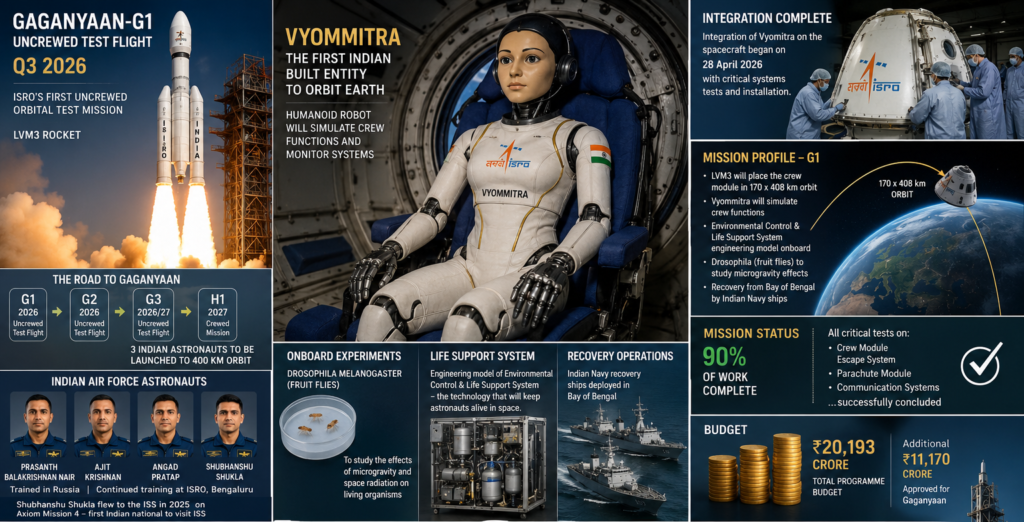
The integration of Vyommitra into the spacecraft began on April 28, 2026, with critical systems tests and installation underway at ISRO’s facility in Bengaluru. ISRO Chairman Dr V Narayanan has confirmed that 90% of work on the G1 mission is complete, with all critical tests on the crew module escape system, parachute module, and communication systems already successfully concluded. Scientists from the Tata Institute of Fundamental Research are also planning to send fruit flies — Drosophila melanogaster — aboard the mission to study the effects of microgravity and space radiation on living organisms. India is going to space with a humanoid robot and fruit flies. That sentence captures exactly the extraordinary ambition and careful scientific methodology of the world’s most cost-efficient space programme.
Gaganyaan-G1 will carry Vyommitra along with an engineering model of the Environmental Control and Life Support System — the technology that will keep India’s astronauts alive in space during future crewed missions. The mission profile calls for the LVM3 rocket to place the crew module in a 170×408 km orbit, after which Vyommitra will simulate crew functions, monitor spacecraft conditions, and demonstrate the spacecraft’s readiness for human occupants. Recovery ships from the Indian Navy will retrieve the capsule from the Bay of Bengal after re-entry. ISRO has placed chartered ships in both the Pacific Ocean and the North Atlantic to monitor the uncrewed mission from observation points across two oceans.
Two more uncrewed test flights — G2 and G3 — will follow the G1 mission before the crewed Gaganyaan-H1 carrying three Indian Air Force astronauts is launched in 2027. The four astronauts selected — Prasanth Balakrishnan Nair, Ajit Krishnan, Angad Pratap, and Shubhanshu Shukla — completed the first part of their training in Russia in early 2020 and continued at ISRO’s training facility in Bengaluru. Shubhanshu Shukla flew to the International Space Station in 2025 on Axiom Mission 4, giving him the distinction of being the first Indian national to travel to the ISS — invaluable practical experience before his Gaganyaan mission.
The G1 launch is the most important single event in ISRO’s history since Chandrayaan-3 landed on the Moon’s south pole in August 2023. It will validate the spacecraft systems, the escape mechanism, the life support infrastructure, and the recovery operations that must all work perfectly before any Indian human being can be placed aboard. The budget is serious: the Gaganyaan initiative has received an additional ₹11,170 crore in financing to support its expanded scope, bringing the total programme budget to ₹20,193 crore.
Looking further ahead, Chandrayaan-4 — India’s lunar sample return mission — is targeted for 2028 with a dual-launch strategy using two LVM3 rockets to place a five-module spacecraft in lunar orbit. If successful, India will become only the fourth country to return samples from the Moon. The Bharatiya Antariksh Station, India’s own space station, will see its first base module launch by 2028 and the station itself operational by 2035. ISRO has also announced plans for Samudrayaan in 2026 — an undersea mission taking three scientists in a submersible to explore the seabed at a depth of 6,000 metres, searching for critical minerals and rare metals that India’s green energy transition will increasingly require.
India also launched NISAR on July 30, 2025 — a joint Earth observation satellite with NASA, the world’s first dual-frequency radar imaging satellite, already operational and collecting data on glaciers, forests, earthquakes, and agricultural patterns across the planet.
From the Moon to the seabed. From fruit flies in orbit to humanoid robots monitoring spacecraft systems. From a budget rocket programme that once launched satellites for foreign countries to a programme with astronauts trained in Russia, hardware tested in Chennai, and recovery ships in the Pacific. India’s space story is not a distant aspiration anymore. It is a launch countdown — and Q3 2026 is approaching fast.
Integration of Vyomitra on the spacecraft began on 28 April 2026 with critical systems tests and installation. All data sourced from Wikipedia, Britannica, ISRO launch schedule, and Newsonair as of July 2026.

