


BREAKING | June 22, 2026 | Education
Yesterday India Held Its Most Secure Examination Ever. This Morning Someone Tried to Sabotage It With a Fake Video. They Failed.
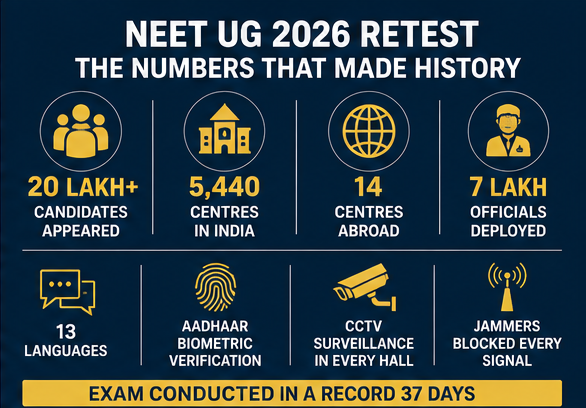
Yesterday, June 21, 2026 — the same day India celebrated its 12th International Yoga Day — 20 lakh medical aspirants walked into examination halls across 5,440 centres in India and 14 centres abroad, sat down, and attempted the NEET UG retest. Seven lakh officials stood guard. Aadhaar biometrics verified every face. CCTV cameras covered every hall. Jammers blocked every signal. And by 5 PM, when the last answer sheet was collected and sealed, the NTA Director General stood before reporters and said four words that India had been waiting 49 days to hear: the exam was clean.
Then, this morning, someone released a fake video on social media claiming the paper had been leaked on Telegram.
They picked the wrong fight.

What Happened Yesterday: The Numbers
Over 2 million candidates appeared for the NEET UG 2026 re-examination across 5,440 centres in India and 14 centres abroad. The exam was conducted in 13 languages, including Hindi and English. Around 700,000 officials — police teams, observers and examination staff — were mobilised across India to conduct this examination, and it was done in a record 37 days.
Let those numbers sit for a moment. Seven hundred thousand officials. Deployed across India. To protect a single examination. That is more people than the armies of most countries. More personnel than India deployed for many of its largest electoral exercises. The most secure single-day examination in Indian history — organised, mobilised, and executed in 37 days.
NTA Director General Abhishek Singh described it as a whole-of-government approach — “Team Bharat,” he called it. “This was not the NTA acting alone. It was Team Bharat — a chain of people across the country who showed up so that, for each candidate, the only thing that mattered that morning was the paper in front of them.”
The Fake Video: What Happened and How It Was Crushed
Just a day after the NEET-UG 2026 re-examination was conducted, a video claiming that the question paper had been leaked began circulating widely on social media. The video triggered concern among students and parents, reviving fears. However, the National Testing Agency categorically denied the allegations, describing the video as fabricated and misleading.
NTA posted on X: “NTA’s attention has been drawn to a fabricated video being circulated on social media regarding NEET UG 2026. The video is FAKE and the claims it makes are false. The examination was conducted successfully today under comprehensive security and surveillance. Manufacturing and deliberately circulating such misinformation to defraud or alarm students is a serious offence. NTA, with the support of I4C and law enforcement agencies, is taking action against those responsible for originating this content.”
The fact-check unit of the Press Information Bureau confirmed the video was fake, stating reports alleging paper leak are unfounded and false. PIB Fact Check posted on X: “A video is being circulated on social media claiming that the NEET UG 2026 Re-Examination question paper was leaked on Telegram before the examination. This Claim is FAKE.”
The speed of the response matters as much as its content. In 2024, and again in May 2026, the NTA was slow to respond to leak allegations — allowing misinformation to spread and panic to build before official denials arrived. This time, the NTA responded within hours, PIB Fact Check amplified the denial, and the I4C — the Indian Cybercrime Coordination Centre — was simultaneously tracking the origin of the fabricated content.
The Paper Itself: More Analytical, More Concept-Based
Education experts who reviewed the paper said it appeared more analytical and concept-based than the earlier May session — a deliberate design choice by NTA to produce a question set that rewarded genuine understanding over rote memorisation, and that was more resistant to being gamed through leaked answer keys.
This is a quiet but important detail. The May 3 paper — the one that was leaked — was described by students as relatively straightforward, making it particularly vulnerable to exploitation via a circulated guess paper. The June 21 paper, designed with input from academic experts at IITs and central universities who had volunteered their time, appears to have been constructed specifically to reduce the advantage that a leaked paper could provide. Analytical questions cannot be answered by memorising a set of expected answers — they require the student to think in the examination hall.
For the 20 lakh students who prepared honestly, a harder, more analytical paper is not a disadvantage. It is an equaliser.
The Two Students Nobody Will Forget
Among the 20 lakh who appeared on June 21, two will stay in the memory of everyone who followed this story. Special arrangements were put in place for around 81 candidates with medical conditions, among them a child who had been in a road accident and a child undergoing chemotherapy, who were determined not to miss an exam they had prepared for years.
A child in chemotherapy. Sitting for a medical entrance examination. Because becoming a doctor is the dream — and the dream does not stop for cancer treatment. That is not just a statistic. That is the entire story of what NEET means to India’s young people, condensed into one sentence.
What Happens Next: Results Faster Than Ever
NTA Director General Abhishek Singh said the evaluation process would begin shortly and results would be announced faster than usual, noting that the agency compressed the entire exam cycle into a record 37 days.
The Supreme Court is watching. The CBI investigation continues with 13 arrested. The larger constitutional bench examining the legality of the May 3 cancellation will convene in the coming weeks. And the government’s commitment — stated explicitly by the Cabinet Secretary and the Education Minister — is that the structural reforms required to prevent another NEET crisis will be implemented before the next examination cycle begins.
But all of that is tomorrow’s story. Today’s story is simpler and more important than any of it. Yesterday, 20 lakh Indian teenagers — most of them having already sat for NEET at least once before, many of them having prepared for years — walked into an examination hall and did what they came to do. They answered questions. They showed what they knew. They gave themselves a chance.
The exam was clean. The fake video failed. Team Bharat showed up.
And somewhere this morning, in a small town in Bihar, in a city in Rajasthan, in a village in Maharashtra — a student who has wanted to be a doctor since they were eight years old is reviewing their answers, calculating their score, and allowing themselves to hope.
That is what June 21, 2026 was for. That is what it delivered.

All information sourced from Business Standard, Asianet Newsable, India TV News, and Public TV English as of June 21–22, 2026.
