


CATEGORY: Business & Finance TAGS: BJP, West Bengal Election 2026, Modi, India Economy, Stock Market, FII, Reforms, Sensex
BREAKING | May 6, 2026 | Politics & Economy
Modi’s BJP Wins Bengal for the First Time — Markets Cheer, But Economists Urge Caution on Reforms
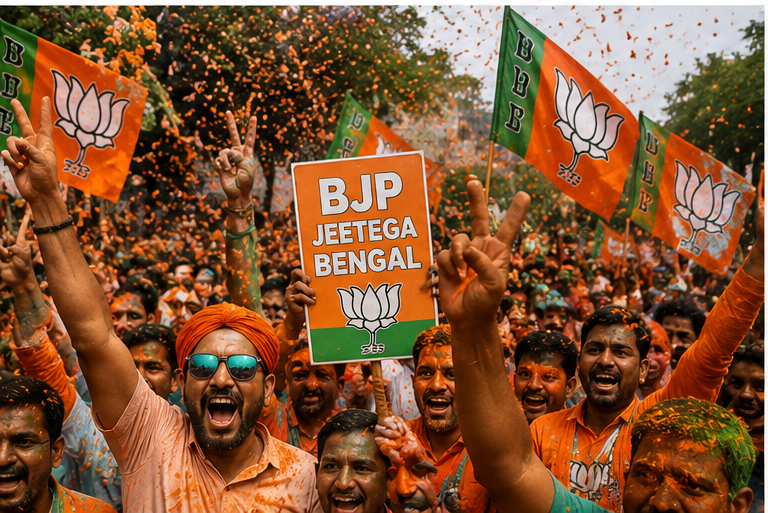
Indian Prime Minister Narendra Modi’s Bharatiya Janata Party achieved a historic election win in West Bengal on Monday, strengthening its grip on power as the country grapples with economic challenges and a pressing need for reforms. The victory — the BJP’s first-ever in the state — sent a strong positive signal to Dalal Street, helping the Sensex rally 356 points on election results day. Frontiers
A Political Sweep Across States
Out of the 11 state elections since 2024, the BJP and its allies have retained power in four states and gained power in two others, reflecting “continued popularity of PM Modi and his party,” global brokerage Citi noted. “Markets would hope that a strong political mandate and easier coordination with state governments will facilitate better implementation of various policy and process reforms,” Citi said. Frontiers
The party also swept Assam, giving the BJP and its allies close to a two-thirds majority in the Rajya Sabha — a milestone that could unlock long-pending legislative reforms.
Why Markets Responded Positively
Political stability is one of the most important variables for equity investors. A BJP sweep across Bengal and Assam signals:
- Reduced political uncertainty heading into the next budget cycle
- Stronger Centre-State policy coordination on infrastructure and investment
- A potential acceleration of privatisation and economic reform bills
But Economists Are Not Celebrating Yet
Despite the electoral triumph, India’s economic growth this year is expected to be hit by the prolonged conflict in the Middle East. Its current account deficit is also expected to widen in FY27, as the Iran war causes higher energy prices and disrupts exports. The Indian government has been reluctant to pass on the rising energy costs to consumers and has taken a “huge hit” on tax revenues by cutting central excise duties on fuel. Frontiers
Morgan Stanley, in an April 22 report, said that India’s net foreign direct investment flows are “near all-time lows of $0.5 billion” in the 12 months ending January 2026. Foreign portfolio investors have sold Indian stocks worth more than $20 billion since January 2026 — already exceeding the $18.9 billion sold in all of 2025. Frontiers
The Reform Challenge
“Having dominance over the electoral map doesn’t necessarily translate into faster reforms,” said Shumita Sharma Deveshwar, chief India economist at GlobalData TS Lombard, adding that “India really only reforms when it is in a crisis.” Frontiers
The BJP still lacks the strong lower house mandate needed to pass tougher structural reforms — labour laws, land acquisition, and financial sector consolidation remain pending.
What This Means for Bengal’s Economy
West Bengal is India’s sixth-largest state economy. The BJP foregrounded jobs and industrial revival in its criticism of the state government. Employment, industrial development and public recruitment were prominent issues, particularly among younger and urban voters. A BJP government in Bengal could unlock significant Central government infrastructure investment and draw FDI to the state’s underdeveloped industrial corridor. Springer
Investor Takeaway
| Factor | Impact on Markets |
|---|---|
| BJP Bengal win | Short-term bullish — political stability |
| FII outflows ($20B+) | Ongoing headwind |
| Crude oil near $113/bbl | Inflation & CAD risk |
| Reform acceleration hopes | Medium-term positive if delivered |
| Rupee at ₹95.32/$ | Continued pressure on importers |

Disclaimer: This article is for informational and educational purposes only and does not constitute investment advice. Please consult a SEBI-registered financial advisor before making investment decisions.
