


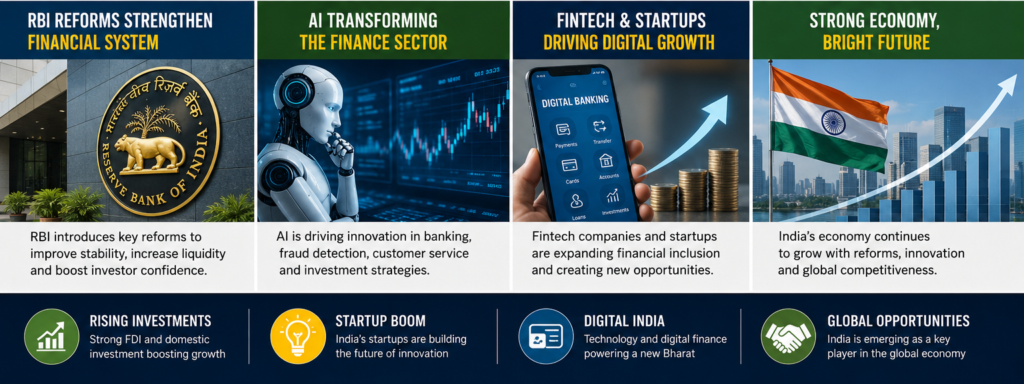
India’s business and financial ecosystem is undergoing one of its biggest transformations in recent years. From AI-powered fintech growth to major reforms by the Reserve Bank of India, the country is rapidly moving toward a more digital, startup-driven, and innovation-focused economy.
Recent developments in banking, fintech, stock markets, and startup funding indicate that India’s financial sector is entering a new era of modernization and global competitiveness. Experts believe that technology, financial inclusion, and policy reforms will become the key drivers of India’s future economic growth.
RBI Reforms Strengthening India’s Financial System
One of the biggest business developments this year has been the series of reforms introduced by the Reserve Bank of India (RBI). The central bank is focusing on:
- Stronger financial stability
- Better banking regulations
- Improved investor protection
- Deeper financial markets
- Increased digital financial participation
Recently, RBI eased rules allowing banks to include quarterly profits in their capital adequacy calculations, which could improve banking flexibility and lending capacity.
RBI Governor Sanjay Malhotra also emphasized that India’s financial markets remain resilient despite global uncertainty, but future growth will depend on stronger infrastructure, deeper liquidity, and wider market participation.
These reforms are expected to:
- Increase investor confidence
- Strengthen banking systems
- Support startup financing
- Improve financial transparency
AI Becoming the New Engine of Finance
Artificial Intelligence (AI) is rapidly transforming India’s financial services sector. Banks, fintech startups, and investment firms are now using AI for:
- Fraud detection
- Customer service automation
- Personalized banking
- Risk analysis
- Market prediction
- Loan approval systems
Industry reports show that AI adoption in finance is increasing significantly as companies aim to reduce operational costs and improve efficiency.
AI tools such as:
are also helping startups and businesses improve:
- Content creation
- Financial analysis
- Marketing strategies
- Customer engagement
Experts believe AI-driven finance could become one of the largest employment and innovation sectors in India over the next decade.

Fintech Companies Driving Digital Growth
India’s fintech industry continues to expand rapidly despite regulatory challenges.
Recently, Paytm forecasted stronger revenue growth for FY2027 after reporting improved profits and expansion in financial services. The company stated that increasing digital payments and financial distribution services are supporting long-term growth.
Meanwhile, several fintech and NBFC companies are preparing major debt sales as borrowing conditions improve in India’s financial markets.
Experts believe that India’s fintech ecosystem is now entering a more mature phase focused on:
- Sustainable growth
- Compliance
- Digital banking
- Profitability
- Financial inclusion
MSMEs and Startups Becoming Economic Growth Drivers
Micro, Small, and Medium Enterprises (MSMEs) are now at the center of India’s business strategy.
India recently pushed a stronger MSME finance agenda under BRICS leadership, focusing on fintech-based credit systems and digital financial inclusion.
The government and financial institutions are increasing support for:
- Startup funding
- Digital lending
- Rural entrepreneurship
- SME financing
- Innovation ecosystems
This trend is especially important for startups connected with agriculture, health products, and digital commerce.
For companies like UdyamKart, this creates opportunities to combine:
- Content marketing
- Startup branding
- AI tools
- E-commerce
- Financial technology
to expand business reach and audience engagement.
India’s IPO and Investment Market Seeing Major Changes
India’s IPO market, which saw rapid expansion in recent years, is now showing signs of adjustment and stabilization. Analysts say investor sentiment is becoming more selective, especially for startups and technology companies.
At the same time, interest remains high around major upcoming IPOs and technology startups.
One of the biggest business headlines recently was the rise of Skyroot Aerospace, which reportedly became India’s first space-tech unicorn after crossing a valuation of over $1 billion.
This reflects how India’s startup ecosystem is expanding beyond traditional sectors into:
- Space technology
- AI
- Fintech
- Green energy
- Deep technology
India’s Economic Outlook Remains Strong
Despite global economic uncertainty, India’s economy continues to show strong momentum.
Recent reports show:
- Strong bank credit growth
- Increasing infrastructure investment
- Rising digital adoption
- Expanding startup ecosystems
India’s banking credit reportedly grew by nearly 15.9% in FY26, supported by reforms and increased capital expenditure.
Experts believe India’s combination of:
- Technology adoption
- Young workforce
- Digital economy
- Startup innovation
- Government reforms
could position the country among the world’s leading business economies over the next decade.
Conclusion
India’s business and finance sector is entering a powerful phase of transformation driven by AI, fintech innovation, startup growth, and RBI reforms. From digital banking to space-tech unicorns and MSME expansion, the country is rapidly building a technology-driven economic ecosystem.
As industries continue adopting AI and digital finance solutions, businesses that combine innovation, branding, and technology will have the greatest opportunities for future growth.
