

BREAKING | June 26, 2026 | World Affairs & Business
The Peace Framework Signed Eight Days Ago Is Already Under Stress — Iran Struck a Ship This Morning, Paused the World’s Biggest Maritime Evacuation, and Reminded Everyone That $72 Oil Can Disappear Overnight.
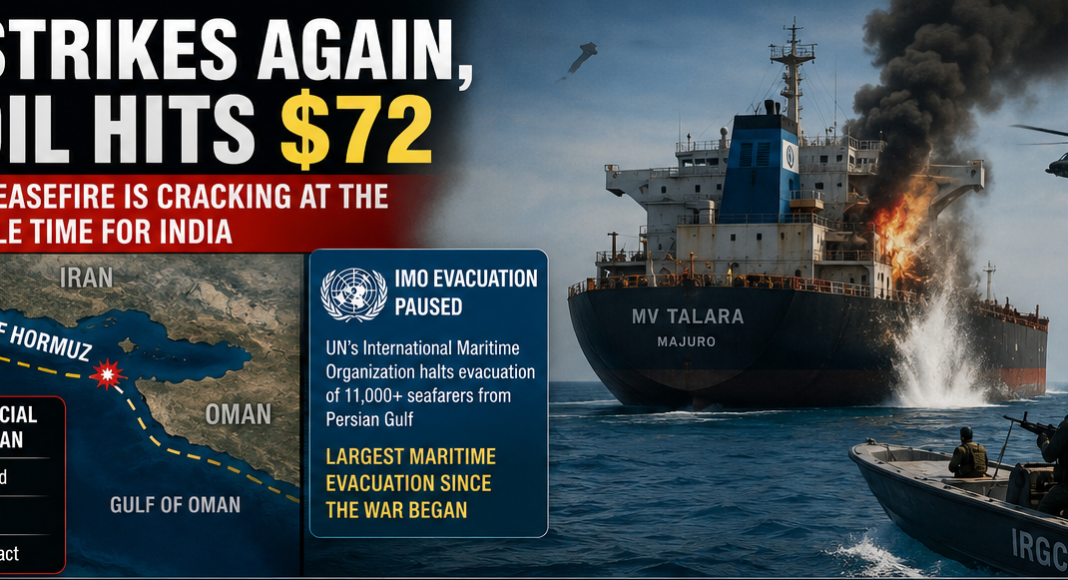
Eight days ago, the world celebrated the signing of the US-Iran peace framework. Brent crude crashed from $113 to $92. India’s Sensex rallied. A petrol price cut was expected within weeks. This morning, the IRGC struck a commercial cargo vessel off the coast of Oman — and the United Nations’ International Maritime Organization immediately paused the largest maritime evacuation operation in decades. The fragile peace is cracking. And for India, which has the most to lose if the Strait of Hormuz closes again, the morning’s news is a stark reminder that nothing in West Asia is ever truly settled.
What Happened This Morning
The ship’s bridge was damaged after it was struck on its starboard side off the coast of Dahit, Oman. The advisory said no casualties or environmental impact were reported. After the strike, the United Nations’ International Maritime Organization temporarily paused a days-old plan to evacuate many of the vessels stranded in the Persian Gulf. IMO Secretary-General Arsenio Dominguez said the halt is needed “in order to reconfirm that the necessary safety guarantees continue to be in place.” The vessel had passed through the Strait of Hormuz before it was struck, and it did not transit under IMO’s evacuation framework.
The IMO had been coordinating the evacuation of more than 11,000 stranded seafarers from the Persian Gulf — the largest maritime evacuation operation since the war began in February. Dozens of vessels that had been trapped in the Gulf for weeks were finally being moved out. One IRGC strike this morning froze that entire operation.
The Toll Dispute: The Real Flashpoint
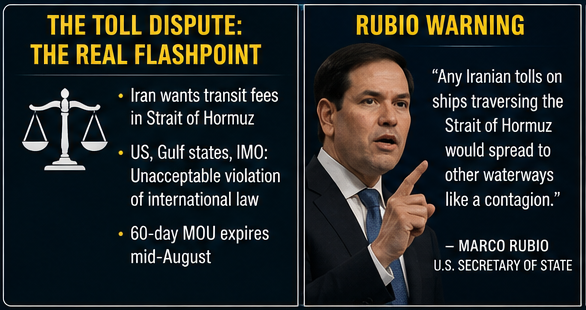
The immediate trigger for the deteriorating situation is Iran’s insistence on charging transit fees for ships passing through the Strait of Hormuz — a demand that the US, Gulf Arab states, and the IMO have all called an unacceptable violation of international law.
Iran has not ruled out seeking tolls for ships that pass through the strait after the memorandum of understanding’s 60-day time limit ends. The Trump administration and U.S. allies in the region have called that idea unacceptable and a violation of international law. Oman has said it plans to jointly manage the strait with Iran but isn’t looking to charge tolls. Iran’s Persian Gulf Strait Authority said Thursday: “Any passage through routes outside the framework designated by PGSA will not be covered by safe passage guarantees and will not be entitled to insurance coverage or related liabilities.”
Secretary of State Marco Rubio, wrapping up a Gulf tour in Bahrain, warned that any Iranian tolls on ships traversing the Strait of Hormuz would spread to other waterways “like a contagion.” “International waterways do not belong to any nation-state,” Rubio said. There was zero support among Gulf countries for any Iranian toll on ships transiting.
The 60-day MOU expires in mid-August. What happens after that — whether Iran imposes tolls, whether the US responds with sanctions or military action, whether shipping companies accept a new fee structure or reroute via the Cape of Good Hope — is the question that will determine whether this morning’s strike is an isolated incident or the opening move in a second round of hostilities.
The Oil Price Paradox: $72 But Dangerously Fragile
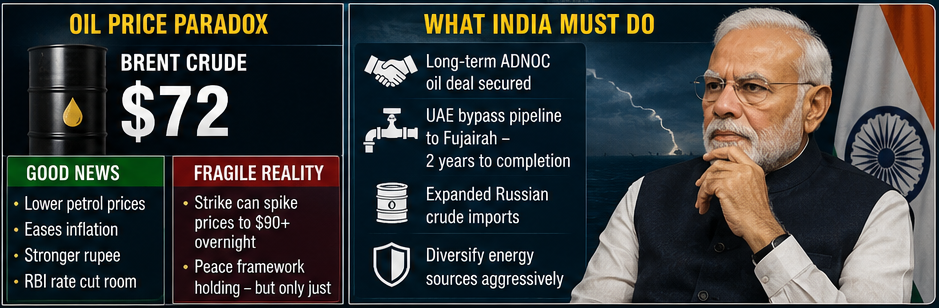
The price of Brent crude hovered around $75 a barrel on Thursday, briefly dropping in the morning to $72 — its closest to its pre-war level of $70 in almost four months.
On one level, $72 Brent crude is extraordinary good news for India. It means petrol prices should fall further, inflation should ease, the rupee should recover, and the RBI has room to cut interest rates. Every dollar Brent falls below $80 saves India roughly ₹10,000 crore per month in import costs.
But this morning’s strike is a reminder of exactly how quickly $72 can become $90 again. The IMO evacuation pause. The IRGC’s casual willingness to strike a vessel that was not even using their designated corridor. The unresolved toll dispute that gives Iran a financial incentive to keep threatening the strait even as it negotiates peace. All of these point to a peace framework that is holding — but only just.
What India Must Do
India cannot control what Iran does in the Strait of Hormuz. But it can control how vulnerable it is to whatever Iran decides. PM Modi’s Abu Dhabi visit last month secured a long-term ADNOC oil deal and set in motion the UAE’s bypass pipeline to Fujairah — the infrastructure project that could eventually route Gulf oil to tankers without passing through Hormuz. That pipeline is two years from completion. In the meantime, India has expanded Russian crude imports and diversified its energy sourcing away from exclusive Gulf dependence. These are the right moves — and this morning’s IRGC strike is the most powerful argument yet for accelerating all of them.
The ceasefire is eight days old. It is already bleeding. India watches, manages its exposure, and hopes that the diplomats in Doha and Muscat are working faster than the IRGC commanders on the water.

All information sourced from CBS News, Al Jazeera, International Crisis Group, and the Hormuz Strait Monitor as of June 26, 2026.