


New Delhi: India’s diplomatic efforts to help end the Russia-Ukraine war have gained fresh attention after Ukraine indicated that it is considering multiple ceasefire proposals, including an initiative from New Delhi. The development comes as both Kyiv and Moscow have acknowledged India’s efforts to encourage dialogue and explore possible pathways toward peace.
For New Delhi, the latest development represents another step in its long-standing position that the conflict cannot be resolved through military action alone. India has consistently advocated dialogue and diplomacy while maintaining communication with both Russia and Ukraine.
Ukraine Considers India’s Proposal
Ukraine has indicated that it is examining several proposals related to a possible ceasefire. These initiatives include ideas put forward by India, Türkiye, Egypt and the United States.
Ukrainian officials have described India’s proposal as broad in scope, suggesting that it addresses several aspects of the conflict rather than concentrating on just one issue.
Kyiv has also indicated openness to discussions involving a possible truce around energy infrastructure and the Black Sea, while broader negotiations concerning the fighting along the frontline remain considerably more complicated.
⚠️ Unverified Footage: This video reportedly shows a Russian missile attack on public infrastructure in Ukraine, but the footage and its claims have not been independently verified by our team.
This is significant because attacks on energy facilities, ports and shipping routes have created consequences far beyond the battlefield.
A limited agreement covering critical infrastructure and maritime security could potentially reduce risks to civilians and international trade while creating space for further negotiations.
What Is India Proposing?
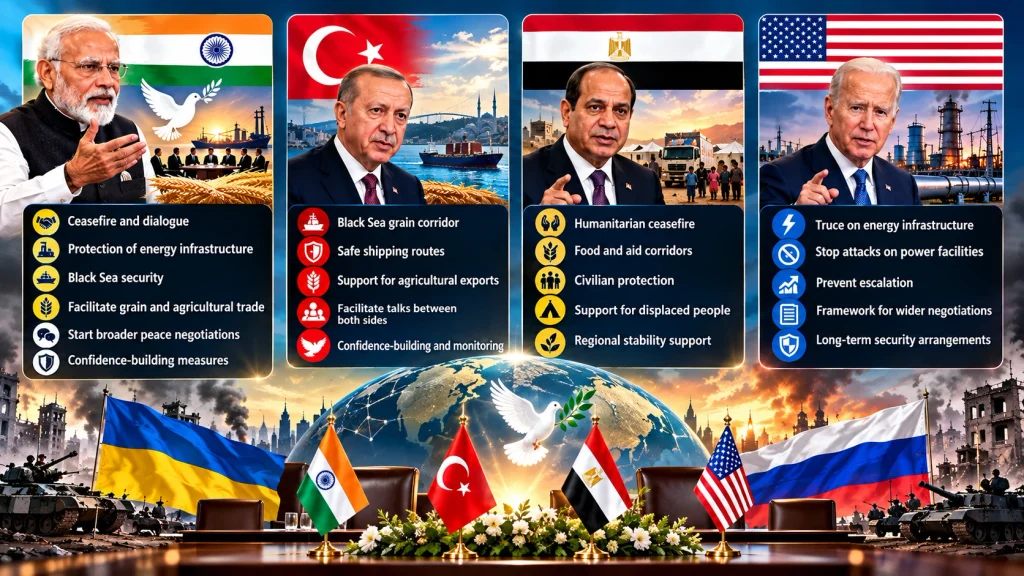
The complete details of India’s proposal have not been publicly disclosed. Therefore, it would be premature to describe it as a finalized peace agreement or a complete settlement framework.
What is clear is that India has been advocating diplomatic measures aimed at reducing the intensity of the conflict and creating conditions for negotiations.
The emerging approach appears to connect several issues rather than focusing exclusively on a temporary halt in fighting.
These include:
- Reducing attacks on critical infrastructure
- Improving security in the Black Sea
- Protecting commercial shipping
- Supporting agricultural and grain trade
- Creating conditions for broader diplomatic negotiations
- Moving toward an eventual cessation of hostilities
Ukraine’s willingness to consider discussions around energy infrastructure and the Black Sea provides possible areas where limited agreements could be explored.
Putin Acknowledges Modi’s Peace Efforts
The Ukrainian comments came amid renewed recognition of India’s diplomatic efforts from Moscow.
Russian President Vladimir Putin has publicly acknowledged Prime Minister Narendra Modi’s efforts to encourage a peaceful resolution to the Ukraine conflict.
Putin has indicated that Modi regularly raises the issue of ending the war and has ideas for finding solutions acceptable to the parties involved.
The comments are significant because India’s diplomatic position depends partly on its ability to communicate with both sides.
New Delhi maintains longstanding strategic relations with Moscow while also maintaining strong diplomatic, economic and strategic relationships with Western countries.
At the same time, India continues to maintain communication with Kyiv.
This gives India diplomatic channels with multiple sides of the conflict.
Modi’s Message: From Endless War to an End of War
India’s position has become increasingly direct.
Prime Minister Modi has repeatedly emphasised that dialogue and diplomacy are necessary for resolving the conflict.
The underlying message is that continued military operations will increase casualties and destruction while potentially making a negotiated settlement more difficult.
India has therefore avoided presenting the conflict solely as a military contest and has instead focused on the need for negotiations.
External Affairs Minister S. Jaishankar has also repeatedly stated that India is prepared to contribute in whatever manner can help bring the conflict toward a peaceful conclusion.
Why the Black Sea Matters
The Black Sea has become one of the most important elements in discussions surrounding the conflict.
The region is strategically important for shipping, agriculture and international trade. Ukraine is a major agricultural producer, and disruptions to its export routes can affect food markets well beyond Europe.
A stable maritime environment could therefore have consequences for countries across Asia, Africa and the Middle East.
India has also highlighted the broader economic consequences of disruptions to international shipping.
Energy, fertiliser and food supplies can all be affected when important maritime routes become unsafe.
For developing countries, these disruptions can translate into higher prices and increased economic pressure.
Several Peace Initiatives Are Being Discussed
The latest developments indicate that diplomacy is not centred around a single peace proposal.
Different countries are exploring different approaches.
India’s proposal reportedly covers a broad range of issues.
Türkiye and Egypt have been associated with initiatives concerning agricultural and grain-related arrangements in the Black Sea.
The United States has focused on the possibility of arrangements involving energy infrastructure.
These initiatives do not necessarily have to remain separate.
Elements from different proposals could potentially become part of a larger ceasefire framework if Russia and Ukraine agree to negotiate.
Can Russia and Ukraine Accept India’s Idea?
This remains the biggest question.
Ukraine’s consideration of India’s proposal does not mean that Kyiv and Moscow have accepted a common framework.
The two sides continue to have major disagreements over territory, security arrangements, military operations and the conditions required for a lasting settlement.
A limited ceasefire covering energy infrastructure or the Black Sea could potentially be easier to negotiate than a comprehensive political settlement.
Such an arrangement could focus on preventing specific categories of attacks without immediately requiring the two sides to resolve every underlying dispute.
If successful, smaller agreements could create confidence and provide an opening for wider negotiations.
India’s Diplomatic Position
India’s position in the international system is unusual.
New Delhi has maintained strong relations with Russia while simultaneously developing closer strategic and economic ties with the United States and European countries.
India has also maintained diplomatic communication with Ukraine.
This allows New Delhi to communicate across several international groupings.
The Indian government has repeatedly stated that its objective is to encourage dialogue rather than take sides in the conflict.
The fact that both Moscow and Kyiv continue to engage with India gives New Delhi an opportunity to contribute diplomatically.
The Economic Dimension
The Russia-Ukraine conflict is not only a European security issue.
The war has affected global energy markets, agricultural supply chains, fertiliser availability and shipping.
India has repeatedly highlighted the consequences for developing countries and the wider Global South.
A prolonged conflict can increase the cost of fuel and fertiliser, disrupt food supplies and put additional pressure on developing economies.
For India, therefore, ending the conflict has implications beyond geopolitics.
Greater stability in the Black Sea and international energy markets could help reduce some of the economic pressures created by prolonged instability.
A Potentially Larger Role for India
The latest developments suggest that India’s role may be evolving from simply calling for dialogue toward potentially helping facilitate specific diplomatic arrangements.
However, there remains a considerable distance between a proposal and an agreement.
The success of any peace initiative will ultimately depend on whether Russia and Ukraine are prepared to accept mutually workable terms.
India can encourage, facilitate and provide diplomatic channels, but the final decisions remain with the parties directly involved.
What Happens Next?
The coming weeks and months could be important for international diplomacy.
If Russia and Ukraine can agree on limited arrangements involving energy infrastructure, Black Sea shipping or agricultural exports, those agreements could potentially create an initial foundation for wider negotiations.
India’s diplomatic challenge will be to maintain communication with both sides while avoiding the perception that it is acting on behalf of one party.
For now, the important development is that Ukraine is considering India’s proposal as part of a wider group of ceasefire initiatives, while Russia has also acknowledged Prime Minister Modi’s efforts to promote a peaceful settlement.
This does not mean that peace has been achieved.
However, it demonstrates that diplomacy remains an important part of the discussion surrounding the future of the conflict.
After years of fighting, the central question is no longer only how the war will continue, but whether sustained diplomatic efforts can create a realistic pathway toward ending it.
India’s role in that process could become increasingly important if both Russia and Ukraine remain willing to keep the diplomatic channel open.
