

SPECIAL REPORT | May 21, 2026 | Agriculture & Science
No More Bleeding Hands — Bihar’s Scientists Just Reinvented Makhana Farming Forever
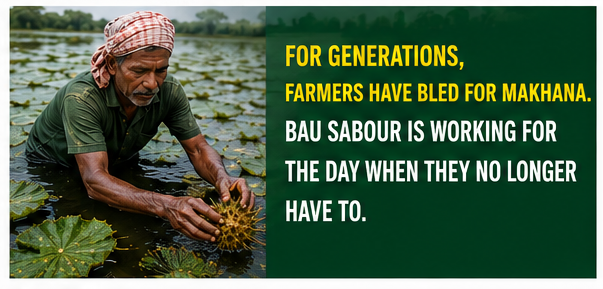
Every year, before dawn, thousands of makhana farmers wade into cold, muddy ponds across Darbhanga, Madhubani, and Mithila. They reach deep below the surface — past leaves covered in sharp, needle-like thorns — to harvest one of India’s most valuable crops. By the time the sun rises, their hands are bleeding. For generations, this has simply been the price of growing makhana. Scientists at Bihar Agricultural University in Sabour are working to change that — forever.
The Thorn Problem Nobody Talked About
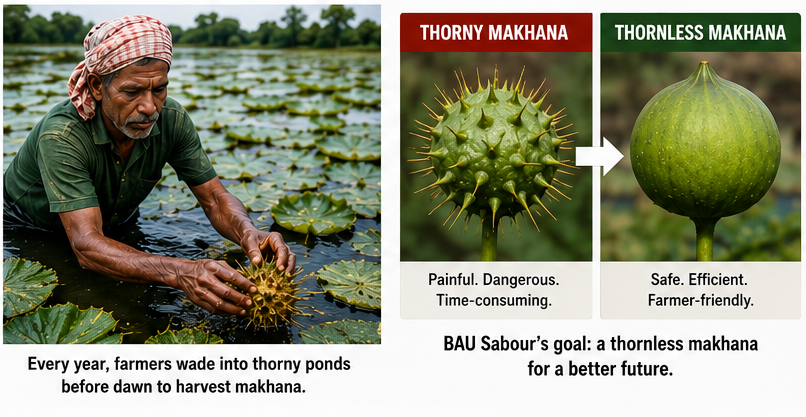
Makhana — botanically known as Euryale ferox — is one of nature’s most paradoxically named plants. The Latin word ferox means fierce or ferocious. Anyone who has ever harvested it understands why. The entire plant — its giant floating leaves, its stems, and the seed pods below — is covered in sharp spines that can pierce skin, cause infections, and make harvesting extremely dangerous, slow, and labour-intensive.
Makhana was once seen as a wild crop growing in waterlogged areas. Harvesting required wading into ponds, often in the early hours of the morning, manually collecting thorny seed pods by hand — a process that has remained largely unchanged for centuries.
For India’s 50,000+ makhana farming families — most of whom earn below ₹2 lakh per year — the thorns are not just a physical hazard. They slow down harvesting speed, increase labour costs, and make it nearly impossible for women and elderly farmers to participate in the harvest. Eliminating them would be one of the biggest quality-of-life improvements in Bihar’s agricultural history.
BAU Sabour’s Breakthrough: Gene Editing Enters the Pond
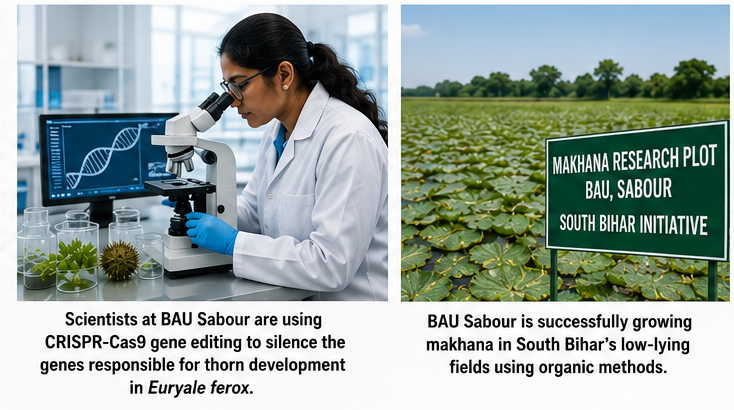
Scientists at Bihar Agricultural University (BAU), Sabour — India’s premier agricultural research institution for makhana — are now applying gene editing technology to develop a thornless variety of makhana. Using advanced genomic tools including CRISPR-Cas9 — the same Nobel Prize-winning technology that has already produced thornless blackberries, non-browning bananas, and disease-resistant crops globally — BAU researchers are targeting the specific genes responsible for spine development in the Euryale ferox plant.
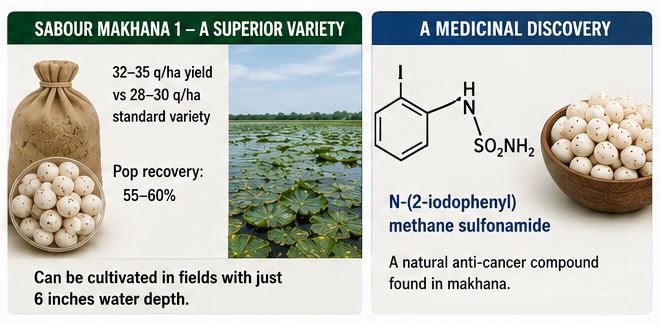
Scientists at BAU Sabour have already demonstrated cutting-edge research capabilities in makhana — recently identifying a unique medicinal compound in makhana called N-(2-iodophenyl) methane sulfonamide, positioning makhana as a key player in the nutraceutical and pharmaceutical industries.
The thornless makhana project is the next frontier — and if successful, it will fundamentally transform how makhana is grown, harvested, and exported.
What Thornless Makhana Would Change for Farmers
The implications are enormous. Consider what happens when you remove the thorns from makhana farming:
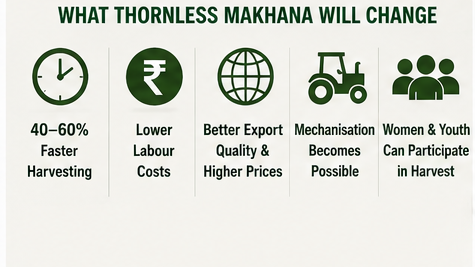
Faster Harvesting: Farmers currently spend enormous time and effort navigating thorny stems underwater. A thornless variety could cut harvesting time by 40–60%, allowing farmers to cover more area per day.
Lower Labour Costs: The dangerous nature of thorn-covered harvesting means farmers need experienced, specialised labour. Thornless makhana opens harvesting to a much wider workforce — including women and younger family members — reducing dependence on costly hired labour.
Better Export Quality: Thorn injuries during handling can damage seed pods, affecting the quality and appearance of the final product. Thornless varieties would produce cleaner, undamaged seeds — fetching higher prices in premium export markets.
Mechanisation Made Possible: Today, makhana harvesting cannot be mechanised because machines cannot navigate thorny plants. A thornless variety opens the door to semi-mechanised harvesting tools — the kind of productivity leap that transformed paddy farming in the 1970s.
BAU’s Track Record: Already Rewriting Makhana Science
This is not BAU Sabour’s first revolution in makhana research. The university has been systematically transforming what was once considered a wild pond crop into a scientifically managed superfood.
BAU Sabour developed the Sabour Makhana 1 variety through seedling selection from makhana germplasm. It achieves a seed yield of 32–35 quintals per hectare and a pop recovery of 55–60%, significantly outperforming the standard Swarna Vaidehi variety which yields 28–30 quintals per hectare. Importantly, Sabour Makhana 1 can be cultivated both in field conditions and pond systems — requiring just 6 inches of water depth in field conditions.
BAU also proved that makhana can be grown in the low-lying fields of South Bihar — a region previously considered unsuitable. Last year, BAU produced makhana in 600 square metres of land and harvested more than two quintals of seeds. This year, cultivation has expanded to two acres. Scientists confirmed South Bihar’s climate is suitable for makhana farming, and the crop is grown organically using vermicompost, neem cake, and neem oil.
BAU Sabour also played a pivotal role in securing the Geographical Indication (GI) tag for Mithila Makhana in April 2022 — a landmark recognition that protects Bihar’s makhana identity globally and ensures farmers receive premium prices for their authentic product.

The Science Behind Thornless: How Gene Editing Works on Plants
Gene editing in crops is no longer science fiction — it is happening in laboratories and fields across India and the world. Makhana is an aquatic crop with unique adaptability to stagnant and shallow aquatic ecosystems, waterlogging tolerance, efficient nutrient recycling, and compatibility with integrated farming systems — traits that make it ideal for gene editing research targeting morphological improvements.
In the thornless makhana project, BAU scientists are working to identify and silence the specific genes in Euryale ferox that trigger spine development — without affecting any other aspect of the plant’s growth, yield, or nutritional quality. The approach is precise, targeted, and leaves no foreign DNA in the final crop — meaning thornless makhana would be chemically indistinguishable from its natural counterpart.
Government Backing: ₹575 Crore and a Dedicated Makhana Board
BAU’s research is happening at the most favourable moment in makhana’s history. The government has placed a massive bet on the crop.
Finance Minister Nirmala Sitharaman announced in the Union Budget 2025 the establishment of a dedicated Makhana Board in Bihar, with PM Narendra Modi formally launching the National Makhana Board in Purnea, Bihar in September 2025. The Centre subsequently approved a comprehensive development package worth ₹475 crore for sector advancement, in addition to the ₹100 crore initial allocation — bringing total government commitment to ₹575 crore.
Bihar Agricultural University has unveiled a comprehensive action plan aimed at transforming makhana into a globally recognised superfood. Key focus areas include variety improvement, pest management, and promotion of organic makhana under the ‘Know Your Crop’ initiative. BAU has also requested the Central Government to open a Centre of Excellence for makhana to promote its production and processing.

A Superfood With a New Scientific Identity
Beyond the thorns, BAU’s research is revealing that makhana is far more than a temple snack or fasting food.
During research, BAU found natural anti-cancer elements in makhana, reinforcing its status as a medically significant superfood. The discovery of the medicinal compound N-(2-iodophenyl) methane sulfonamide positions makhana as a key ingredient in the nutraceutical and pharmaceutical industries — an entirely new market beyond food.
Makhana’s climate resilience is attributed to its tolerance to waterlogging, efficient nutrient recycling, and compatibility with integrated farming systems such as fish-makhana-vegetable models. With minimal external input requirements and the ability to restore soil fertility through organic biomass accumulation, makhana offers a sustainable livelihood alternative for marginal farmers.
What This Means for Bihar’s Future
The thornless makhana project is not just a scientific experiment happening in a Bhagalpur laboratory. It is a signal about what Bihar’s agricultural future can look like — when ancient crops meet modern science, when traditional knowledge meets gene editing, and when a state that the world once overlooked steps forward with a superfood that the world now wants.
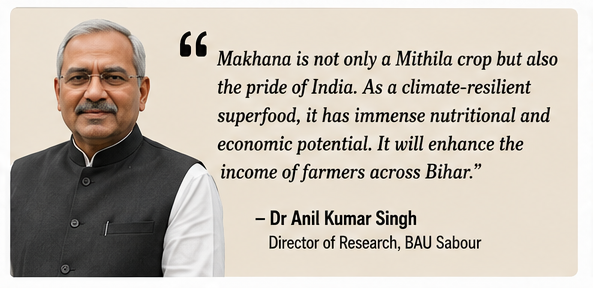
“Makhana is not only a Mithila crop but also the pride of India. As a climate-resilient superfood, it has immense nutritional and economic potential. It will enhance the income of farmers across Bihar,” said Dr Anil Kumar Singh, Director of Research at BAU.
For the farmer who wades into the cold pond before dawn — bleeding hands, muddy water, thorns that have drawn blood for a thousand harvests — the scientists at BAU Sabour are working on the day when that pain is finally a thing of the past.
That day may be closer than anyone thinks.
Key Facts: BAU Sabour Makhana Research
| Achievement | Details |
|---|---|
| Sabour Makhana 1 Variety | 32–35 q/ha yield vs 28–30 q/ha standard |
| Pop Recovery | 55–60% (improved from standard) |
| Field Cultivation Proven | Just 6 inches water depth needed |
| South Bihar Expansion | 2 acres under cultivation in 2026 |
| Anti-cancer Compound Found | N-(2-iodophenyl) methane sulfonamide |
| GI Tag Secured | April 2022 — protects Mithila Makhana globally |
| Thornless Research | Gene editing to eliminate harvest-time thorns |
| Centre of Excellence | Requested from Central Government |
| Government Support | ₹575 crore committed by Centre |
All information sourced from Patna Press, Bihar Say, ICAR Indian Horticulture, Wikipedia, and BAU Sabour research publications as of May 2026.