
BREAKING | June 19, 2026 | Sports & Business
The Biggest Sporting Event on Earth Starts Today. India Is Not Playing. India Does Not Care — It Is Watching Anyway. And India’s Advertisers Are Spending Crores Because of It.
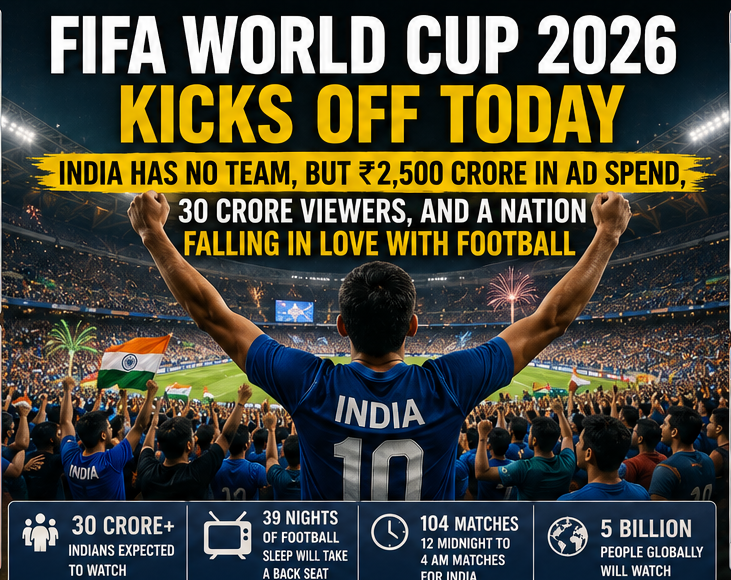
Tonight in Mexico City, the opening match of the FIFA World Cup 2026 kicks off under stadium lights that will be watched by an estimated 5 billion people globally. India has no team on the field. India has never qualified for a World Cup. The Indian national football team ranks somewhere in the 120s on the FIFA global rankings. And yet, across India tonight, millions of people will stay up past midnight to watch football. Advertisers will spend ₹2,500 crore on World Cup-associated campaigns. A dozen Indian brands have already committed to broadcasting partnerships. And Nielsen ranks football as India’s second most followed sport after cricket. Welcome to the most paradoxical sports story in the world — India, the country that does not play football at the highest level, but cannot stop watching it.
The Numbers: India’s Invisible Football Economy
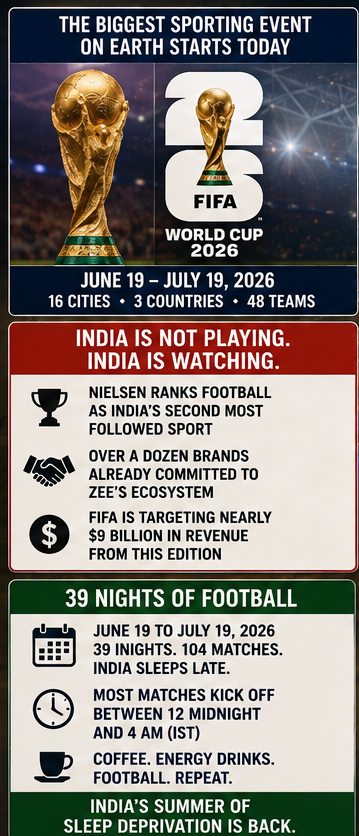
Nielsen ranks football as India’s second-most followed sport, and over a dozen brands have already committed to Zee’s ecosystem before kickoff in Mexico City. FIFA is targeting nearly $9 billion in revenue from this edition.
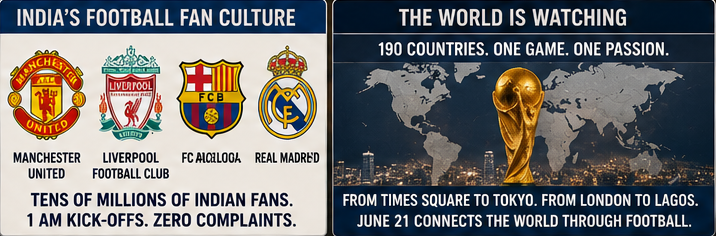
India’s relationship with football is unlike any other major nation’s relationship with the sport. Indians do not just follow club football passively — they are among the most devoted fans of the English Premier League, La Liga, the Champions League, and the UEFA Euros in the world. Manchester United, Liverpool, Barcelona, and Real Madrid each have tens of millions of Indian fans who wake up at 1 AM and 3 AM on weekends to watch their teams. The football culture is real, it is deep, and it is growing — particularly among India’s young urban population aged 15 to 35.
For many advertisers, the draw isn’t cricket; it’s the audience that cricket delivers. Sports events, reality shows, and other major media properties are valuable because they bring together large audiences at a single moment in time, and brands can engage with them collectively. It’s similar to why brands participate in something like the Mahakumbh. It’s not necessarily because they have a religious affiliation. It’s because 36 crore people gather there, and opportunities to communicate with that many people at once are extremely rare. The FIFA World Cup works in much the same way.
Thirty-six crore Indians at one event. That is more people than the entire population of the United States. When India’s media and advertising industry looks at the FIFA World Cup 2026, it sees not a football tournament — it sees a concentration of human attention at a scale that only a handful of events in human history have achieved.
39 Nights of Football: India’s Summer of Sleep Deprivation
The FIFA World Cup 2026 — expanded for the first time to 48 teams, hosted across 16 cities in the United States, Canada, and Mexico — runs from June 19 to July 19, 2026. Thirty-nine nights. Six weeks. 104 matches. And because the host countries are 9.5 to 12.5 hours behind India Standard Time, the majority of matches will kick off between 12 midnight and 4 AM in India.
India’s workforce will lose sleep. India’s productivity data for July will show a dip. India’s coffee and energy drink brands are already running campaigns anticipating exactly this consumer behaviour. And millions of Indians — especially the 18-to-35 age group in cities — will not care at all, because staying up until 3 AM to watch Argentina or Brazil or France is exactly the kind of collective cultural experience that defines their generation’s relationship with global sport.
The Messi Question: His Last World Cup?
Taken together, the perspectives frame the World Cup as more than a sporting event — it becomes a media opportunity, an economic test case and a creative challenge simultaneously.
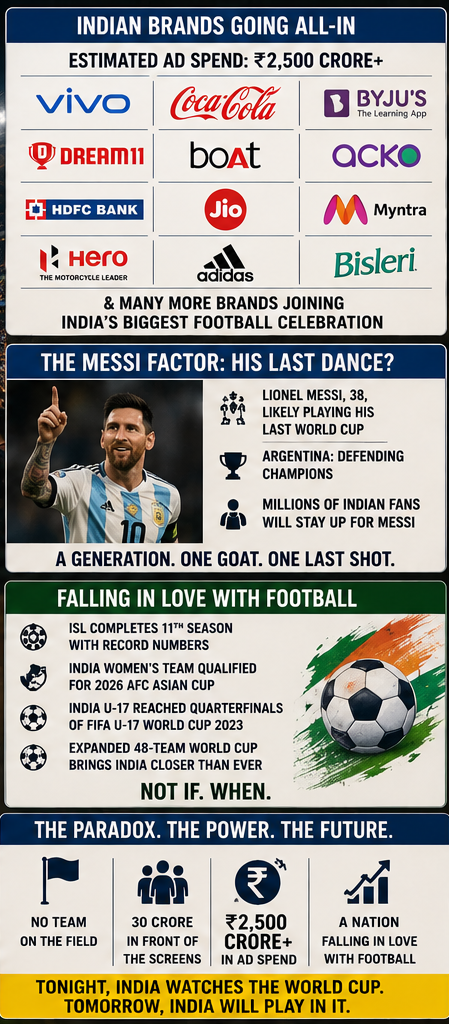
For India’s football fans in particular, this World Cup carries a bittersweet emotional weight. Lionel Messi — the greatest player in the history of the sport, the man who finally won the World Cup with Argentina in Qatar 2022 after a career of near-misses — is 38 years old. This is almost certainly his final World Cup. And for an entire generation of Indian football fans who grew up with the Messi-Ronaldo debate as a defining cultural argument, watching the GOAT play his last matches on the world’s biggest stage is not something they will miss for any amount of sleep.
The Messi factor alone will drive Indian football viewership figures to records that no previous World Cup has achieved in this country. Every time Argentina plays, social media in India will explode. WhatsApp groups across the country will be alive at 2 AM. And millions of fans wearing Argentina’s sky-blue jersey in Bengaluru, Mumbai, Kolkata, and Patna will cheer as if their own country were on the pitch.
Indian Brands: The Ad Spend Revolution
As India watches 39 nights of football without its own team on the field, the core question remains whether brands will merely buy attention or build long-term cultural relevance that extends beyond the final whistle.
The brands betting on the World Cup to build that cultural relevance span a remarkable range of sectors — smartphones, beverages, fantasy sports, online gaming, insurance, banking, and e-commerce. The common thread is the young Indian consumer, who is digitally native, globally aware, and increasingly choosing brands that align with the cultural content they consume.
The World Cup advertising ecosystem in India operates on a different model from cricket. In cricket, the BCCI controls rights exclusively and commands astronomical premiums. In football, the rights landscape is more fragmented — Zee Sports holds significant broadcast rights, but digital streaming, social media, and fantasy sports platforms create multiple layers of brand association that allow advertisers to reach football fans without buying a single television spot.
The Bigger Picture: Is India Falling in Love With Football?
The story of India and football in 2026 is not the story of a nation quietly satisfied with being a fan rather than a participant. It is the story of a country whose football infrastructure is slowly, quietly, and determinedly being built — and whose ambitions are beginning to match its passion.
The ISL — Indian Super League — completed its eleventh season in 2026 with record viewership and attendance figures. The women’s Indian football team qualified for the 2026 AFC Asian Cup. The Indian U-17 team reached the quarterfinals of the FIFA U-17 World Cup in 2023, giving the country a glimpse of what its football future might look like. And FIFA’s expanded 48-team World Cup format — which will eventually include more Asian confederation spots — brings India’s first World Cup qualification closer than at any point in the country’s football history.
Tonight, India watches. Tomorrow, India continues to build. And somewhere between the passion of 30 crore viewers and the ambition of a nation that has recently learned what it means to compete on the world stage in cricket, hockey, badminton, and athletics — the question of when India will finally play at a FIFA World Cup is no longer if. It is when.

All information sourced from Pitch On Net, Sportskeeda, Nielsen, and Newsonair as of June 17–19, 2026.