


TRIBUTE | July 5, 2026 | Culture & National Affairs
At 3:15 AM this morning at AIIMS Raipur, the voice that had carried the Mahabharata to audiences in New York, Paris, Tokyo, London, and Moscow — in a dialect that most of those audiences could not understand a single word of, and yet felt in their bones — fell silent forever. Padma Vibhushan Dr Teejan Bai, the legendary Pandavani folk singer who carried Chhattisgarh’s rich folk tradition to audiences across the world, passed away at the age of 70 after battling illness for a while, breathing her last at AIIMS Raipur at 3:15 AM on July 5, 2026, where she had been undergoing treatment since May 27 after experiencing severe breathing difficulties.
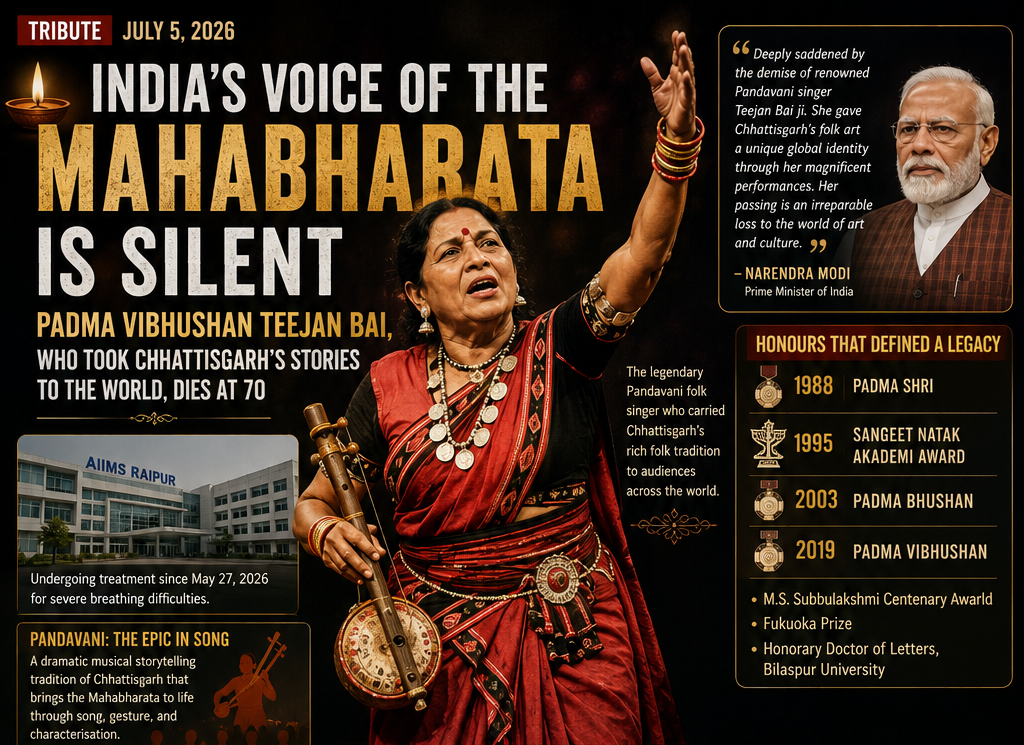
Prime Minister Narendra Modi expressed grief over Teejan Bai’s death, crediting her for giving Chhattisgarh’s folk art a distinct global identity through her performances. “Deeply saddened by the demise of renowned Pandavani singer Teejan Bai ji. She gave Chhattisgarh’s folk art a unique global identity through her magnificent performances. Her passing is an irreparable loss to the world of art and culture,” Modi said.
Born into poverty in 1956, she overcame an abusive marriage and societal rejection to master the traditionally male-dominated art form. She transformed Pandavani into a dramatic theatrical experience, taking it from tribal villages to international stages and winning India’s highest civilian honors.
The story of Teejan Bai’s life is the story of what a single human being’s refusal to accept the limitations placed on her can accomplish. At a time when women traditionally performed Pandavani in the seated Vedamati style, she broke convention by adopting the dramatic Kapalik style, standing on stage like her male counterparts. This was not a minor aesthetic choice — it was an act of cultural rebellion that her own community initially rejected. When she dared to sing Pandavani — a traditionally male-dominated art form — her own community ostracised her. Undeterred, she built a small hut for herself, borrowing utensils and food from kind neighbours, and refused to abandon her calling. She performed her first public rendition at just 13.
She performed extensively in India and abroad, including in the United States, the United Kingdom, France, Japan, Russia, Australia and Germany, earning global recognition for Chhattisgarh’s rich cultural heritage.
In recognition of her immense contribution to Indian culture, the Government of India honoured her with the Padma Shri in 1988, the Sangeet Natak Akademi Award in 1995, the Padma Bhushan in 2003 and the Padma Vibhushan in 2019. She also received the M.S. Subbulakshmi Centenary Award, the prestigious Fukuoka Prize and an honorary Doctor of Letters degree from Bilaspur University.
What made Teejan Bai extraordinary was not just the awards or the international performances — it was the specific quality of her artistry. Her performances transcended language barriers, allowing audiences unfamiliar with the Chhattisgarhi dialect to connect emotionally with the timeless narratives of the Mahabharata. People who did not understand a word she sang wept at her concerts. That is the rarest gift a performing artist can possess — the ability to communicate feeling directly, without the mediation of language.
Teejan Bai’s life was a testament to the triumph of talent over adversity, of art over orthodoxy, and of one woman’s indomitable will to preserve her cultural heritage. In an era when traditional arts often struggle for survival, she shone as a flag-bearer — proving that the stories of our ancestors can still resonate powerfully in modern times.
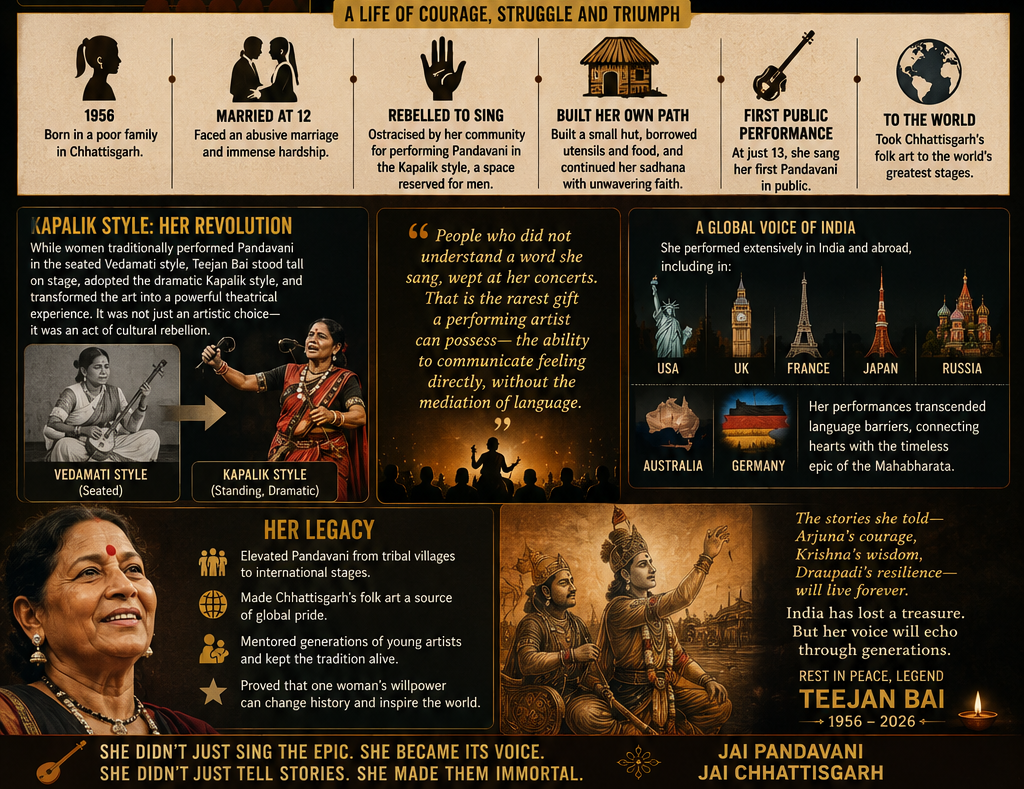
She was married at 12. She survived an abusive marriage. She was ostracised by her community for performing in a style reserved for men. She built her own hut with borrowed utensils. And from that hut, with her tambura and her voice, she reached the stages of the world’s greatest performance venues. The Pandavani she practiced — the dramatic retelling of the Mahabharata through gesture, song, and characterisation — was not a relic she preserved. It was a living fire she kept burning through the force of her own extraordinary personality.
Teejan Bai devoted herself to mentoring younger performers and promoting folk traditions, ensuring that Pandavani remained a living, evolving art form rather than a forgotten relic of the past.
India has lost a treasure this morning. But the stories she told — Arjuna’s courage, Krishna’s wisdom, Draupadi’s resilience — those stories do not die. Teejan Bai made sure of that.
All information sourced from NewSX, The Logical Indian, The Federal, and New Kerala as of July 5, 2026.
