


Mobile technology has become an inseparable part of modern life, transforming how people communicate, work, and learn. In the field of education, smartphones, tablets, and mobile applications have opened up new opportunities for both students and teachers. However, while mobile technology offers significant advantages in enhancing learning, it also brings challenges that can negatively impact students if not used properly. This makes it a double-edged sword—powerful yet potentially harmful.
The Positive Impact of Mobile Technology in Education
One of the biggest advantages of mobile technology is accessibility. Students today are no longer limited to textbooks or classroom lectures. With a smartphone, they can access a vast amount of information anytime and anywhere. Educational platforms, online courses, and digital libraries have made learning more flexible. A student in a rural area can now watch lectures from top universities or learn new skills through apps and websites. This has significantly reduced the gap between different educational backgrounds.
Another major benefit is interactive learning. Mobile technology has made education more engaging through videos, animations, quizzes, and gamified learning apps. Instead of passive learning, students can actively participate in lessons. For example, educational apps use visuals and interactive exercises to explain complex concepts, making learning easier and more enjoyable. This is especially helpful for subjects like science and mathematics, where visualization plays a key role.
Mobile devices also support personalized learning. Every student learns at a different pace, and traditional classroom methods often fail to address individual needs. Mobile apps and AI-based platforms can track a student’s progress and provide customized content accordingly. This helps slow learners catch up while allowing advanced students to move ahead without being held back.
Communication is another area where mobile technology has made a big difference. Students can easily connect with teachers and classmates through messaging apps, video calls, and online forums. Doubts can be cleared instantly, and collaboration on projects has become much easier. This has improved the overall learning experience and made education more connected.
Moreover, mobile technology encourages self-learning and skill development. Students are no longer dependent solely on teachers. They can explore topics of interest, learn new languages, develop coding skills, or even start small online businesses. This promotes creativity, independence, and lifelong learning habits.
The Negative Impact of Mobile Technology in Education
Despite its many benefits, mobile technology also has several drawbacks. One of the most serious concerns is distraction. Smartphones are not just educational tools; they also provide access to social media, games, and entertainment. Students often find it difficult to resist these distractions, leading to reduced focus on studies. Notifications and constant connectivity can interrupt learning and lower productivity.
Another issue is over-dependence on technology. Many students rely heavily on mobile devices for answers instead of thinking critically. Instead of solving problems themselves, they tend to search for quick solutions online. This can weaken analytical and problem-solving skills, which are essential for real-world success.
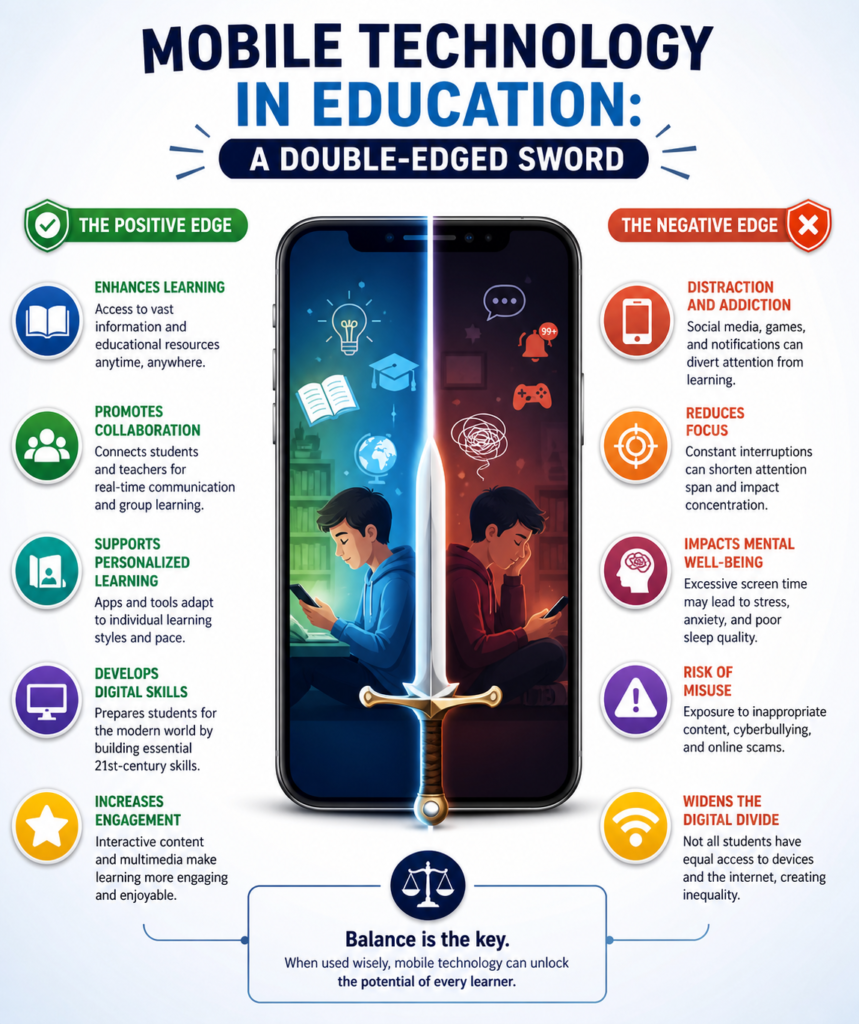
Mobile technology can also lead to health problems. Excessive screen time is associated with eye strain, poor posture, sleep disturbances, and even mental health issues like anxiety and stress. Students who spend long hours on their phones may also experience reduced physical activity, which can affect their overall well-being.
A significant concern is the quality of information available online. Not all content on the internet is accurate or reliable. Students may come across misleading or incorrect information, which can negatively impact their learning. Without proper guidance, it becomes difficult for them to differentiate between credible and unreliable sources.
Another negative aspect is reduced social interaction. While mobile technology connects people digitally, it can reduce face-to-face communication. Students may spend more time on their devices than interacting with peers and teachers in person. This can affect their social skills and emotional development.
There is also the issue of digital inequality. Not all students have access to smartphones or high-speed internet. This creates a gap between those who can benefit from mobile learning and those who cannot. As a result, technology can sometimes increase educational inequality instead of reducing it.
Finding the Right Balance
The impact of mobile technology on education depends largely on how it is used. It is neither entirely good nor entirely bad. To maximize its benefits and minimize its drawbacks, a balanced approach is necessary.
Teachers and parents play a crucial role in guiding students. They should encourage the use of mobile devices for educational purposes while setting limits on screen time and entertainment use. Schools can integrate mobile technology into their teaching methods in a structured way, ensuring that it supports learning rather than distracting from it.
Students, on the other hand, need to develop discipline and responsible usage habits. They should learn to use technology as a tool for growth rather than a source of distraction. Critical thinking skills should also be emphasized so that students can evaluate the information they find online.
Conclusion
Mobile technology has revolutionized education by making learning more accessible, interactive, and personalized. It empowers students with knowledge and skills that were once difficult to obtain. However, it also brings challenges such as distraction, over-dependence, and health concerns.
In the end, mobile technology is a powerful tool that must be used wisely. When used correctly, it can enhance education and open new opportunities for learners. But if misused, it can hinder academic performance and personal development. The key lies in maintaining a balance and using technology in a way that supports meaningful and effective learning.
