

BREAKING | May 15, 2026 | World Affairs
The Most Important Meeting on Earth Just Ended — Here Is Everything That Happened and Why Every Indian Should Care
Two days. Two of the world’s most powerful men. One city that has seen empires rise and fall. The Trump-Xi Beijing Summit of 2026 is over — and the world is still figuring out exactly what happened.
The Summit That Shook the World
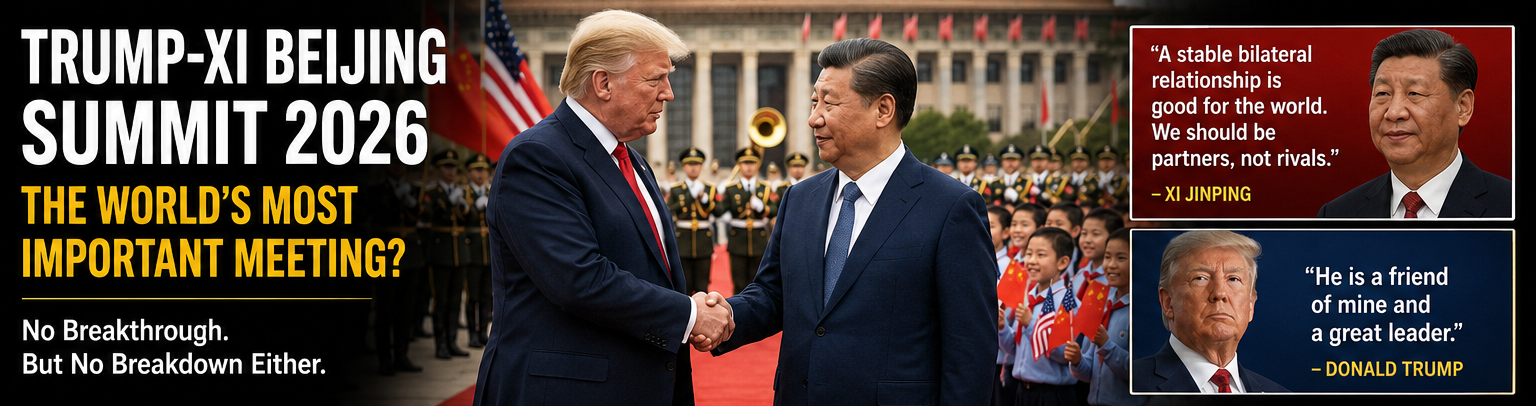
The day began with President Donald Trump and Chinese President Xi Jinping shaking hands outside Beijing’s Great Hall of the People on Thursday morning. The two leaders chatted during an opening ceremony that featured a brass band, marching military units, and cheering children waving American and Chinese flags. “A stable bilateral relationship is good for the world,” Xi said. “We should be partners, not rivals.” Trump called Xi a friend and a “great leader,” saying the two have always been able to work out their disagreements.
It was Trump’s first visit to China since 2017 — and the first by any sitting U.S. president in nearly a decade. The symbolism alone was enormous. But what actually came out of those closed-door rooms?
The Deals on the Table: Boeing, Oil & Hundreds of Billions
Trump brought 17 American corporate leaders with him to Beijing — including Tesla’s Elon Musk, Apple’s Tim Cook, and Nvidia’s Jensen Huang. Trump said Beijing had agreed to buy U.S. oil and 200 Boeing aircraft. Trump administration officials also indicated that China will increase purchases of U.S. agricultural products and work to establish a “Board of Trade” to manage investments between the countries.
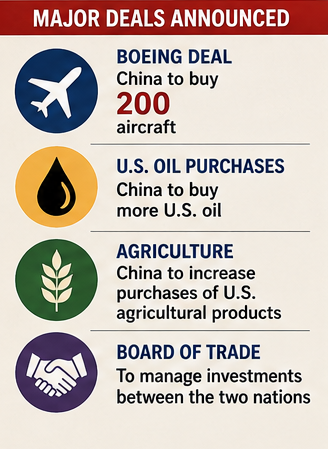
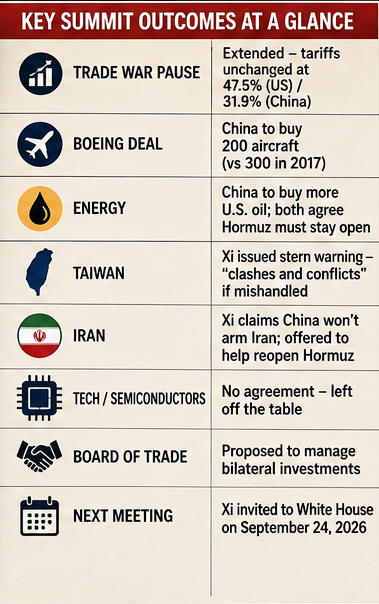
Trump said he had made “many business deals,” including commitments from China to purchase 200 Boeing aircrafts and more U.S. oil. But the last time Trump visited in 2017, he brought nearly 30 executives and the U.S. had announced deals totaling more than $250 billion. China agreed to buy 300 Boeing airplanes that time. The contrast tells its own story — China needs America less than it did a decade ago.
Taiwan: Xi’s Stern Warning
The most serious moment of the summit came behind closed doors — and it was about Taiwan.
Chinese President Xi Jinping had stern words for President Trump on Taiwan, warning of potential “clashes and even conflicts” if the issue isn’t “handled properly.” Xi stressed that “the Taiwan question is the most important issue in China-U.S. relations. If it is handled properly, the bilateral relationship will enjoy overall stability. Otherwise, the two countries will have clashes and even conflicts, putting the entire relationship in great jeopardy.” Xi also told Trump that ‘Taiwan independence’ and cross-Strait peace are as irreconcilable as fire and water.
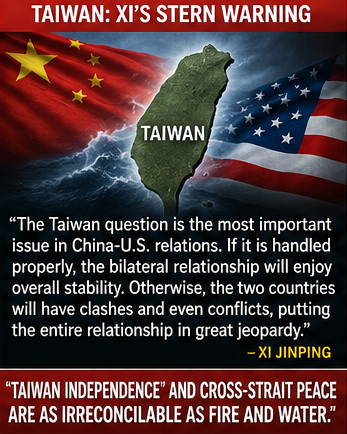
Trump and Xi both ignored reporters’ questions about Taiwan after the meeting — a silence that spoke louder than any statement.
The Iran Angle: China as Peacemaker?
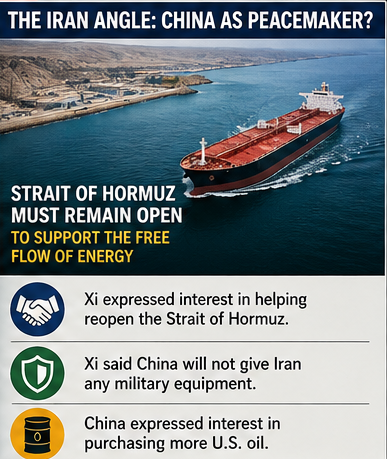
Trump told Fox News’ Sean Hannity that Xi told him he would like to help open the Strait of Hormuz, and claimed that Xi said he’s not going to give Iran any military equipment.
During their meeting, Xi “expressed interest” in purchasing more U.S. oil, and the two leaders agreed that the Strait of Hormuz, which has been in effect closed amid the Iran war, “must remain open to support the free flow of energy,” according to a White House readout.
The recent Beijing visit by Iranian Foreign Minister Abbas Araghchi shows China positioning itself as having already weighed in with Iran to reopen the Strait of Hormuz. If China can actually deliver this — getting Iran to reopen the Strait — it would be the most consequential diplomatic achievement of 2026.
No Breakthrough — But No Breakdown Either
No new deals have been announced yet from the summit, though Trump said the two countries “settled a lot of different problems that other people wouldn’t have been able to settle.”
While Trump and Xi are anticipated to extend the one-year pause in their trade war agreed to in South Korea in October, the prevailing outlook is a stabilisation — not revitalisation — in ties between the world’s two largest economies. Several sensitive topics were largely absent from public discussion, including international sanctions, tech export controls, and Chinese electric vehicles.
The average U.S. tariff on Chinese goods stood at 47.5 percent after the South Korea summit, up from 3.1 percent before Trump’s first term. China’s average tariff on U.S. goods stood at 31.9 percent, up from 8.4 percent in 2018. Two-way goods trade amounted to about $415 billion in 2025, down sharply from its 2022 peak of $690 billion.

The trade war scars run deep — and two days in Beijing cannot erase a decade of economic warfare.
What the Trump-Xi Summit Means for India
This is the question every Indian business leader, investor, and policymaker is asking this morning. The answer is complicated — and critically important.
If the Strait of Hormuz reopens: India wins immediately. With Brent crude near $113 per barrel and the rupee at an all-time low of ₹95.32, a reopened Strait could slash India’s oil import bill by tens of thousands of crores. Every $10 drop in crude oil prices relieves approximately ₹1 lakh crore from India’s annual import burden.
If US-China trade stabilises: India could face stiffer competition in global export markets as Chinese goods find easier access to American buyers. But it also reduces global uncertainty — which is good for FII flows back into Indian equities.
If China mediates the Iran crisis: PM Modi, who lands in Abu Dhabi today on his five-nation tour, will find a very different energy negotiation landscape than expected. A China-brokered Hormuz reopening would significantly change India’s energy security calculus.
If nothing changes: India continues to benefit from being the preferred alternative supply chain destination for Western companies reducing China dependence — the “China Plus One” strategy that has brought billions in manufacturing FDI to India.
The Bigger Picture: A World Reorganising Itself
President Trump’s May 14–15, 2026, visit to China will likely represent a relatively modest step toward greater stability and predictability in the world’s most important bilateral relationship. Like every president who goes to Beijing, Trump faces outsized expectations against the backdrop of a much more complex and challenging relationship.
The world’s two superpowers met, shook hands, ate a state banquet together, and walked away with 200 Boeing jets and a lot of unresolved tension. That is not a breakthrough — but in today’s world, it is not nothing either.
For India — simultaneously dealing with the Iran oil crisis, a weakening rupee, FII outflows, and PM Modi’s own diplomatic sprint across five nations — today’s Beijing summit is one more variable in an already complex global equation.
India must navigate its own path. It always has.
Key Summit Outcomes at a Glance
All information sourced from CNN, CBS News, Al Jazeera, and CSIS as of May 15, 2026 IST. This is a developing story — Loktime will update as more details emerge.