
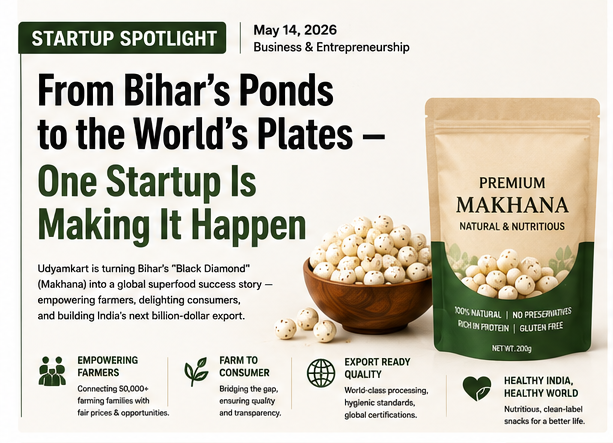

STARTUP SPOTLIGHT | May 14, 2026 | Business & Entrepreneurship
From Bihar’s Ponds to the World’s Plates — One Startup Is Making It Happen
They call it the “Black Diamond” of Bihar. Harvested by hand from muddy ponds at the crack of dawn, dried under the sun, and popped at high heat into the white, crunchy kernel the world is now falling in love with — Makhana is no longer just an offering at a temple or a fasting snack. It is India’s next billion-dollar export story. And Udyamkart is stepping right into the middle of it.
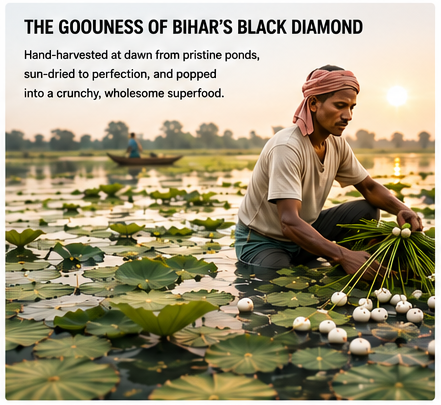
Meet Udyamkart — Bihar’s Newest Makhana Startup
In a market that is rapidly professionalising, Udyamkart has entered the makhana space with a clear and focused mission: bridge the massive gap between Bihar’s 50,000+ makhana farming families and the booming domestic and global demand for this superfood. The startup is building a farm-to-consumer pipeline that ensures farmers get fair prices, products meet export-grade quality, and health-conscious consumers across India get the freshest makhana possible — without the middlemen eating the margins.
The timing could not be better. India’s makhana market is on fire — and Udyamkart is lighting the match at exactly the right moment.
Why Makhana? Why Now?
The India makhana market size was valued at INR 9.29 Billion in 2025 and is expected to grow at a compound annual growth rate of 8.85% from 2026 to 2034, reaching INR 19.95 Billion by 2034, driven by rising health consciousness, expanding organized retail networks, and growing e-commerce penetration.
The global fox nuts market is valued at USD 1.7 Billion in 2026, driven by the National Makhana Board establishment, VC-funded D2C scaling, and international superfood demand. The market is projected to grow at a CAGR of 11.0% from 2026 to 2036, reaching USD 4.7 Billion by 2036.
In plain numbers: the world’s appetite for makhana is doubling every decade — and India controls 90% of the global supply. For a startup like Udyamkart, that is not just a market opportunity. That is a once-in-a-generation opening.
Bihar: The Undisputed Capital of Makhana
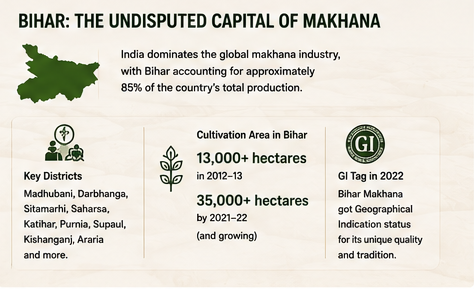
India dominates the global makhana industry, with Bihar accounting for approximately 85% of the country’s total production. Key districts like Madhubani, Darbhanga, Sitamarhi, Saharsa, Katihar, Purnia, Supaul, Kishanganj, and Araria serve as the primary hubs, since they have favourable climatic conditions and fertile soil that contribute to the superior quality of makhana. Bihar’s makhana gained Geographical Indication (GI) status in 2022, recognising its unique quality and traditional cultivation methods.
Cultivation area in Bihar has expanded dramatically from 13,000 hectares in 2012-13 to over 35,000 hectares by 2021-22, with seed production increasing from 20,800 metric tonnes to 56,400 metric tonnes during this period.
For Udyamkart, this means the raw material — the world’s finest makhana — is right in its backyard. The startup’s location advantage is built into its DNA.
The Government Tailwind: ₹575 Crore Behind Makhana
Udyamkart could not have picked a better time to launch. The Indian government has placed an enormous policy bet on makhana — and that bet is paying off directly for every startup in the space.
In the Union Budget 2025, the government announced the establishment of a dedicated Makhana Board with an initial allocation of Rs. 100 crore. The Board is set up as the apex body to coordinate all aspects of makhana development — from farming, research, processing, marketing, to export promotion.
The National Makhana Board was officially launched by Prime Minister Narendra Modi in Purnea, Bihar, in September 2025. The Centre subsequently approved a comprehensive development package worth ₹475 crore for sector advancement.
The One District One Product (ODOP) Scheme has identified makhana as a priority product in Bihar, offering financial assistance, infrastructure development, and training programmes. APEDA has played a crucial role in promoting exports, organising trade fairs and facilitating certifications like organic and fair trade to meet global standards. NABARD also offers financial aid to farmers and entrepreneurs for processing units and storage facilities.
For Udyamkart, this policy environment translates into subsidies, credit support, export facilitation, and a government that is actively marketing Indian makhana to the world.
India’s Makhana Export Boom — The Global Opportunity
India leads the world in makhana exports, supplying around 90% of the global market. In the 2024-25 fiscal year, exports reached INR 255 crore ($30.5 million), up 27% year-on-year thanks to strong demand from the USA, UAE, and Canada. The United States stood out as a major buyer, taking over 17% of the total exports, while the UAE accounted for more than 8%.
Makhana export prices range between $14–$20 per kg, depending on quality and destination. Premium markets like Germany offer prices as high as $25 per kg.
This export premium is the opportunity Udyamkart is chasing. By building an export-ready supply chain — FSSAI certified, quality graded, hygienically packaged — the startup can tap into the premium pricing that global health food markets willingly pay for clean-label, traceable Indian superfoods.
The Health Food Wave Udyamkart Is Surfing
Makhana’s nutritional profile — low fat, high protein, rich in calcium, magnesium, and antioxidants — positions it as a premium alternative to fried snacks. Urban consumers increasingly associate makhana with weight management, diabetes-friendly diets, and Ayurvedic wellness practices.
With obesity rates rising and lifestyle-related disorders such as diabetes affecting over 100 million Indians, consumers are actively reducing consumption of fried and processed snacks. Makhana, containing less than 1% fat and approximately 9-10% protein, aligns strongly with these dietary changes.
The Farmley Healthy Snacking Report 2025 reveals that 55% of Indian consumers now prioritize preservative-free snacks, with 52% favoring eco-conscious packaging. Snacking habits are evolving due to lifestyle changes, as 45% prefer on-the-go formats.
Udyamkart’s product — natural, preservative-free, Bihar-sourced makhana — is the definition of what today’s health-conscious Indian and global consumer is looking for.
The Startup Opportunity: What Udyamkart Is Building
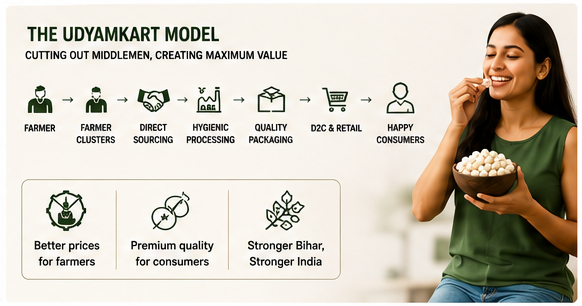
The makhana industry’s biggest structural problem has always been fragmentation. Farmers sell to local traders at low prices. Traders sell to processors. Processors sell to brands. By the time makhana reaches the consumer, margins have been extracted at every step — and the farmer who harvested it at 4 AM in a Bihar pond sees the least of it.
Udyamkart is building the shortcut. By sourcing directly from farmer clusters in Darbhanga and Madhubani, processing with hygiene-certified facilities, and selling through D2C digital channels and organised retail — the startup compresses the supply chain, gives farmers better prices, and gives consumers better quality at competitive rates.
In 2026, India’s startup evolution is moving firmly toward agri-tech in Tier-2 and Tier-3 cities, with sector-specialised clusters emerging across the country. What was earlier considered “non-metro” is becoming the new hub of demand creation. Udyamkart is exactly this kind of startup — rooted in Bihar, building for the world.
The Makhana Market at a Glance — Why Investors Should Watch
| Metric | Data |
|---|---|
| India Makhana Market (2025) | USD 1.46 Billion |
| Projected Market Size (2034) | USD 3.12 Billion |
| Global Fox Nuts Market (2026) | USD 1.7 Billion |
| Global Market CAGR (2026–36) | 11.0% |
| India’s Share of Global Production | 90% |
| Bihar’s Share of India Production | 85–90% |
| Makhana Exports FY24-25 | INR 255 crore (up 27% YoY) |
| Export Price Range | $14–$25 per kg |
| Top Export Destinations | USA, UAE, Canada, UK, Germany |
| Government Support Allocated | ₹575 crore (Makhana Board + Package) |
A Message to Bihar’s Entrepreneurs
Udyamkart’s makhana startup is not just a business story — it is a statement about what Bihar’s entrepreneurs can build when they combine local knowledge, government support, and modern startup thinking. The same ponds that have sustained makhana farming families for generations are now the source of a global superfood revolution.
Makhana’s journey from a niche pond product of Bihar to a global superfood offers a template for other Indian crops with similar potential. These local foods can be re-branded, made to conform to international quality standards, backed by supportive policies, to become the latest culinary sensation.
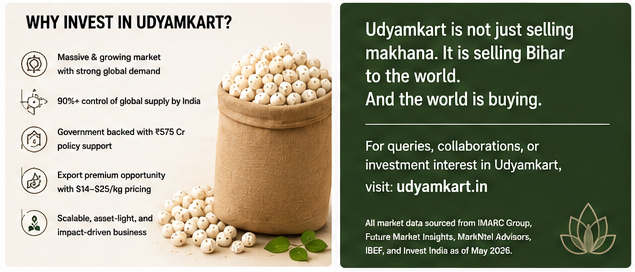
For queries, collaborations, or investment interest in Udyamkart, visit: udyamkart.in | All market data sourced from IMARC Group, Future Market Insights, MarkNtel Advisors, IBEF, and Invest India as of May 2026.