

BREAKING | May 29, 2026 | National Affairs
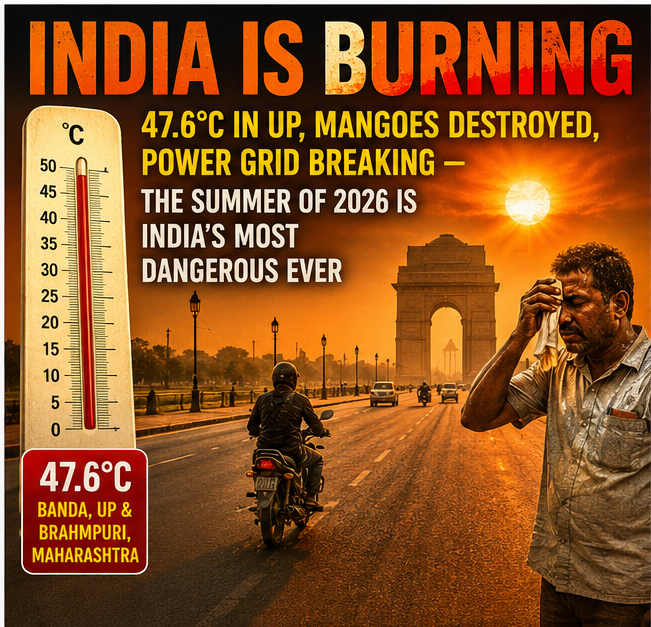
47.6 Degrees. Zero Relief. A Nation on Fire.
It is not yet June. The monsoon is still weeks away. And India is already living through what climate scientists are calling the most dangerous summer in the country’s recorded history. From the scorched fields of Vidarbha to the melting streets of New Delhi, from Bihar’s drying ponds to Maharashtra’s ruined mango orchards — the summer of 2026 is not just breaking records. It is breaking lives.
The Numbers That Tell the Story
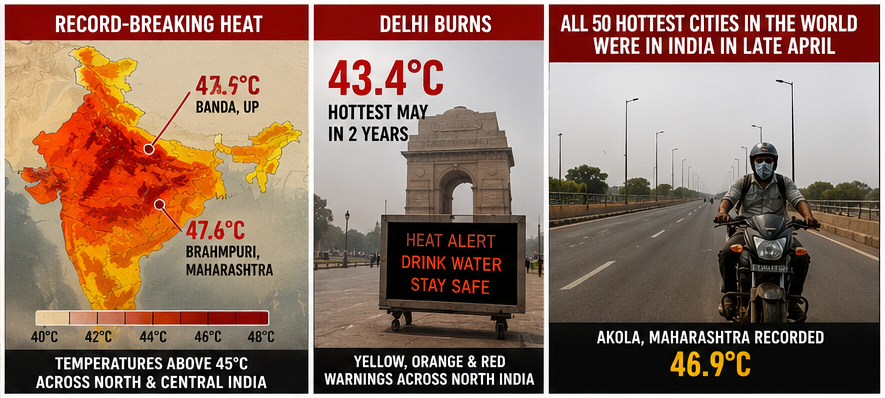
Banda in Uttar Pradesh and Brahmpuri in Maharashtra’s Vidarbha region recorded the country’s highest maximum temperature at 47.6 degrees Celsius this week — temperatures so extreme that being outdoors for more than 30 minutes without protection can cause heatstroke within hours.
The city of Delhi hit 43.4°C — the hottest May weather in the last two years. Yellow, orange and red warnings from the Indian Meteorological Department are in effect across northern India simultaneously. The highest maximum temperature recorded last week was 46°C in Akola, Maharashtra — a number that AccuWeather described as “dangerous for the elderly and very young.”
Across the country, temperatures have crossed 45 degrees Celsius, with Akola in Maharashtra’s Vidarbha region recording 46.9°C in late April. On a single day in late April, all of the top 50 hottest cities in the world were located in India — a statistic so staggering it needs to be read twice. All 50. Every single one. India.
The Power Grid Is Cracking
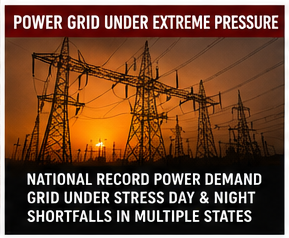
The scorching heat drove India’s power demand to a new national record. With millions of air conditioners, coolers, and fans running simultaneously across the country, the electricity grid is under pressure it has never experienced before — not only during the day, but at night as well, resulting in occasional shortfalls across multiple states.
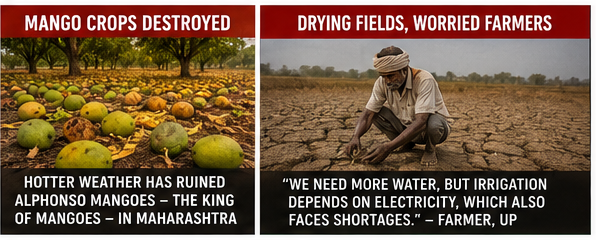
Farming conditions have worsened simultaneously. “Our wheat crop this year was affected because the grains were weak, as they could not grow properly due to early onset of heat. Paddy, too, is suffering because it is a water-intensive crop, and with the soil drying much faster in temperatures touching 47 degrees Celsius, we need more water than usual. But irrigation depends on electricity supply, which also faces shortages during heatwaves,” said a farmer from Uttar Pradesh.
The King of Mangoes Has Fallen
Maharashtra is renowned for its Alphonso mangoes, but officials say hotter weather has ruined this year’s crop of the variety known as the King of Mangoes.
India remains the world’s largest mango producer, with output estimated at nearly 28 million tonnes last year. But mango growers across several states are reporting lower yields after prolonged heat, erratic weather patterns, and worsening water scarcity damaged flowering and fruit development. Farmers now fear that repeated heatwaves and shrinking water availability could severely impact future harvests — not just this year, but for years to come.
For millions of Indians who wait all year for the mango season, this is personal. For the farmers who depend on it, it is devastating.
The Human Cost — Deaths, Disease, Despair
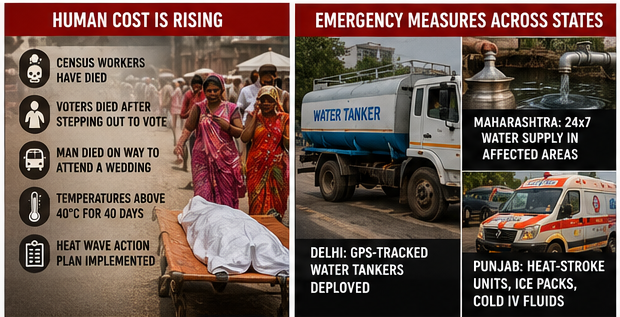
Census workers have died. Voters who stepped out in the recently concluded West Bengal election have died. A man who boarded a bus to attend a wedding died before he reached his destination. After temperatures remained above 40°C for 40 consecutive days, the Modi government implemented its much-awaited Heat Wave Action Plan.
In 2024, heat exposure resulted in a loss of 247 billion potential labour hours — a record high and 124 percent more than in 1990-1999, according to a Lancet India study. This year’s numbers are expected to be higher. The United Nations has expressed concern that the heatwaves are pushing India’s food supply to the brink.
Governments across states have announced emergency measures. Delhi authorities have deployed GPS-tracked water tankers. Maharashtra has initiated round-the-clock water supply operations in affected areas. Punjab hospitals have activated dedicated heat-stroke management units, with ambulances carrying ice packs and cold IV fluids for emergency cooling treatment.
Why Is 2026 So Much Worse?
Scientists say several factors are combining to make 2026 exceptionally dangerous. Long-term climate change is raising baseline temperatures across the planet — heatwaves are becoming more frequent, more intense, and longer lasting. Urban areas are especially vulnerable because concrete and asphalt trap heat, creating urban heat island effects. Meteorologists are also closely watching the possible development of an El Niño event in 2026 — a climate phenomenon linked to warmer Pacific Ocean temperatures that can disrupt global weather patterns. For India, El Niño years are often associated with weaker monsoons, higher temperatures, and drought conditions. Some climate researchers have warned that if a strong or super El Niño develops, 2026 could become one of the hottest years on record globally.
IMD’s Warning System Is Getting an Overhaul
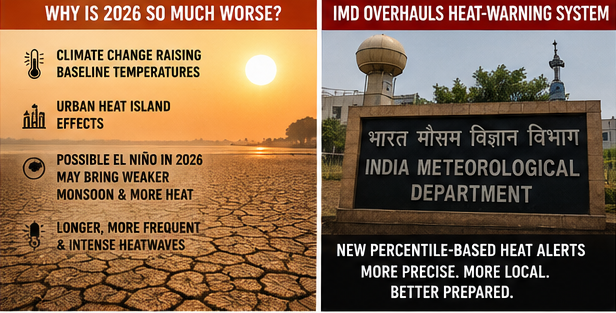
India’s heat-warning system will undergo an overhaul to address gaps, the government announced this week, particularly in coastal areas. The IMD is also planning a new percentile-based heat alert system, where warnings may be triggered when temperatures exceed the historical 95th percentile for a location — a more precise and locally relevant approach than the current fixed-threshold system.
The irony is painful. India is overhauling its heat warning system in the middle of the worst heatwave the system has ever been asked to manage.
The Monsoon: India’s Only Hope
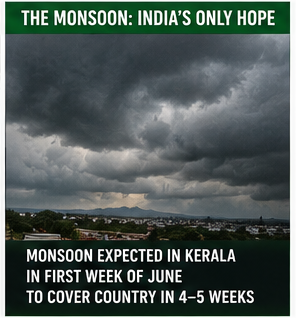
The monsoon is expected to arrive in Kerala in the first week of June and cover the rest of the country within four to five weeks. But as temperatures remain above normal with no immediate relief in sight, India’s summer of 2026 is revealing a deeper crisis — because extreme heat becomes far deadlier when even water begins to disappear.
For the fruit seller on the roadside who sprinkles water over his mangoes every hour to stop them from wilting. For the farmer whose wheat grains could not form properly because the heat arrived too early. For the elderly woman in a Delhi colony waiting for the water tanker that GPS says is on its way. For the construction worker who has no choice but to work under a sun that reached 47.6 degrees today — the monsoon cannot come fast enough.
India is burning. And the monsoon is still weeks away.
All information sourced from The Federal, Al Jazeera, AccuWeather, Business Today, The Globe and Mail, and Business Standard as of May 22–29, 2026.