


BREAKING | May 29, 2026 | Technology
The CEO of Google Just Admitted His Company Is Losing the AI Race. India — With 100 Million ChatGPT Users — Is Where That Race Will Be Won or Lost.
When the boss of one of the most powerful technology companies in history openly admits his firm is trailing competitors, the world takes notice. This week, that is exactly what Sundar Pichai did. And for India — which has quietly become the most contested AI market on the planet — the admission carries enormous consequences.
Google’s CEO Admits the Gap
Sundar Pichai’s admission that Google is trailing in AI compared to some competitors underscores rapid advances in artificial intelligence and the need for continuous innovation in big tech. Pichai specifically acknowledged that Google is behind rivals in agentic AI coding — the next frontier of AI development where models do not just answer questions but autonomously write code, debug software, and build entire applications without human intervention.
This is not a small admission. Agentic AI is where the next trillion dollars in value will be created. It is the technology that could replace entire software engineering teams, automate business workflows, and fundamentally transform how companies operate. For Google — which built its empire on search and advertising — falling behind in agentic AI is an existential warning signal.
India: The World’s Most Important AI Battleground
Here is what makes this story so important for India specifically.
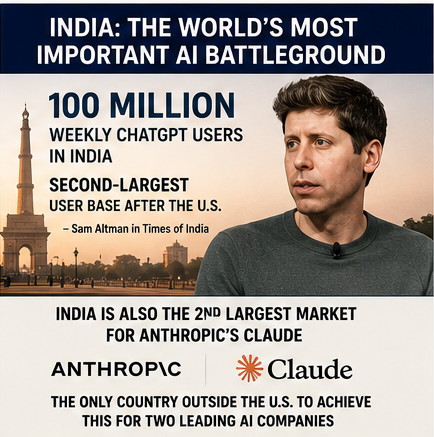
India has now become OpenAI’s second-largest user base after the United States, with 100 million weekly active ChatGPT users. Sam Altman personally wrote in the Times of India to announce this milestone. Simultaneously, Anthropic confirmed that India has become the second-largest market for its Claude platform — making India the only country outside the U.S. to be the second-largest market for two of the world’s leading AI companies simultaneously.
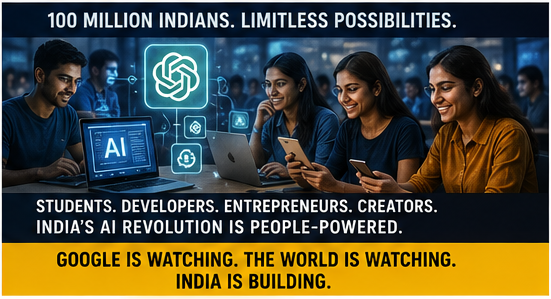
Let that sink in. One hundred million Indians use ChatGPT every week. The AI revolution is not coming to India. It is already here, already embedded in daily life, already reshaping how millions of people work, study, and create.
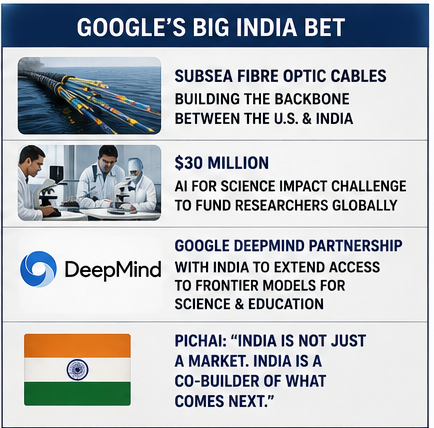
Google’s Big India Bet — Subsea Cables, $30 Million for Science, DeepMind Partnership
Google is not surrendering India without a fight.
Sundar Pichai said India is on track for an “extraordinary trajectory” in artificial intelligence and could emerge as a major player across development, adoption and governance of the technology. “I believe India is going to have an extraordinary trajectory with AI, and we want to be a part of it,” Pichai said. He added that India is not just a market to be served but a co-builder of what comes next. “India is going to be a full-stack player in AI,” he said.
To back those words, Google launched a $30 million AI for Science Impact Challenge to fund researchers globally using AI to drive scientific breakthroughs, and announced a new partnership between Google DeepMind and the Indian government to extend access to frontier models for science and education.
Google is also building a vast network of subsea fibre optic cables to strengthen physical digital infrastructure connections between the U.S. and India — the backbone that will carry the data flows of the AI economy.
The Deepfake Problem: Google’s SynthID Solution
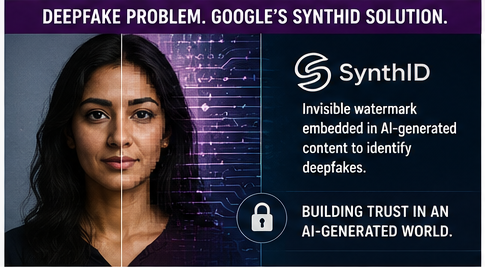
As AI-generated content floods the internet, trust has become AI’s biggest challenge. To fight deepfakes, AI content generated by Google’s platforms features an invisible SynthID embedded into the output, which makes it possible to identify the content as AI-generated. With India’s deepfake problem growing rapidly — from political misinformation to celebrity scams — SynthID’s deployment at scale in India could have significant social consequences.
India’s Sovereign AI Response: BharatGen
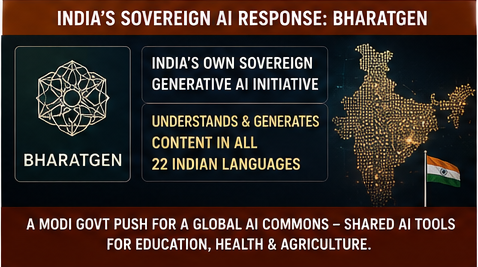
India is not content to simply be a consumer of American AI. The government’s response to the concentration of AI power in U.S. hands is BharatGen — India’s own sovereign generative AI initiative designed to understand and generate content in all 22 Indian languages. Underpinning it all is a Modi government push for a global AI commons — a shared repository of AI tools focused on education, health, and agriculture — a move that reflects a broader anxiety that frontier AI development remains too concentrated in the hands of a few American companies.
This is India’s declaration of AI independence. Not rejection of global AI — but a demand for a seat at the table where the rules are written.
The India AI Impact Summit: Where the World Came to India
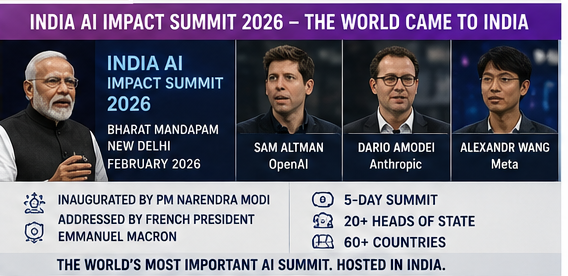
Earlier this year, the most important AI summit in history took place not in Silicon Valley or London or Beijing — but in New Delhi. The India AI Impact Summit 2026 was held at Bharat Mandapam, New Delhi in February — the fourth in a global series of AI summits and the first ever to be hosted by a Global South nation. The summit was inaugurated by Prime Minister Narendra Modi and also addressed by French President Emmanuel Macron.
The five-day summit featured OpenAI’s Sam Altman, Anthropic’s Dario Amodei, and Meta’s Alexandr Wang alongside political leaders. More than 20 heads of state and representatives from over 60 countries attended — making New Delhi the global capital of AI for that week.
The fact that the world’s most important AI summit came to India is not symbolic. It is a recognition that the 1.4 billion-person Indian market, combined with India’s engineering talent, digital infrastructure, and government ambition, makes this country the most consequential AI battleground of the next decade.
What It Means for India’s Economy
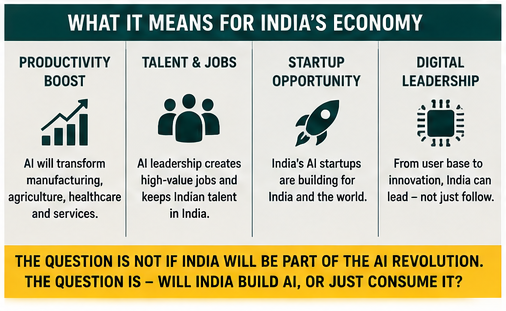
The AI race has direct economic stakes for India. A country that leads in AI adoption gains enormous productivity advantages — in manufacturing, agriculture, healthcare, and services. A country that falls behind risks having its most talented engineers and entrepreneurs migrate to wherever AI opportunity is greatest.
Pichai acknowledged the “profound economic shifts” ahead, noting that AI will undeniably reshape the workforce and emphasising the important role governments can and will play in regulating the technology.
India’s government, its startups, its universities, and its 100 million ChatGPT users are all — in their own ways — participants in the most consequential technological transition since the internet. The question is not whether India will be part of the AI revolution. It already is. The question is whether India will be a builder of AI or merely a consumer of tools built elsewhere.
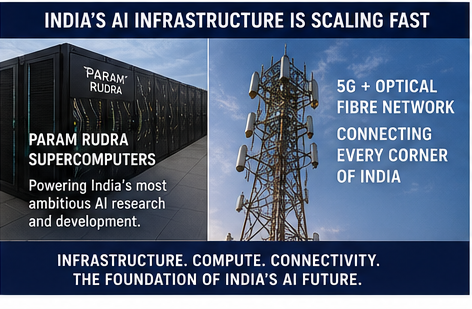
With BharatGen, with PARAM Rudra supercomputers, with the world’s AI leaders coming to New Delhi for summits, and with a generation of young Indians who have grown up with smartphones and are now growing up with AI — the answer is beginning to take shape.
And Google, for one, is paying very close attention.
All information sourced from Business Today, Fortune, Mashable, Wikipedia, and Storyboard18 as of February–May 2026.
