

BREAKING | July 5, 2026 | Technology & Business
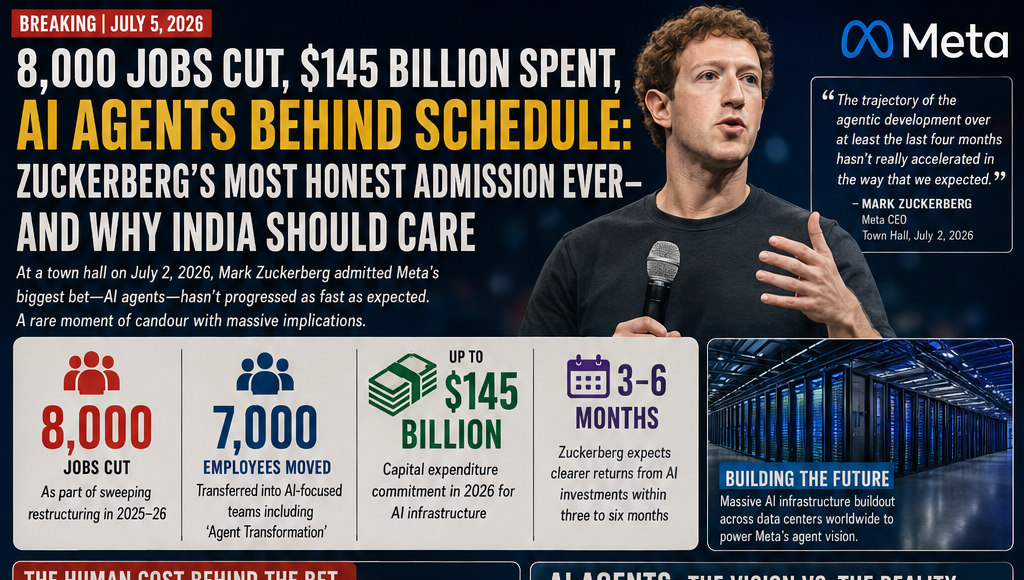
He cut 8,000 jobs to fund it. He transferred 7,000 more employees into teams dedicated to building it. He committed up to $145 billion in capital expenditure — more money than the annual GDP of most countries — to build the infrastructure to run it. And then, at an internal town hall on July 2, 2026, Mark Zuckerberg sat in front of his remaining employees and said the thing that no CEO wants to say about the biggest bet of his company’s history: it hasn’t worked as fast as we expected.
Meta Chief Executive Mark Zuckerberg acknowledged shortcomings in the company’s sweeping restructuring at an internal town hall on Thursday, saying the systems known as AI agents had not progressed as quickly as he had expected. He added that a company reorganisation that included major job cuts was not as “clean” as it could have been and that executives had miscalculated on the timing of the changes.
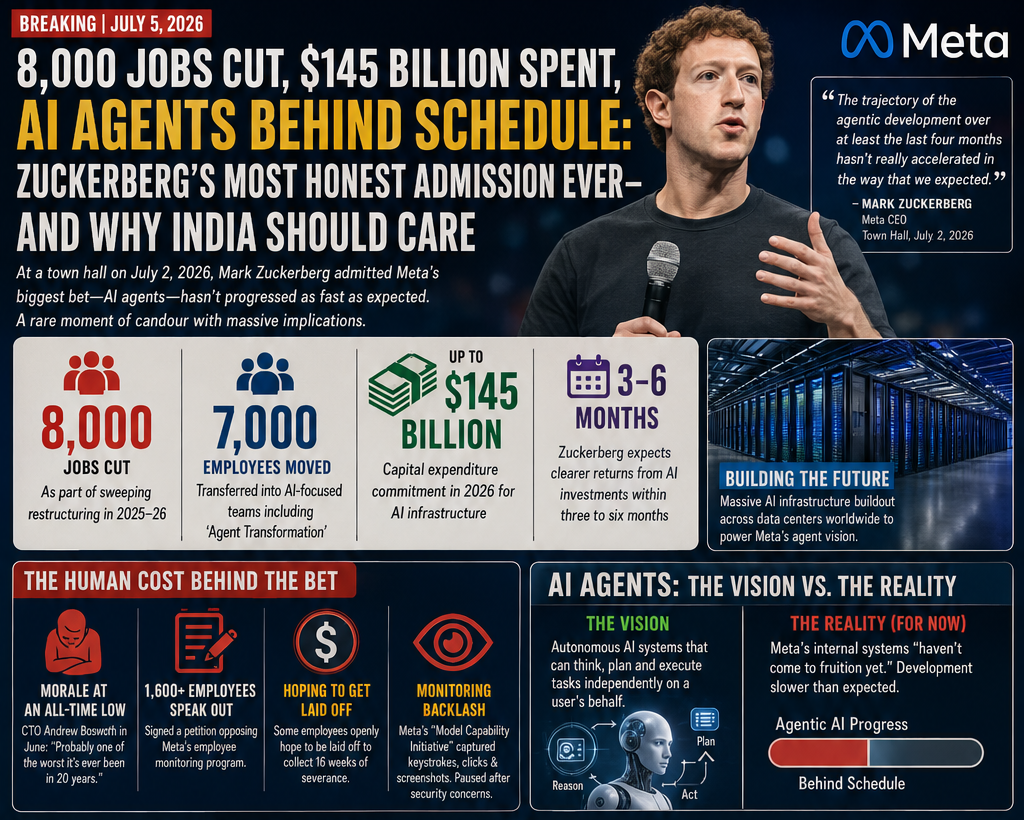
In retrospect, he said, “the trajectory of the agentic development over at least the last four months hasn’t really accelerated in the way that we expected,” and that the company’s bets on the new structure “haven’t come to fruition yet.”
The comments come after roughly 8,000 layoffs and 7,000 employees reassigned to AI groups, including one called Agent Transformation. He said clearer returns from Meta’s up to $145 billion 2026 AI infrastructure spend should show within three to six months.
The admission is extraordinary for multiple reasons. First, because Zuckerberg has been the loudest voice in Silicon Valley arguing that autonomous AI agents — systems that can think, plan, and execute tasks independently on a user’s behalf — are the next great computing platform. He has staked Meta’s entire future on that thesis. When the person authorising that much capital tells his own workforce that the timeline slipped, it becomes a datapoint about the broader agent thesis, not just about Meta’s org chart.
Second, because the human cost of this thesis-in-progress has been enormous. Some employees are openly hoping to be laid off to collect 16 weeks of severance. CTO Andrew Bosworth described internal morale in June as “probably one of the worst it’s ever been in 20 years,” and more than 1,600 employees signed a petition opposing the company’s employee monitoring program.
The monitoring program itself became its own crisis. Meta deployed software called the Model Capability Initiative to US employees’ work laptops in April 2026, capturing keystrokes, mouse movements, click locations, and screenshots to generate AI training data, without offering an opt-out. After a security review found that sensitive data had been broadly accessible inside Meta’s internal systems, the program was paused.
The broader picture across the AI industry validates Zuckerberg’s candour rather than singling Meta out. Only 11 percent of enterprises that have adopted agentic AI tools are running them in production, according to research aggregating Gartner, McKinsey, and Digital Applied data, and analysts project that more than 40 percent of all agentic AI projects will be cancelled by the end of 2027.
For India, this story matters in a specific way. India is actively building BharatGen — its own sovereign AI system in 22 languages — and positioning itself as a global AI player through the India AI Summit, PARAM Rudra supercomputers, and a ₹1 lakh crore research commitment. India’s AI ambitions are real. But the Meta story is a cautionary tale about the gap between AI capability in controlled demonstrations and AI capability running reliably in production environments under real-world load. That gap does not disappear because a government announces a programme or a company announces a budget. It closes through engineering, iteration, and time.
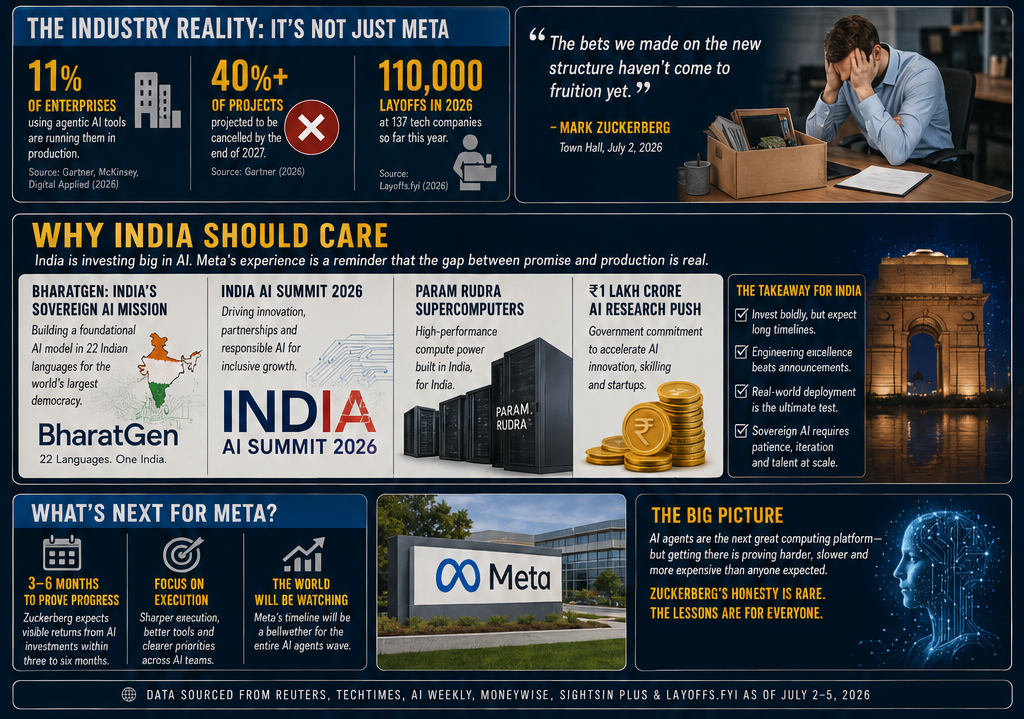
So far in 2026, there have been almost 110,000 layoffs at 137 tech companies, according to Layoffs.fyi. The AI era is creating enormous value at the top of the technology food chain — but it is simultaneously destroying jobs at scale across the companies that cannot keep pace with the transformation. India, with its 5 million-strong IT workforce, is watching that dynamic very carefully.
Zuckerberg expects results in three to six months. The whole world will be checking his math.
All data sourced from Reuters, TechTimes, AI Weekly, Moneywise, and SightsIn Plus as of July 2–5, 2026.