
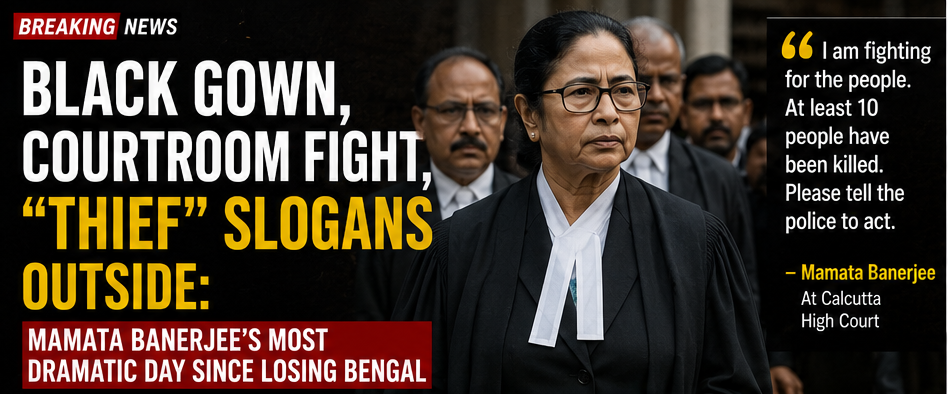

BREAKING | June 22, 2026 | Politics
She Lost the State She Ran for 15 Years. But Mamata Banerjee Is Not Done Fighting. Last Week, She Put on a Lawyer’s Gown and Walked Into the Calcutta High Court — and Bengal Politics Erupted.
There are politicians who lose power and retreat. And there are politicians who lose power, pick up their LLB degree, put on a black advocate’s gown, and walk into the highest court in their state to personally argue a case for their party workers. Mamata Banerjee — 71 years old, former Chief Minister of West Bengal for 15 uninterrupted years, just defeated by the BJP in the 2026 Assembly elections — is very clearly the second kind. Her appearance at the Calcutta High Court last Thursday is one of the most dramatic political moments in Bengal’s recent history. And the events that unfolded outside the courtroom — the “thief” slogans, the chaotic exit, the security scrum — tell the story of just how raw and volatile Bengal’s post-election moment truly is.
What Happened at the Calcutta High Court
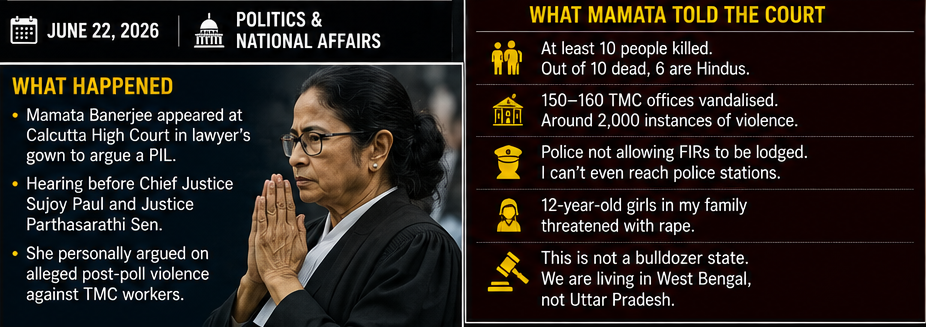
Former Chief Minister of Bengal and Trinamool Congress supremo Mamata Banerjee on Thursday appeared at the Calcutta High Court wearing a lawyer’s gown to appear before the Chief Justice HC Sujoy Pal in connection with a public interest litigation related to alleged post-poll violence in the state following the 2026 State Assembly polls’ results. Mamata Banerjee arrived at the court in traditional legal attire, creating a significant moment in post-election politics after the 2026 state Assembly elections. Videos of her appearing in the attire have gone viral on social media.
The TMC supremo arrived at the Calcutta High Court dressed in a lawyer’s black gown, appearing before a Division Bench led by Chief Justice Sujoy Paul and Justice Parthasarathi Sen to personally argue a Public Interest Litigation regarding alleged widespread violence against her party workers following the 2026 West Bengal Assembly elections. The sight of the TMC supremo in formal legal attire created a stir within the court premises.
Mamata Banerjee holds an LLB degree. She is a qualified lawyer. But seeing a former Chief Minister — a woman who ran one of India’s largest states for fifteen years, who survived assassination attempts and political crises that would have broken most politicians — walking into court in advocate’s robes to personally argue a case is rare, striking, and deeply symbolic. It says: I will fight for these people with everything I have, including a qualification I earned decades ago that I have rarely used publicly until now.
What She Told the Court
The TMC chief submitted that at least 10 people have been killed, some 150-160 TMC party offices vandalised and around 2,000 instances of violence have taken place in the state in the aftermath of the election results. Out of 10 dead, six are Hindus. Please tell the police to act accordingly. They are not allowing FIRs to be lodged. In my family, 12-year-old girls are being threatened with rape.
Mamata Banerjee alleged that the situation has come to such a pass that even she isn’t able to reach police stations to file complaints, and depended on the online mode. Banerjee also asserted that it is not a bulldozer state, amid ongoing demolition drives against illegal structures, adding we are living in West Bengal, not Uttar Pradesh.
The claims are serious. Ten dead. Two thousand instances of violence. Party offices set on fire. Women and children threatened. FIRs refused by police. If accurate, these represent a post-election humanitarian crisis that demands urgent judicial intervention. The TMC is asking the court to step in precisely because it no longer controls the machinery of state — the police, the administration — that it once used to manage exactly these situations.
The BJP’s Counter: “TMC Infighting, Not BJP Violence”
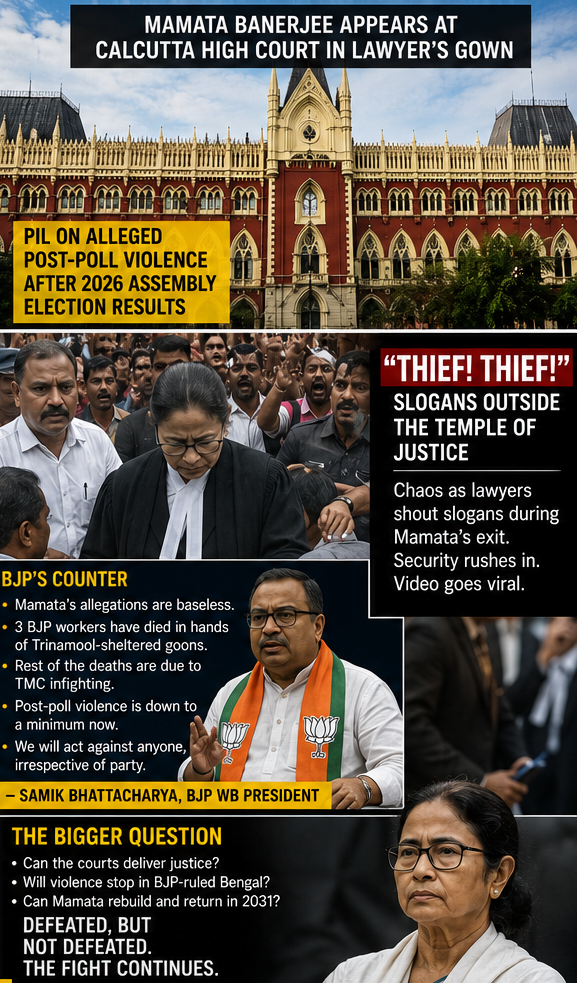
BJP West Bengal unit president Samik Bhattacharya called Mamata Banerjee’s allegations baseless, claiming that while three BJP workers have died in the hands of Trinamool-sheltered goons since the poll results were declared, the rest of the deaths were results of TMC infighting. Fact is that post-poll violence is down to a minimum in Bengal because a BJP government is now in power. We have pledged to free the state from its culture of political violence, and we are taking strict action against those, irrespective of their party colours or positions. Prime Minister Modi and Home Minister Shah are both keeping strict vigil on the state’s post-poll scenario.
The BJP’s narrative is the mirror image of the TMC’s. What Mamata calls BJP-sponsored violence against her workers, the BJP calls TMC infighting and internal score-settling playing out after the party’s devastating defeat. Both versions cannot be entirely true — but in Bengal’s deeply polarised political environment, establishing objective truth about who started what, where, and on whose orders is an extraordinarily difficult task for any court.
The Moment That Went Viral: “Thief” Slogans at the Temple of Justice
The legal drama was not limited to the courtroom. As Banerjee was exiting the High Court building following the hearing, she was met with thief slogans from a section of lawyers present on the premises. The situation briefly turned chaotic as TMC legal cell members and security personnel struggled to escort her to her vehicle. Kalyan Banerjee later addressed the media, condemning the heckling. The court is a place for legal arguments, not for public branding or political slogans. If a former Chief Minister can face such conduct inside the temple of justice, one can only imagine the plight of ordinary workers in remote villages.
“Thief” slogans. Inside the Calcutta High Court premises. Directed at a former Chief Minister who had just appeared in lawyer’s robes to argue a case. The video of that moment — Mamata in her black gown, being jostled toward her vehicle by security personnel as lawyers in the background chanted slogans against her — is the image that captured everything about where Bengal politics stands in June 2026. Bitter. Raw. Unresolved. And conducted entirely in public, without even the pretence of restraint.
What the Post-Poll Violence Crisis Tells Us About Bengal
West Bengal has a long and painful history of post-election political violence. After the 2021 elections — which the TMC won — violence against BJP workers was widely documented and led to multiple Supreme Court interventions. Now, the wheel has turned. The BJP has won. And the TMC is in the position that the BJP occupied five years ago — alleging that its workers are being attacked, displaced, and denied police protection while the new ruling party controls the state machinery.
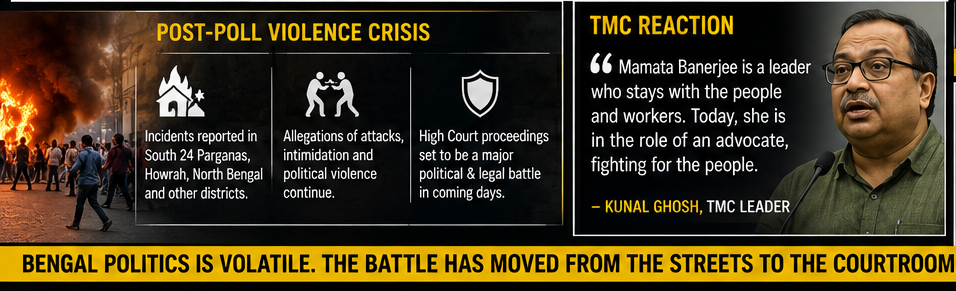
The 2026 West Bengal Assembly elections have triggered intense political conflict in the state. The BJP’s victory ended the long political dominance of the TMC government led by Mamata Banerjee, leading to heightened tensions between workers of rival parties. Allegations of political violence, intimidation and attacks have continued surfacing from several districts since the results were announced. The High Court proceedings are now expected to become a major political and legal battle in the coming days.
The petition highlights specific incidents in South 24 Parganas, Howrah, and parts of North Bengal — precisely the districts where TMC’s voter base is deepest and where the BJP’s victory margin was either narrow or built on a fragile coalition of switched voters. These are the places where scores are settled the quickest after a change of power, and where ordinary party workers on both sides pay the highest price for political transitions that are conducted at the top by leaders who are perfectly safe.
The Bigger Question: What Is Mamata’s Next Move?
TMC leader Kunal Ghosh said: Mamata Banerjee is a leader who stays with the people and workers. Today, she is in the role of an advocate, fighting for the people.
The courtroom appearance is not just about this particular PIL. It is about Mamata Banerjee sending a message to her party, her workers, and the BJP that she is not finished. She did not travel abroad. She did not retreat to her residence in South Kolkata and issue statements through spokespeople. She put on a black gown, walked into the most important court in the state, and stood up in front of the Chief Justice to argue personally for people she says are being persecuted.
Whether the courts provide the relief TMC is seeking, whether the violence allegations are proven or contested, whether the BJP’s new Bengal government manages the post-election transition without a repeat of 2021 — all of these questions will be answered over the coming weeks. What is already answered is this: Mamata Banerjee, in defeat, remains one of the most combative, creative, and unpredictable political leaders in India.
Bengal’s new chapter has barely begun. And its most dramatic character is already in the middle of the next act.
All information sourced from Daily Pioneer, India.com, Dainik Jagran English, OneIndia, and Republic World as of May 14 — June 2026.