
BREAKING | June 22, 2026 | Business & Startups
A French Beauty Giant Just Bought One of India’s Most Loved Hair Care Brands. India Now Has 127 Unicorns. And ₹8,400 Crore Has Already Been Invested in Indian Startups This Year. The Revolution Is Not Coming. It Is Here.
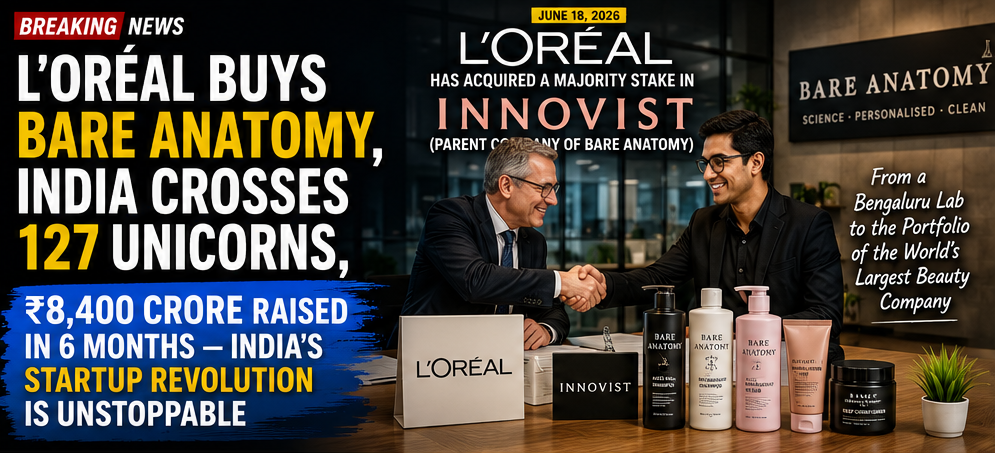
On June 18, 2026, L’Oréal — the world’s largest beauty company, with brands spanning Lancôme, Maybelline, Garnier, and Kérastase — quietly announced the acquisition of a majority stake in Innovist, the parent company of Bare Anatomy. The deal would barely make the front page in Paris. In India, it should be read as something far more significant: the moment a French multinational with 117 years of history looked at the Indian beauty startup ecosystem and said — we cannot beat this from the outside. We need to own a piece of it from the inside.
The Bare Anatomy Story: From a Bengaluru Lab to a Global Beauty Giant’s Portfolio
Bare Anatomy was not built to be acquired. It was built because its founders were frustrated with the gap between what Indian consumers needed and what global beauty brands were offering them. India’s hair is different. Its climate is different. Its water is different. Its dietary patterns affect hair health differently. And yet, for decades, Indian consumers were sold solutions designed for European or American hair, marketed with Indian celebrities, but fundamentally built for a different consumer.
Bare Anatomy flipped that model. Science-first formulations. Personalised hair care. Clean ingredients. Dermatologist-developed products. A direct-to-consumer digital-first strategy that bypassed the expensive retail distribution system. And a brand voice that spoke to India’s educated, urban, ingredient-conscious consumer — the same consumer who reads the back of the shampoo bottle, who has a 12-step skincare routine, and who will not use a product just because a film star endorsed it.
L’Oréal acquired a majority stake in Bare Anatomy parent Innovist, in one of the most significant beauty sector acquisitions in Indian startup history. The acquisition validates everything the Indian D2C beauty sector has been building for the last five years — and it sends a clear signal to every global beauty giant still watching from the sidelines: India’s homegrown brands have achieved the quality, scale, and consumer loyalty that make them worth owning.
India’s Startup Ecosystem in June 2026: The Numbers That Tell the Story
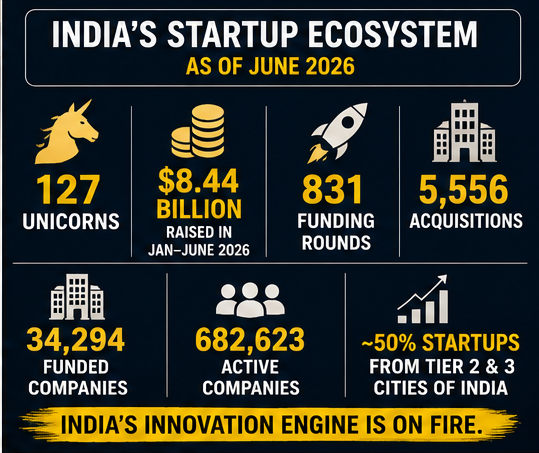
In the year 2026, till June 2026, $8.44 billion has been raised in 831 equity funding rounds across India. As of June 2026, India has produced 127 unicorns. India has seen a total of 5,556 acquisitions. A total of 34,294 companies in India have secured funding. As of June 2026, there are 682,623 companies in India.
One hundred and twenty-seven unicorns. $8.44 billion invested in just six months. 682,000 companies operating. These are not the statistics of an emerging startup ecosystem. They are the statistics of a mature, globally significant innovation economy — one that is producing companies capable of attracting L’Oréal, capable of going public at valuations of tens of thousands of crores, and capable of competing with global incumbents in their own product categories.
With 207,000 recognised startups, 112 unicorns under the Startup India programme, $350 billion or more in value, and nearly half of startups coming from Tier 2 and Tier 3 cities, India now offers scale with wider access. India’s startup growth is built on structure, not just funding. Policy support, digital public rails, seed programs, and founder networks give repeatable ways to start and grow.
The Tier 2 and Tier 3 city number is the one that deserves the most attention. Half of India’s recognised startups are now coming from outside the traditional hubs of Mumbai, Bengaluru, and Delhi. Founders in Jaipur, Coimbatore, Patna, Bhubaneswar, and Indore are building companies that are attracting funding, winning customers, and solving problems that the metros either cannot see or do not prioritise. That geographical spread is what separates a startup ecosystem that matters from one that merely exists.
Rusk Media and Nazara: India’s Gaming and Creator Economy Consolidates
Rusk Media raised Rs 100 crore in a pre-Series C round led by Nazara Technologies.
Nazara Technologies — India’s most established listed gaming company — is continuing to build its creator and short-form content empire through strategic investments in platforms that understand India’s vernacular internet consumer. Rusk Media, which operates in the short-video and creator monetisation space, joins a growing portfolio that reflects where India’s entertainment economy is heading: away from passive consumption and toward creator-driven, interactive, community-centred experiences that generate revenue through multiple channels simultaneously.
SAP Startup Studio: Global Enterprise Comes to India’s Deeptech Founders
SAP Labs India launched the SAP Startup Studio Cohort 2026, marking 10 years of its open-innovation accelerator programme. The six-month initiative supports startups in enterprise AI, agentic systems, robotics, cloud infrastructure, industrial intelligence, and quantum-safe security. The programme provides access to SAP leaders, enterprise customers, and global commercialisation opportunities. Selected startups include ANSCER Robotics, Drishya AI, QNu Labs, Pulse Energy, and Perceptory AI Labs.
Quantum-safe security. Agentic AI systems. Industrial intelligence robotics. These are not consumer apps or e-commerce platforms — they are the deep technology building blocks of India’s next industrial revolution. The fact that SAP, a €36 billion global enterprise software giant, has run this programme for ten consecutive years from India is itself a statement about where India’s engineering talent sits in the global deeptech hierarchy.

The Funding Slowdown: Reading the Numbers Honestly
2026 has seen a 14.72 percent drop in funding in companies of India as compared to 2025. In the year 2026 till June 2026, 157 acquisitions happened in India. Last year in 2025, a total of 412 acquisitions happened in India.
Intellectual honesty requires acknowledging that 2026 is not a peak funding year for India. Global venture capital has tightened. Interest rates, geopolitical uncertainty from the West Asia crisis, and a general correction from the excess of 2021-2022 have all contributed to a more cautious investment environment. The 14.72 percent drop in funding and the sharp decline in acquisitions both reflect this global tightening.
But $8.44 billion in six months is not a crisis number. It is a healthy, sustainable, quality-over-quantity investment environment — one where capital goes to companies with real revenue, real unit economics, and real paths to profitability, rather than to anyone with a pitch deck and a growth hack. The correction was necessary. The ecosystem is stronger for it.
What the L’Oréal-Bare Anatomy Deal Means for Every Indian Startup Founder
The Bare Anatomy acquisition carries a message that extends far beyond the beauty sector. It says: if you build something genuinely good, genuinely differentiated, and genuinely loved by Indian consumers — the world will come to you. You do not need to dream of going global to be validated globally. Sometimes, global comes to your door.
India’s startup ecosystem has produced Flipkart, Paytm, Ola, Zomato, Zepto, CRED, Razorpay, Freshworks, and now 127 unicorns spanning every sector from fintech to agritech to deeptech. L’Oréal’s acquisition of Innovist is a reminder that the next chapter of that story is not just about unicorn valuations and stock market listings — it is about Indian brands becoming global brands, absorbed into the portfolios of the world’s largest companies because they have earned that right through exceptional product development and genuine consumer love.
The revolution, as the numbers make clear, is not coming. It is here. And it is being built in Bengaluru labs and Tier 3 city coworking spaces and Patna founder meetups, one product launch at a time.

All information sourced from Tracxn, Entrackr, Mean CEO, and Dailyhunt startup roundups as of June 18–22, 2026.