


BREAKING | June 2026 | Society & Economy
India Is Still the World’s Youngest Major Nation. But That Era Is Beginning to End.
For decades, India’s greatest advantage was simple:
Youth.
A young workforce. Young consumers. Young voters. Young dreamers.
It powered economic growth, attracted global investment, and helped India emerge as one of the world’s fastest-growing major economies.
But beneath the headlines, a historic demographic shift is quietly unfolding.
India is aging.
Not dramatically. Not overnight.
But steadily enough that economists, businesses and policymakers are beginning to prepare for a future that would have seemed unimaginable just a generation ago.
For the first time in modern Indian history, the country is approaching a demographic turning point where population growth is slowing, birth rates are falling, and the number of elderly citizens is rising faster than ever before.
The India of 2050 may look very different from the India of 2000.
The End of the Population Explosion
For much of the twentieth century, India’s challenge was managing rapid population growth.
Every year brought millions of new births.
Schools expanded.
Cities spread outward.
Governments focused on creating jobs for a rapidly growing workforce.
Today, the picture is changing.
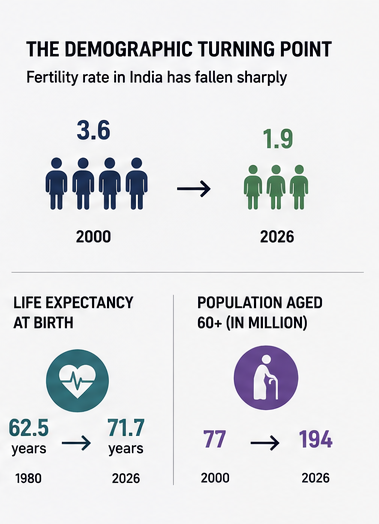
Fertility rates have fallen sharply across most states.
Families are becoming smaller.
Urban lifestyles, education, rising incomes and changing social expectations are reshaping demographic patterns.
The population is still growing.
But not at the pace that defined previous generations.
The Rise of the Silver Generation
The most significant change may be happening at the other end of the age spectrum.
Indians are living longer.
Healthcare has improved.
Life expectancy has increased dramatically compared with the decades after independence.
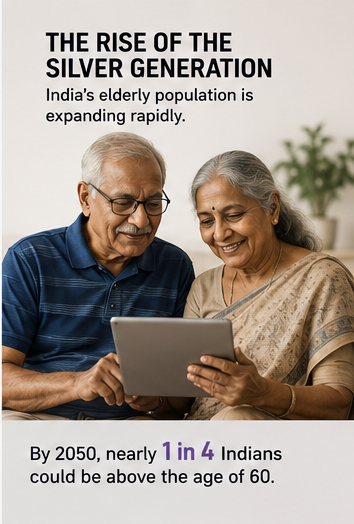
As a result, the number of senior citizens is expanding rapidly.
Within the next few decades, hundreds of millions of Indians will be above the age of 60.
That shift will create new demands for healthcare, pensions, elder care, housing and social support systems.
Why Economists Are Paying Attention
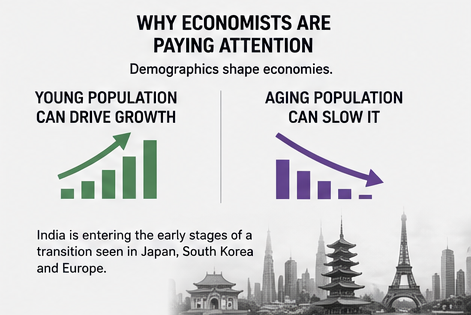
Demographics shape economies.
A large working-age population can drive growth.
An aging population can slow it.
Countries such as Japan, South Korea and several European nations have already experienced the economic consequences of demographic aging.
India is not there yet.
But experts say the country is entering the early stages of the same transition.
The question is no longer whether India will age.
The question is how prepared it will be when it does.
A Different India for Business
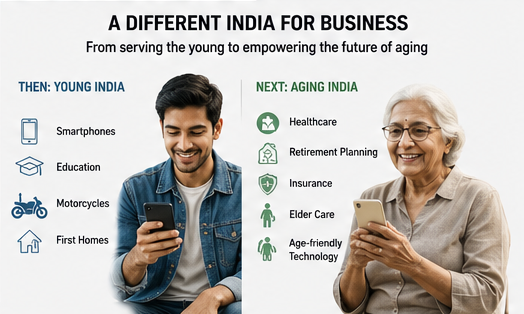
The demographic shift could transform consumer markets.
For decades, companies targeted young Indians buying smartphones, motorcycles, education services and first homes.
The next generation of growth may come from healthcare, retirement planning, insurance, assisted living and age-friendly technology.
Businesses are beginning to recognize that India’s future consumers may not be younger.
They may be older.
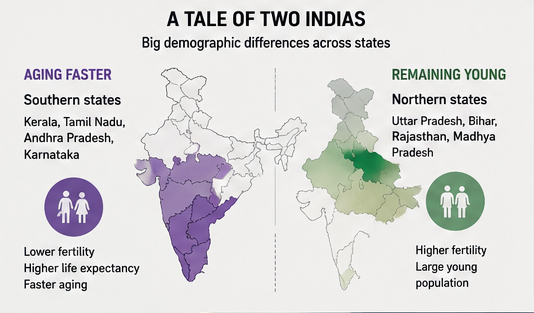
A Tale of Two Indias
The transition will not happen uniformly.
Some states are aging rapidly.
Others remain remarkably young.
Southern states are already experiencing demographic patterns closer to developed economies.
Many northern states continue to have relatively young populations.
The result could be a new political and economic geography shaped by age rather than income.
The Biggest Challenge Nobody Talks About
Infrastructure can be built.
Roads can be expanded.
Technology can be imported.
Demographics are different.
They unfold slowly and are difficult to reverse.
The decisions India makes today about healthcare, pensions, urban planning and workforce participation may determine whether the country’s aging transition becomes a challenge or an opportunity.
India’s Next Great Transformation
For decades, India’s story was defined by population growth.
The next chapter may be defined by population maturity.
The country that once worried about too many young people is beginning to prepare for a future with many more older citizens.
It is a transformation that will unfold quietly over decades.
Yet its consequences could be as significant as any election, economic reform or technological revolution.
The Numbers Board
- India remains the world’s most populous country.
- Fertility rates have fallen significantly over the past two decades.
- Life expectancy has risen sharply since independence.
- The senior citizen population is growing faster than ever.
- Key sectors affected: healthcare, pensions, insurance, housing and employment.
- Key question: Can India grow rich before it grows old?

The demographic clock is ticking. And for the first time, India’s future may be shaped not by how many people it has — but by how old they are.
