
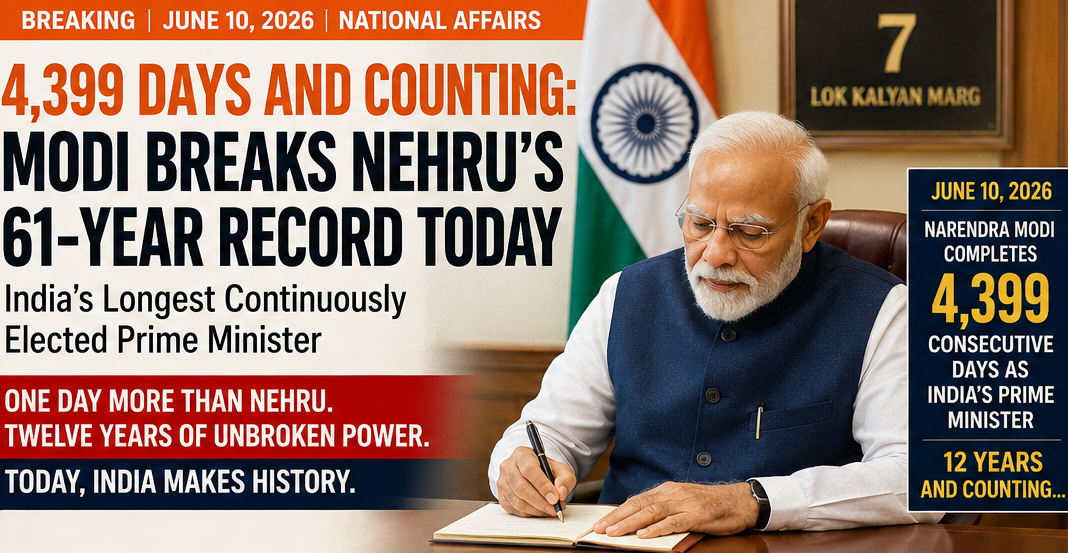

BREAKING | June 10, 2026 | National Affairs
One Day More Than Nehru. Twelve Years of Unbroken Power. Today, India Makes History.
On the morning of June 10, 2026, Narendra Modi walked into his office at 7 Lok Kalyan Marg and quietly made history. By the time the sun set today, he will have completed 4,399 consecutive days as India’s Prime Minister — one day more than Jawaharlal Nehru, the man who built this nation from scratch after independence. It is a milestone that no sitting Indian Prime Minister has reached in 61 years. And it arrives on a Wednesday morning — not with fanfare from Modi himself, but with a nation pausing to take stock of twelve uninterrupted years of one man’s leadership.
The Record That Stood for 61 Years
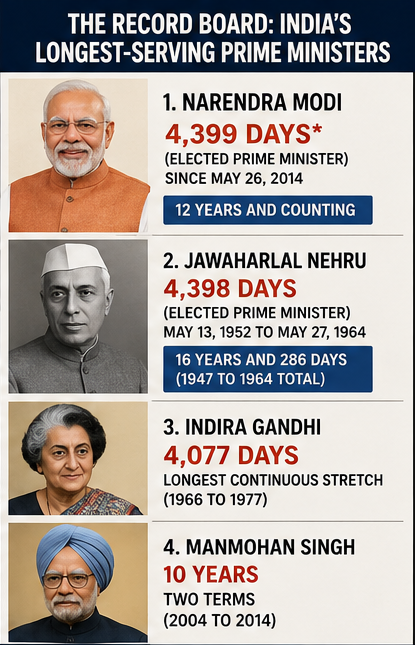
According to historical records, Jawaharlal Nehru took office as India’s first Prime Minister on May 13, 1952, following the country’s first general election. Nehru remained in office until his death on May 27, 1964, serving continuously for 4,398 days. On June 10, 2026, Narendra Modi’s uninterrupted tenure will reach 4,399 days, exceeding Nehru’s record by one day and establishing a new benchmark in India’s democratic history.
While Jawaharlal Nehru remains India’s longest-serving Prime Minister by overall tenure, having served approximately 16 years and 286 days between 1947 and 1964, Prime Minister Modi is set to establish a new record for the longest continuous tenure by an elected Prime Minister. The top three longest-serving Prime Ministers by total tenure remain Jawaharlal Nehru, Indira Gandhi and Narendra Modi, with the Prime Minister now entering a new chapter in India’s political history through his third consecutive term in office.
The distinction matters. Nehru’s pre-election years from 1947 to 1952 were as head of an interim government — before India held its first democratic election. Modi’s entire 4,399 days have been earned through the ballot box, three consecutive times. That is what makes today’s milestone uniquely his.
How India Got Here: Three Mandates, Twelve Years
Modi first assumed office on May 26, 2014, after the BJP’s historic 282-seat majority — the first time any party had won an outright majority in the Lok Sabha since Rajiv Gandhi’s 1984 landslide. He was re-elected in 2019 with an even larger mandate of 303 seats. And in 2024, leading a coalition NDA government, he began his third consecutive term — a hat-trick that no BJP leader had achieved before and that only Nehru had accomplished before him in independent India.
Modi’s milestone marks more than 12 years at the helm of the Union government, a period during which the Bharatiya Janata Party consolidated its position as the country’s dominant political force, expanded into new regions, and broadened its support base across communities.
The Celebration: NDA Conclave at Bharat Mandapam
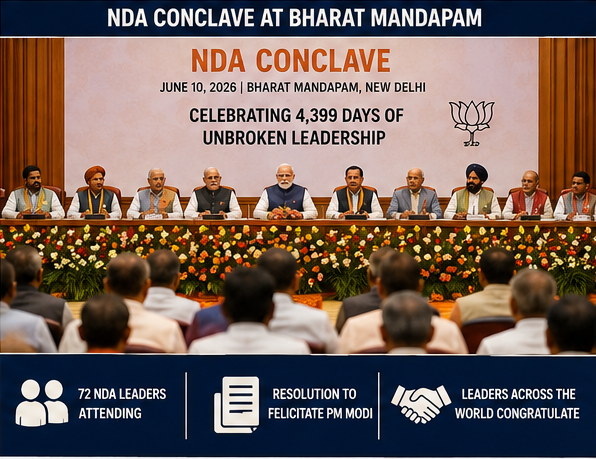
The milestone coincides with a key NDA conclave at Bharat Mandapam in New Delhi, where Prime Minister Modi is scheduled to chair a meeting of Chief Ministers, Deputy Ministers and NDA leaders to mark the occasion.
To mark the occasion, the NDA is expected to pass a resolution and felicitate Modi at a meeting attended by 72 NDA leaders. The BJP put up banners across the national capital. Congratulatory messages poured in from every corner of the political spectrum — and from world leaders.
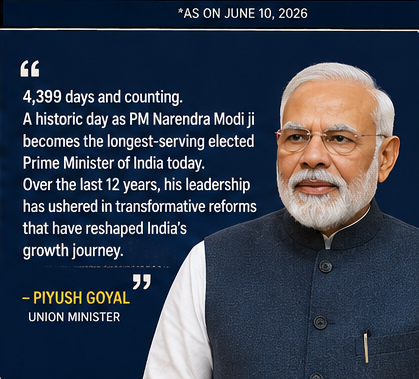
Union Minister Piyush Goyal wrote: “4,399 days and counting. A historic day as PM Narendra Modi ji becomes the longest-serving elected Prime Minister of India today. Over the last 12 years, his leadership has ushered in transformative reforms that have reshaped India’s growth journey.”
What Changed in 4,399 Days
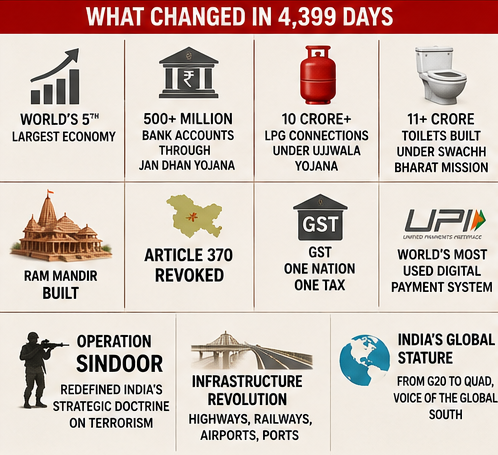
Twelve years is long enough to transform a country — and India’s transformation under Modi has been visible, dramatic, and deeply contested depending on who you ask. The economy grew to become the world’s fifth largest and is closing in on the fourth. Hundreds of millions of Indians received bank accounts, cooking gas connections, and toilets under flagship schemes. The Ram Mandir was built. Article 370 was revoked. The Goods and Services Tax unified a fractured indirect tax system. UPI became the world’s most used digital payments platform, processing more transactions than Visa and Mastercard combined. Operation Sindoor last year redrew India’s strategic doctrine on cross-border terrorism.
Critics point to unemployment, rising inequality, democratic backsliding, and the concentration of media ownership. Supporters point to infrastructure, welfare schemes, and India’s rising stature on the global stage. The debate will continue long after this tenure ends. Today, however, belongs to the record.
Modi and Nehru: Two Leaders, Two Eras, One Number
Political analysts note that Nehru and Modi governed India during vastly different periods in the nation’s development. Nehru led a newly independent nation facing the challenges of institution-building, economic planning and national integration. Modi, meanwhile, has governed a far larger and more complex India characterized by rapid technological advancement, global economic competition, and deep social change.
To compare the two men is to compare incomparable eras. Nehru built the institutions — the IITs, the PSUs, the Parliament itself, the idea of a secular democratic republic. Modi has tried to reshape many of those institutions in his own vision of India. Whether history judges that reshaping as modernisation or revision is a question that scholars will debate for decades.
What is not debatable is this: on June 10, 2026, Narendra Modi surpassed the man who came first. In twelve unbroken years of democratic mandate, he has outlasted every Prime Minister who came after Nehru. And he is still counting.
The Record Board: India’s Longest-Serving Prime Ministers
Jawaharlal Nehru served 4,398 days as continuously elected PM (1952 to 1964) and 16 years and 286 days total (1947 to 1964). Narendra Modi has now completed 4,399 days as continuously elected PM since May 26, 2014 and has served 12 years and counting. Indira Gandhi served 4,077 days in her longest continuous stretch from 1966 to 1977. Manmohan Singh served 10 years total across 2004 to 2014 in two terms.
All information sourced from NewsX, Republic World, ANI, India TV News, and International News and Views as of June 10, 2026.