
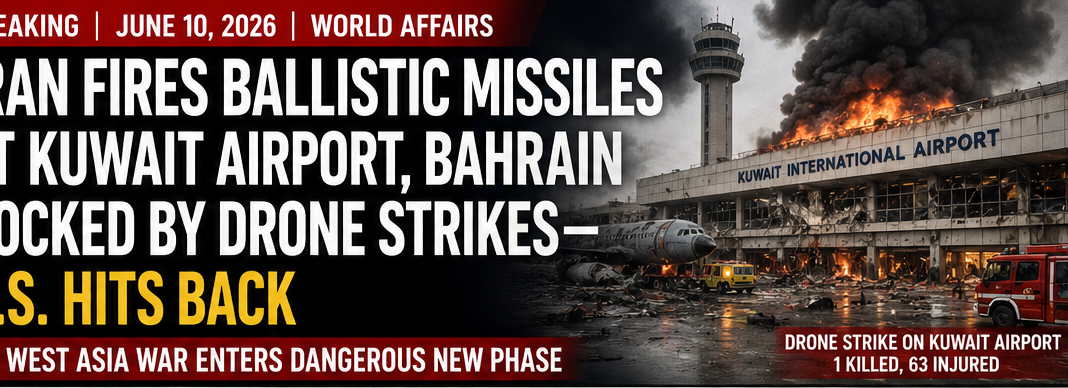

BREAKING | June 10, 2026 | World Affairs
Sirens Over Kuwait. Fire at the Airport. Explosions in Bahrain. The West Asia War Is Escalating Again — And India Is Watching Anxiously.
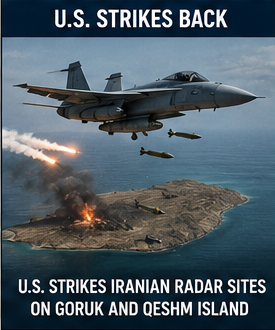
The sirens went off at Kuwait International Airport before dawn today. An Iranian drone struck a passenger terminal, killing one person and wounding 63. Within hours, the U.S. Central Command confirmed that Iran had launched seven ballistic missiles toward Kuwait and Bahrain — six were intercepted, one fell short. American forces hit back, striking Iranian coastal radar sites on Goruk and Qeshm Island in the Strait of Hormuz. And with every exchange of fire, the world’s most important waterway gets closer to a complete, catastrophic shutdown.
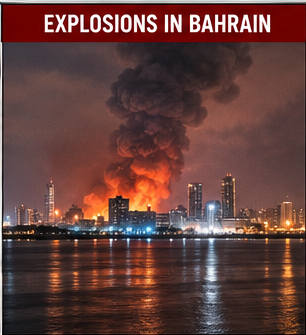
What Happened Today: The Full Picture
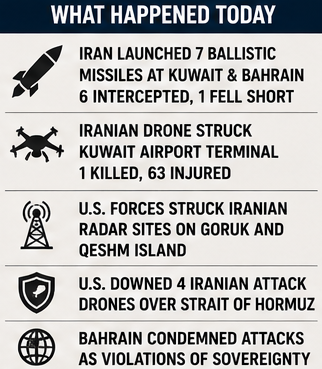
US forces said Iran launched seven ballistic missiles at Kuwait and Bahrain; six were intercepted and one fell short without harming US personnel. CENTCOM reported downing four Iranian attack drones over the Strait of Hormuz and striking coastal surveillance radar sites in Goruk and Qeshm. Kuwait’s army said explosions heard were air-defence interceptions, urging the public to follow safety and security instructions from relevant agencies. Bahrain condemned the attacks as violations of sovereignty, urged reopening the Strait of Hormuz, and warned that defending its territory is a red line.
An Iranian drone strike on a passenger terminal at Kuwait’s international airport killed one person and wounded 63 on Wednesday. Multiple explosions were heard in areas near Kuwait International Airport. Kuwait has strongly condemned a series of repeated Iranian attacks, describing them as a blatant act of aggression that ignores international appeals to stop and endangers the lives of citizens and residents as well as regional security and stability.
A passenger airport. A civilian terminal. One person dead. Sixty three wounded. This is what the West Asia war looks like in June 2026 — no longer confined to military installations, now reaching the gates where ordinary people arrive and depart.
How The War Began: From Hormuz to All-Out Conflict
US-Israeli airstrikes on Iran began following the killing of Iranian Supreme Leader Ayatollah Ali Khamenei. Explosions were reported in Tehran, as Israel stated it was expanding its operations into the heart of the Iranian capital. Iran launched a retaliatory attack with missiles and drones on Israel, US military installations across West Asia, and sites in Saudi Arabia and the UAE, including Dubai.
Iran and Iranian-backed militias have continued to strike US assets across Gulf countries, including the UAE, Kuwait and Bahrain. Britain, France and Germany have said they are ready to work with the US to counter Iran’s attacks, and a group of Gulf countries said it reserved the right to respond to Iranian strikes.
What began as a targeted U.S.-Israeli campaign to eliminate Iran’s nuclear program and bring down its Supreme Leader has evolved into something far more dangerous — a grinding, multi-front war of attrition that is being fought in the air above Kuwait, in the waters of the Strait of Hormuz, and in the energy markets of every country on the planet that imports oil.

The Strait of Hormuz: The Chokepoint That Threatens India
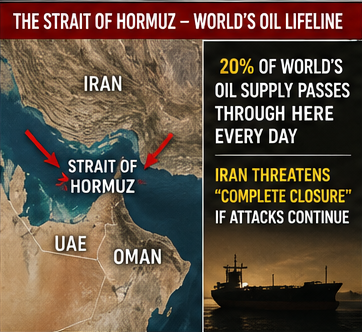
Iran has now issued its most direct warning yet. Iran warned the US that it faced “complete closure” of the strait if attacks continue. The attack on the Gulf is the second since June 3.
Complete closure. Of the Strait of Hormuz. The narrow waterway through which 20% of the world’s oil supply flows every single day. The passage through which India imports the majority of its crude oil from the Persian Gulf.
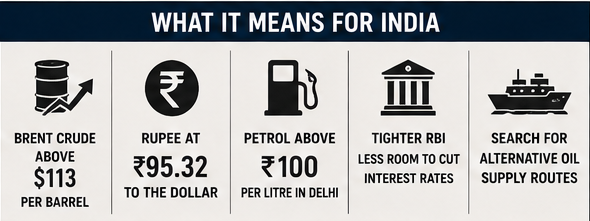
India is not at war. India has not taken sides. India has called for dialogue and diplomacy at every multilateral forum. But India cannot escape the consequences of what is happening in the waters between Iran and the Arabian Peninsula. Brent crude above $113 per barrel. The rupee at ₹95.32 to the dollar. Petrol above ₹100 per litre in Delhi. Every single one of these is a direct consequence of the war being fought today above Kuwait International Airport.
The Human Toll: Weeks of Carnage
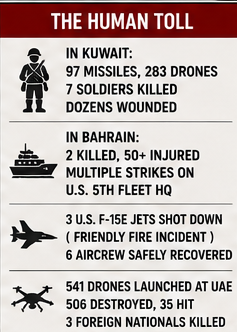
Since the conflict began on February 28, 2026, Iran has launched 97 ballistic missiles and 283 drones that have been shot down over Kuwait alone. Seven soldiers have been killed and dozens wounded. Three U.S. F-15E Strike Eagles were shot down in a friendly fire incident over Kuwait, with all six aircrew safely recovered. One MQ-9 Reaper drone was destroyed and two Eurofighter Typhoons damaged.
In Bahrain, where the US Navy’s 5th Fleet is headquartered at Naval Support Activity Bahrain, strikes have continued since February 28, primarily targeting American military installations and industrial, commercial, and residential infrastructure. As of the latest reports, two fatalities and more than 50 injuries have occurred in Bahrain since the start of the war.
Iran fired 165 ballistic missiles at the UAE, of which 152 were intercepted, while 13 fell into the sea. Tehran also launched 541 bomb-carrying drones at the UAE — 506 were destroyed and 35 struck the UAE, killing three people from Pakistan, Nepal and Bangladesh and injuring 58 others. Two people were hurt when debris from intercepted drones fell into the courtyards of two homes in Dubai.
The Diplomatic Track: Pakistan’s Surprising Role
Amid the carnage, the most unexpected diplomatic development of this crisis has emerged from Islamabad. Pakistan — India’s neighbour, and the country India struck with missiles less than fourteen months ago — has stepped forward as the most credible potential mediator between Washington and Tehran.
The Islamabad talks brokered by Pakistan’s Field Marshal Asim Munir produced the first direct U.S.-Iran diplomatic contact since 1979. President Trump publicly credited Pakistan multiple times. But today’s fresh strikes suggest those talks have not yet produced a durable ceasefire. The fragile progress of late May is fraying again.
The Saudi Arabia Factor: Oil Supply on a Knife’s Edge
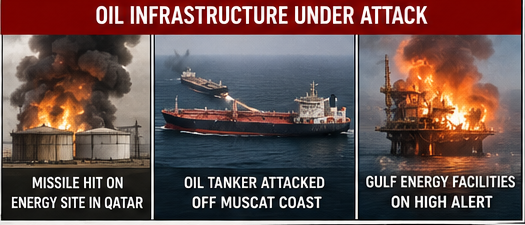
Qatar’s Ministry of Defence announced that two missile attacks struck energy-related sites in the country. Oman’s Maritime Security Centre reported that an oil tanker was attacked by an explosive-laden boat while sailing 52 nautical miles off the coast of Muscat Governorate, killing at least one crew member after the attack resulted in a fire and explosion in the engine room.
Energy infrastructure across the Gulf is now a target. Oil tankers are being struck. Offshore facilities are being hit. Every attack on Gulf energy infrastructure sends crude prices higher and tightens the screws on oil-importing nations like India.
What It Means for India: Five Consequences Right Now
Every day that this war continues and the Strait of Hormuz remains even partially closed, India pays a price that most Indians do not directly see but every Indian feels. Higher petrol prices at the pump. A weaker rupee that makes every import more expensive. Lower foreign investment inflows as global risk appetite shrinks. A tighter RBI with less room to cut interest rates and support the economy. And a government that is spending enormous diplomatic capital trying to secure alternative oil supply routes — the UAE bypass pipeline, long-term ADNOC deals, expanded Russian crude imports — to reduce India’s vulnerability to exactly the kind of crisis playing out today.
PM Modi called for Hormuz to remain free and open during his Abu Dhabi visit last month. The UAE announced plans for a bypass pipeline to Fujairah. The U.S. and Iran are, somewhere, still talking. But this morning, in the departure hall of Kuwait International Airport, one person died and sixty-three were wounded.
The war in West Asia is not pausing for diplomacy. And until it ends, India cannot fully breathe.

All information sourced from The National, Gulf News, Radio Free Europe, Newsonair, and Wikipedia as of June 6–10, 2026.