
SPECIAL REPORT | June 2026 | Society
They Are the Last Indians Who Remember a World Without Google
Somewhere in India today, a child is asking an AI assistant for help with homework.
A few kilometres away, a teenager is scrolling endlessly through short videos without thinking about it.
A shopkeeper is scanning a QR code for payment.
And an older relative is trying to adjust to video calls with family spread across cities and countries.
For most people, this feels normal now.
But there is a generation that remembers when none of it existed.
And that generation is now quietly turning 30.
A Generation Between Two Worlds
People born in the mid-1990s occupy a strange place in history.
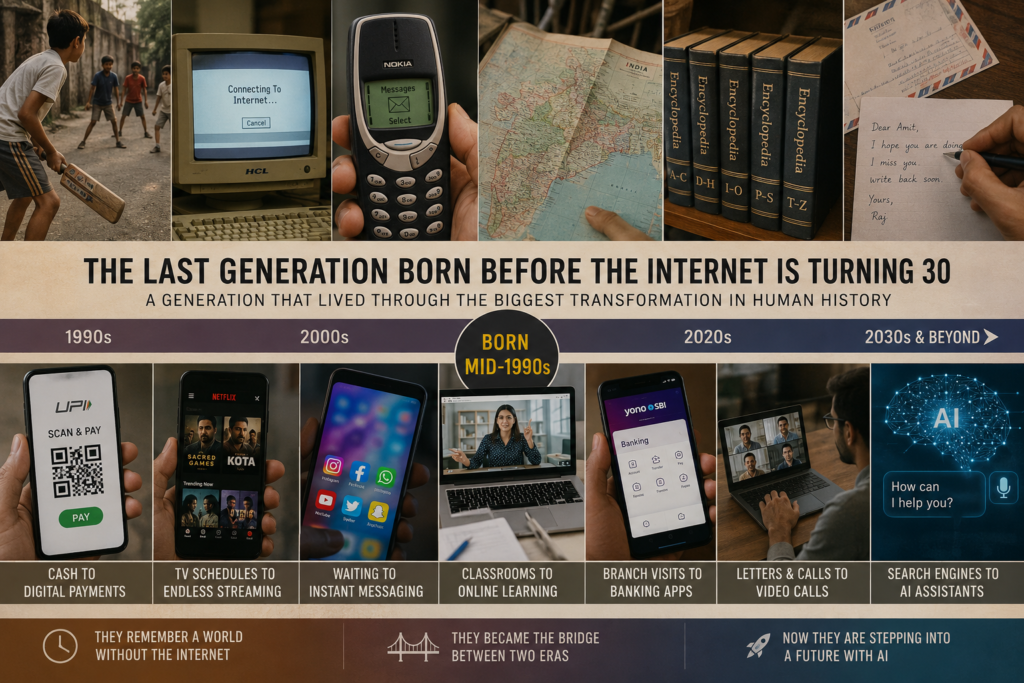
They are old enough to remember dial-up internet tones, cyber cafés, and phones with keypads.
But they are young enough to have grown into a world dominated by smartphones, apps, and constant connectivity.
They did not just witness change.
They lived through a technological rewrite of everyday life.
When Everyday Life Quietly Disappeared and Reappeared
In their childhood, maps were paper folders, not apps.
Money meant cash in hand, not digital transfers.
Entertainment meant television schedules, not endless streaming feeds.
Communication meant waiting, not instant messaging.
Within a single lifetime, all of it changed.
Not suddenly.
But permanently.
The Internet Didn’t Arrive as a Revolution — It Became Routine
Unlike past revolutions that arrived with disruption and noise, the digital shift slipped into daily life quietly.
Emails replaced letters.
Search engines replaced encyclopedias.
Social media replaced bulletin boards and group calls.
Smartphones replaced dozens of separate devices.
At some point, the internet stopped being “online life” and simply became life.
A Childhood That No Longer Exists
For the last pre-internet generation, childhood was slower.
Waiting was normal.
Information was limited.
Attention was not constantly pulled in multiple directions.
There was boredom, but also stillness.
That version of childhood is now difficult to recreate, even in memory.
The First True Digital Adults
This generation became adults at the exact moment India went fully digital.
Banking moved to apps.
Payments moved to QR codes.
Government services moved online.
Education began blending with digital platforms.
Work itself became portable.
They did not adapt to the digital world.
They grew into it.
Now A New Shift Has Begun
Just as this generation adjusted to the internet, another transformation is beginning.
Artificial intelligence is moving into everyday tools.
Search is becoming conversational.
Phones are becoming assistants.
Work is becoming partially automated.
The next generation may not even remember a world without AI support.
What This Moment Really Means
This is not just about age or technology.
It is about how fast human life is changing.
For most of history, generations lived in relatively stable worlds.
Today, each decade feels like a new version of society.
The last generation born before the internet is turning 30.
And they are becoming the final bridge between two completely different eras of human life.
A Future No One Has Lived Yet
No one knows what comes next.
But one thing is certain.
The world they grew up in no longer exists.
And the world that is coming next will feel just as unfamiliar to today’s children as the internet once felt to their parents.
History is no longer something distant.
It is something happening in real time.
And every generation now carries a different version of reality.