


SPECIAL REPORT | June 2026 | Economy
Nine Years Ago at Midnight, Parliament Changed How India Did Business Forever.
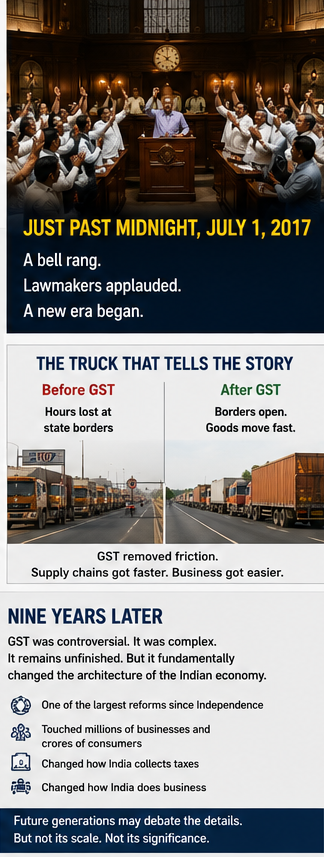
Just after midnight on July 1, 2017, the lights came on inside Parliament’s historic Central Hall.
A bell rang.
Lawmakers applauded.
And India launched what many economists called the biggest tax reform since Independence.
The Goods and Services Tax — GST.
Nine years later, the verdict remains debated.
But one fact is undeniable:
Few government policies have changed the day-to-day functioning of India’s economy more dramatically.
The Problem GST Was Designed to Solve
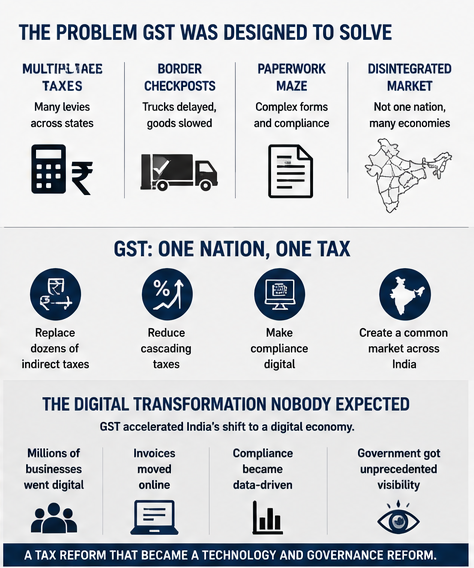
Before GST, India was not one market.
It was many.
Every state imposed its own taxes.
Trucks stopped at state borders.
Businesses dealt with a maze of forms and levies.
Goods often moved more slowly because of paperwork than because of distance.
Economists argued that India was effectively operating as a collection of smaller economies rather than one integrated national market.
GST promised to change that.
One Nation, One Tax
The vision sounded simple.
Replace dozens of indirect taxes with a unified system.
Reduce cascading taxes.
Make compliance digital.
Create a common market stretching from Kashmir to Kanyakumari.
The execution, however, would prove far more complicated.
Businesses struggled initially.
Technology systems faced pressure.
Tax rates became a constant political debate.
Yet the system survived.
Then expanded.
Then became routine.
The Digital Transformation Nobody Expected
GST did more than change taxation.
It accelerated digitisation.
Millions of businesses entered formal reporting systems.
Invoices moved online.
Compliance became data-driven.
Government agencies gained unprecedented visibility into economic activity.
What began as a tax reform became a technology reform.
And eventually, a governance reform.
Winners and Critics
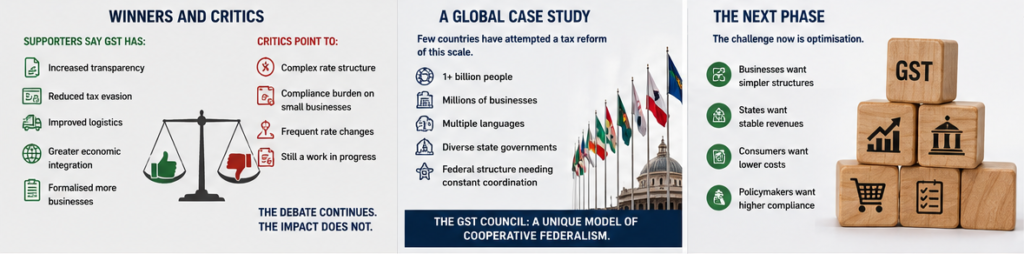
Supporters point to higher transparency, reduced tax evasion, improved logistics and greater economic integration.
They argue that GST helped formalise parts of the economy that had long operated outside the tax net.
Critics point to compliance burdens, complex rate structures and challenges faced by smaller businesses.
Many economists believe the system remains a work in progress rather than a finished project.
The debate continues.
The impact does not.
The Truck That Tells the Story
Perhaps the most visible symbol of GST’s success is not found in government statistics.
It is found on India’s highways.
Before GST, trucks frequently spent hours waiting at state checkpoints.
Today, much of that friction has disappeared.
Goods move faster.
Supply chains operate more efficiently.
Warehouses are located based on business logic rather than tax considerations.
A reform designed on paper changed how products physically move across the country.
A Global Case Study
Countries around the world have implemented value-added taxes.
Few attempted it on India’s scale.
More than a billion people.
Millions of businesses.
Multiple languages.
Diverse state governments.
A federal structure requiring constant coordination.
The GST Council became one of the most significant cooperative institutions in modern Indian governance.
The Next Phase
The next challenge is no longer implementation.
It is optimisation.
Businesses want simpler structures.
States want stable revenues.
Consumers want lower costs.
Policymakers want higher compliance.
The GST story is no longer about whether the reform succeeded.
It is about what comes next.
Nine Years Later
Major economic reforms are often understood only in hindsight.
GST belongs to that category.
It was controversial.
It was complex.
It remains unfinished.
But it fundamentally changed the architecture of the Indian economy.
Future generations may debate whether every aspect worked as intended.
What they are unlikely to debate is its scale.
Few reforms have touched so many businesses, consumers and governments at once.
The Numbers Board
- Launch Date: July 1, 2017
- Objective: One Nation, One Tax
- Scope: India’s largest indirect tax reform
- Impact Areas: Logistics, compliance, business operations and tax collection
- Governing Body: GST Council
- Historical Significance: One of the most consequential economic reforms since Independence

Nine years ago, India changed how it collected taxes. In the process, it changed how its economy works.
