

BREAKING | June 10, 2026 | Economy & Technology
A Decade Ago, It Was an Experiment. Today, It Moves Trillions Every Month.
Ten years ago, most Indians still carried cash for everyday purchases.
Today, a vegetable vendor in Patna, a tea seller in Mumbai, and a tourist guide in Varanasi can all receive money instantly through a smartphone scan.
What began in 2016 as the Unified Payments Interface (UPI) has become the backbone of India’s digital economy — and one of the most successful financial technology revolutions in modern history.
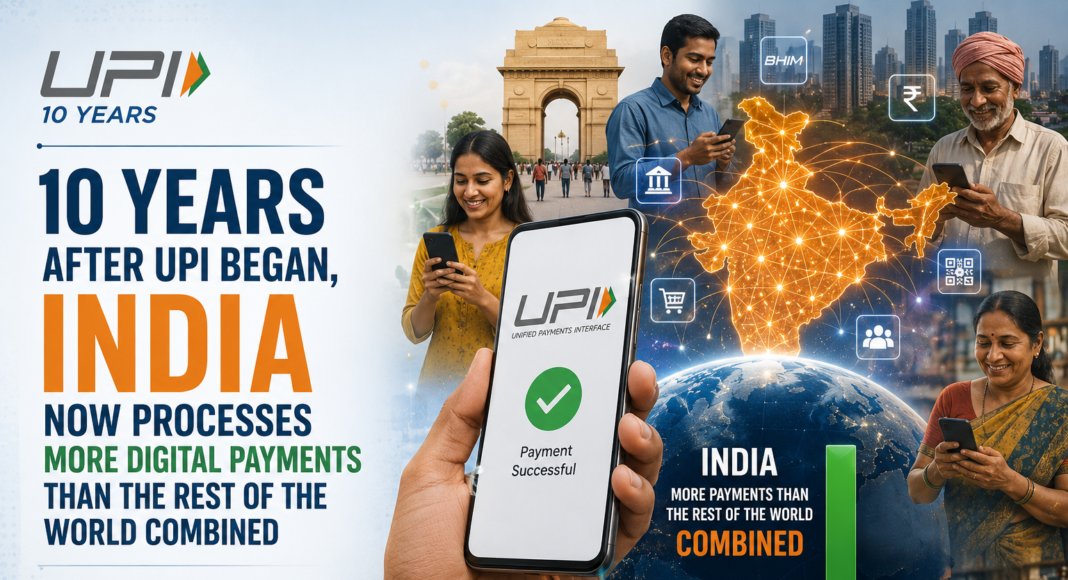
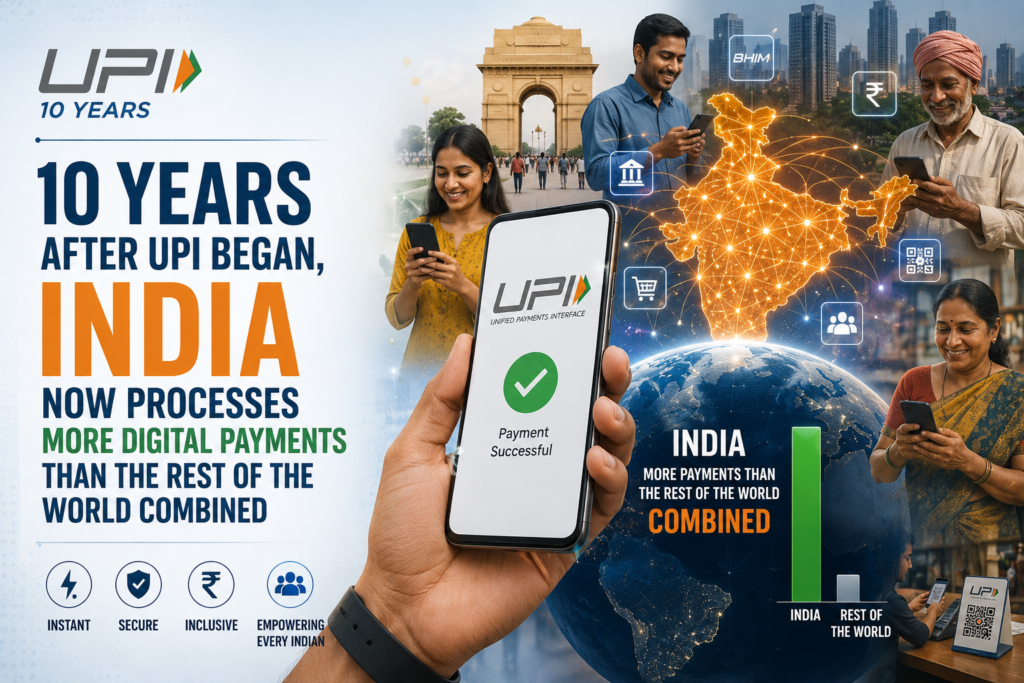
As UPI completes a decade of operation, India is processing more digital payment transactions than any other country on Earth, transforming how 1.4 billion people spend, save and conduct business.
The System That Changed Everyday Life
Before UPI, digital payments were often slow, expensive, or dependent on card networks.
Bank transfers required account details.
Card machines were costly.
Small merchants often operated entirely in cash.
UPI changed the equation.
A simple QR code allowed instant payments between bank accounts in seconds.
No wallet.
No card machine.
No waiting.
For consumers, it became easier than cash.
For businesses, it became cheaper than traditional payment systems.
The Numbers That Tell the Story
The scale of UPI’s growth is staggering.
From a few million monthly transactions in its early years, the platform now processes billions of payments every month.
The value of transactions runs into trillions of rupees.
India’s digital payments ecosystem has become a case study studied by governments, central banks and technology experts around the world.
Countries across Asia, Africa and Europe are exploring versions of India’s payment architecture.
What was once considered a developing-world challenge has become a global benchmark.
How QR Codes Conquered India
The revolution did not begin in corporate boardrooms.
It happened on street corners.
Small merchants rapidly adopted QR codes because they required almost no investment.
Customers embraced them because payments were instant.
Banks supported them because they expanded financial inclusion.
The result was one of the fastest technology adoption curves ever recorded in the country.
Today, QR codes have become as common in India as price tags.
The Unexpected Winners
The biggest beneficiaries were not necessarily large corporations.
Millions of small businesses entered the formal financial system for the first time.
Street vendors gained access to digital transaction histories.
Small traders found it easier to qualify for loans.
Workers could receive payments directly into bank accounts.
The digital trail created by UPI became an economic asset in itself.
For many Indians, financial inclusion stopped being a government slogan and became a daily reality.
Challenges Beneath the Success Story
The success has also raised new questions.
Cybersecurity threats continue to evolve.
Digital fraud remains a concern.
Payment providers are searching for sustainable business models in a system where transactions remain largely free for users.
Experts also warn that increasing reliance on digital infrastructure makes resilience and security more important than ever.
The next challenge may not be expansion.
It may be protection.
India’s Soft-Power Export
UPI is no longer just an Indian platform.
It is becoming a diplomatic tool.
Several countries are exploring payment connectivity agreements with India, allowing cross-border transactions and reducing dependence on traditional international payment networks.
In doing so, India is exporting not merely technology, but a model of digital public infrastructure that many nations hope to replicate.
A Decade That Changed Money
Most technological revolutions are visible only in hindsight.
UPI is different.
Its impact is visible every day.
In markets, taxis, restaurants, railway stations and neighbourhood shops.
A decade after its launch, the platform has fundamentally changed how Indians think about money.
What began as a government-backed payment innovation has become part of everyday life.
And unlike most revolutions, it arrived not with noise or spectacle, but with a simple message on a phone screen:
“Payment Successful.”
The Numbers Board
- Launch Year: 2016
- Users: Hundreds of millions of Indians
- Merchants Accepting UPI: Tens of millions
- Payment Method: Instant bank-to-bank transfers
- Global Significance: One of the world’s largest digital payment systems
- Biggest Impact: Financial inclusion, low-cost transactions, and a cash-light economy
Ten years ago, India changed how money moves. The world is still catching up.