


SPECIAL REPORT | May 30, 2026 | Defence & National Affairs
114 Fighter Jets. ₹2.5 Lakh Crore. Made Mostly in India. The Biggest Defence Deal in Indian History Is About to Be Signed.
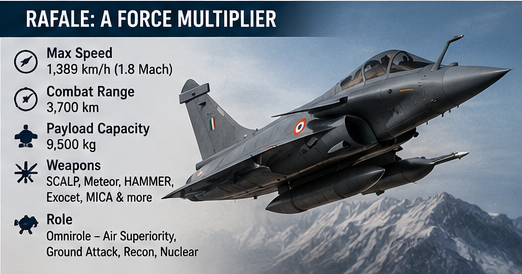
India already has 62 Rafale fighter jets. They changed the strategic equation of South Asia when they were deployed during Operation Sindoor. Now, India is on the verge of ordering 114 more — and this time, most of them will be built on Indian soil. Defence analysts are calling it the “Contract of the Century.” They are not exaggerating.
How We Got Here
The visit of French President Emmanuel Macron to India in February 2026 followed New Delhi’s confirmation that it intended to place a major order for Dassault Rafale jets, as well as the signing of a landmark free trade agreement between India and the European Union in January.
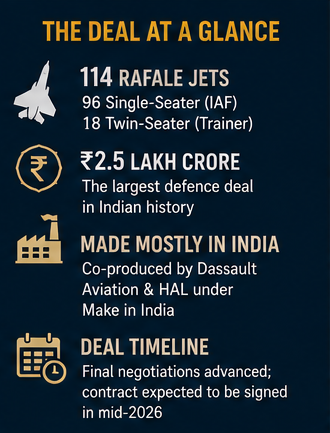
A potential ₹2.5 lakh crore deal for 114 Rafales is on the table, with French officials expressing confidence that a historic agreement could be reached. India’s Prime Minister Narendra Modi said that in today’s turbulent world, the India-France partnership is one for global stability. Macron said the remarkable acceleration of ties with India came in response to the changing international order.
French President Emmanuel Macron defended New Delhi’s proposed move to purchase and co-produce 114 Rafale fighter jets, saying the mega defence plan will make India stronger while deepening strategic coordination and creating jobs in both countries. An Indian defence ministry statement confirmed that the proposed purchase of Rafale jets had been cleared — with the majority of them to be manufactured in India.
Why 114 Jets? What India Is Building
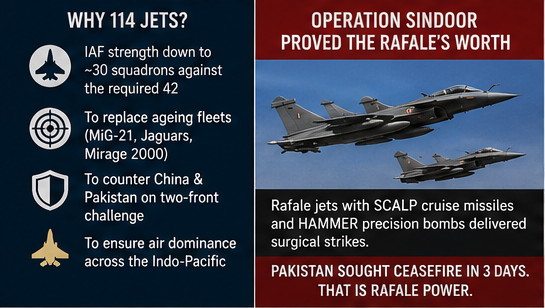
India’s air force currently operates under severe strain. The Indian Air Force is supposed to have 42 active squadrons — it currently has around 30. Every retired MiG-21, every ageing Jaguar, every squadron that reaches end of life without a replacement widens a gap that China and Pakistan both watch carefully.
India had earlier signed a deal in 2016 to purchase 36 Rafale jets for the Indian Air Force. The aircraft have since been inducted and deployed in key strategic sectors. Additionally, India cleared the acquisition of 26 Rafale-M marine variant jets for the Indian Navy to operate from INS Vikrant. Now, negotiations are in advanced stages for the new large-scale order of 114 additional Rafale fighter jets.
The breakdown of the 114-jet order is strategically precise: approximately 96 single-seat fighters for the Indian Air Force, and 18 twin-seat trainers — with the overwhelming majority to be co-produced under the Make in India programme at a facility being set up in partnership with Hindustan Aeronautics Limited.
Operation Sindoor Proved the Rafale’s Worth
India does not need to imagine what 114 Rafales will mean for its security. It already knows.
Last year’s Operation Sindoor demonstrated — in live operational conditions — exactly what Rafale jets with SCALP cruise missiles and HAMMER precision-guided bombs can do. The strikes were surgical, fast, and devastating. Pakistan sought a ceasefire within three days. The Rafale’s role in that operation has become the most powerful recruitment argument for the 114-jet deal that any defence ministry presentation could ever make.
With 114 more Rafales entering service over the next decade, India’s air power would reach a level of sophistication and volume that would fundamentally alter the strategic calculus across the entire Indo-Pacific region.
The Make in India Revolution in Defence
This is what makes the 114-Rafale deal fundamentally different from the 2016 purchase of 36 jets in fly-away condition.
Macron stated that the mega defence plan will make India stronger while deepening strategic coordination and creating jobs in both countries. The deal involves Make in India co-production, stronger strategic ties, job creation, submarine cooperation, and expanded collaboration in AI and emerging technologies.
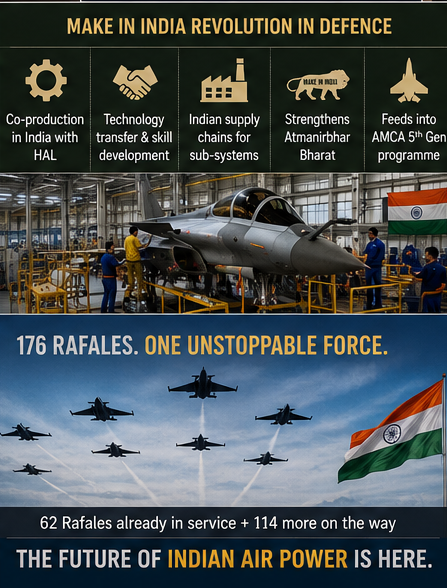
The technology transfer embedded in this deal means India will not just fly Rafales — it will learn to build them. HAL engineers will work alongside Dassault Aviation technicians. Indian aerospace supply chains will manufacture sub-systems. And over time, the knowledge accumulated will feed directly into India’s own fifth-generation Advanced Medium Combat Aircraft programme.
New Delhi has sought over the past decade to reduce its dependence on Russia, its traditional main supplier of military equipment, turning to other countries while also pushing for more domestic production. The Rafale deal, with its Make in India clause, is the clearest expression yet of that strategic pivot.
The India-France Alliance: Bigger Than Just Jets
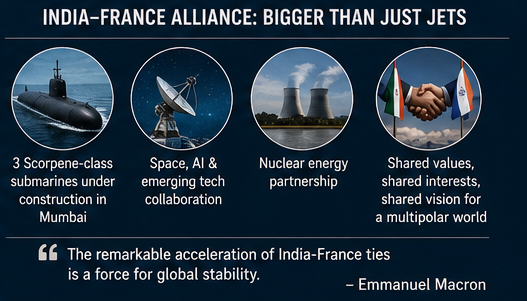
Macron praised the remarkable acceleration of India-France ties as a force for global stability. The partnership encompasses AI cooperation, space collaboration, submarine deals, nuclear energy, and now the largest fighter jet contract in Indian history.
France is also building three additional Scorpene-class submarines for the Indian Navy at Mazagon Dock Limited in Mumbai — extending India’s underwater reach at a time when the Indian Ocean is becoming the world’s most contested strategic waterway.
Macron lauded India’s digital transformation and its pioneering role in technology governance, calling the nation’s progress a global benchmark. The India-France relationship is no longer defined by individual transactions — it is a full-spectrum strategic partnership built on shared values, shared interests, and a shared view of a multipolar world.
What ₹2.5 Lakh Crore Buys India
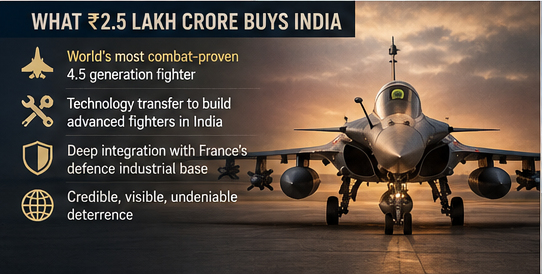
When the final numbers are signed, India will have spent approximately ₹2.5 lakh crore on 114 Rafale jets — the largest single defence procurement in the country’s history. What does that buy?
It buys the replacement of India’s entire ageing fleet with the world’s most combat-proven fourth-generation-plus multirole fighter. It buys the technology transfer to build advanced fighter aircraft on Indian soil. It buys deep integration with France’s defence industrial base — a partner that shares India’s concerns about both Chinese expansionism and Russian unpredictability. And it buys deterrence — the kind of credible, visible, undeniable deterrence that makes adversaries calculate twice before they calculate once.
India’s defence analyst Christophe Jaffrelot described the potential deal as the contract of the century — and if finalised, the jets would add to the 62 Rafales that India has already purchased, creating a formidable combined fleet of 176 Rafale aircraft across the Indian Air Force and Indian Navy.
176 Rafales. That is not just a fleet upgrade. That is a declaration about what kind of military power India intends to be in the world of 2030 and beyond.
All information sourced from Arab News, France24, AFP, Open The Magazine, Beyond The Punchlines, and Deccan Herald as of February–May 2026.
