


BREAKING | June 2, 2026 | Business & Economy
₹7.5 Per Litre in 11 Days. Petrol Above ₹100 in Delhi. This Is India’s Most Painful Fuel Shock Since 2022.
You felt it at the petrol pump last week. You felt it again this week. And if global crude oil prices do not come down soon, you will feel it again next week too. In just 11 days between May 15 and May 25, 2026, petrol and diesel prices across India rose by nearly ₹7.5 per litre — one of the sharpest fuel price hike cycles the country has seen since the Russia-Ukraine shock of 2022. For the average Indian family, this is not an abstract economic headline. It is ₹500 more every time you fill your tank. It is more expensive vegetables, costlier auto rides, and a household budget that simply does not add up anymore.
How It Happened: The Three Triggers
In just 11 days, petrol and diesel prices in India rose by nearly ₹7.5 per litre, making it one of the sharpest fuel hike cycles in recent years. The surge was driven by rising global crude oil prices, tensions in West Asia, and a weakening rupee, which increased India’s oil import costs.
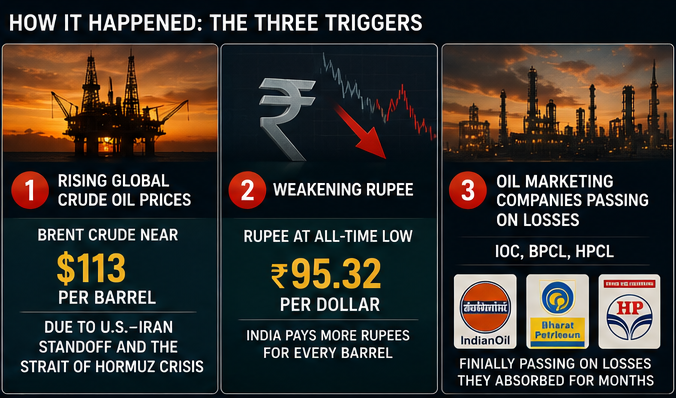
The three triggers feeding each other in a vicious cycle. Brent crude near $113 per barrel because of the U.S.–Iran standoff and the Strait of Hormuz crisis. The Indian rupee at an all-time low of ₹95.32 per dollar — meaning India pays more rupees for every barrel even if the dollar price stays flat. And oil marketing companies — IOC, BPCL, and HPCL — finally passing on losses they had been absorbing for months.
One important reason the hikes felt abrupt is because India had effectively delayed the impact for years. Since 2022, government-controlled oil marketing companies such as IOC, BPCL, and HPCL reportedly absorbed large under-recoveries instead of immediately passing global price increases to consumers. Retail prices remained relatively controlled despite crude volatility. But this model becomes difficult to sustain when global crude prices remain elevated for long periods. The May 2026 hikes were not only about current crude prices — they also reflected the accumulated cost of months of suppressed pricing.
In plain language: India’s oil companies were bleeding quietly so that voters would not feel the pain at the pump. The IPL season and the state elections created political pressure to hold prices. The moment both ended, the gates opened.
City by City: Where the Pain Is Worst
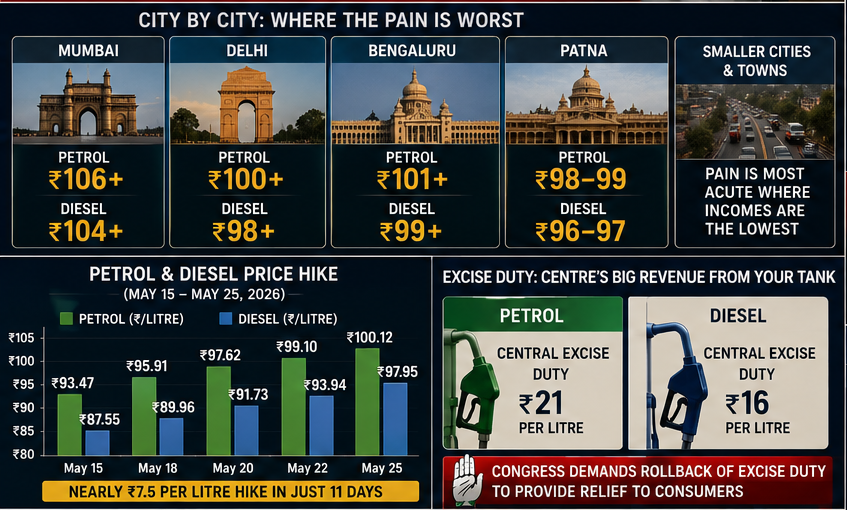
The price increases happened in phases through May 2026. The first major hike came on May 15, followed by multiple revisions within days. By May 25, petrol and diesel prices had climbed sharply across most cities. In Delhi, petrol prices moved from around ₹94–95 per litre to above ₹100 per litre within less than two weeks.
Mumbai, which has historically had the highest petrol prices in India due to state VAT, crossed ₹106 per litre. In Patna, where state taxes are lower, petrol settled around ₹98–99 per litre. In Bengaluru — India’s tech capital where millions of two-wheeler commuters fill up daily — petrol crossed ₹101 per litre for the first time. In smaller cities and towns across Bihar, UP, and Rajasthan, where daily wages are lower and fuel consumption as a percentage of income is higher, the pain is the most acute.
The Ripple Effects: Why Fuel Prices Touch Everything
This is what non-economists miss about fuel price hikes. It is never just about the pump. Every rupee increase in petrol and diesel sends shockwaves through the entire economy.
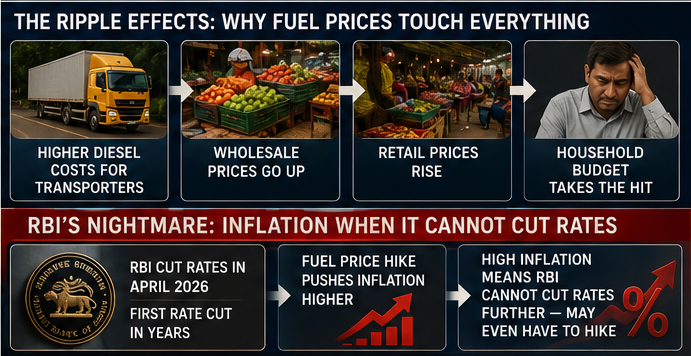
Truck drivers who carry vegetables, fruits, and grains from farms to mandis pay more for diesel. They pass that cost to the wholesale traders. Wholesale traders pass it to retail vendors. Retail vendors pass it to consumers. A 15% increase in diesel prices does not translate to a 15% increase in tomato prices — but it contributes to a 3–5% increase in the cost of almost every food item that travels more than 50 kilometres to reach your kitchen.
Auto-rickshaw fares rise. Bus fares rise. Delivery charges for e-commerce packages rise. School van fees rise. Every service that requires a vehicle to move becomes more expensive — and in India, that is almost every service.
Higher diesel and petrol prices eventually push up transportation, logistics, and daily household expenses, increasing inflationary pressure across the economy. The hikes also highlight how vulnerable India still remains to global energy shocks.
The RBI’s Nightmare: Inflation When It Cannot Cut Rates
The Reserve Bank of India cut interest rates in April 2026 — its first rate cut in years — hoping to stimulate a slowing economy. The fuel price hike threatens to undo that stimulus immediately.
Higher fuel prices push consumer price inflation higher. When inflation rises, the RBI cannot cut rates further — and may even be forced to reverse course and hike. This is the policy trap India is in: a weakening economy that needs lower interest rates, and surging inflation that prevents them.
Opposition parties have been quick to capitalise. The Congress demanded an immediate rollback of central excise duty on fuel, pointing out that the Centre currently collects approximately ₹21 per litre on petrol and ₹16 per litre on diesel in central excise alone — revenue that could be used to cushion consumers from global price volatility without the oil companies absorbing losses.
The Only Solution: Hormuz Must Reopen
There is only one way this ends — and it has nothing to do with India’s domestic politics or the RBI’s monetary policy tools. The Strait of Hormuz must reopen. The U.S.–Iran standoff that has kept crude oil elevated since late 2025 is the root cause of everything India is experiencing at the pump today.
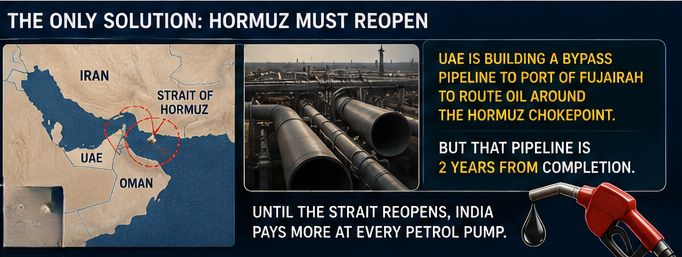
PM Modi’s recent UAE visit addressed this directly — the UAE is building a bypass pipeline to the Port of Fujairah specifically to route oil around the Hormuz chokepoint. But that pipeline is two years from completion. In the meantime, India’s 1.4 billion people fill their tanks, watch the numbers climb, and wait for a geopolitical crisis 3,000 kilometres away to finally resolve itself.
Until it does, every trip to the petrol pump in India is a reminder of just how deeply connected this country’s daily life is to the price of oil in the Persian Gulf.
All information sourced from Indmoney, Business Standard, and GoodReturns as of May 25 — June 2, 2026.
