


BREAKING | May 30, 2026 | Education
“Sad You Haven’t Learned” — Supreme Court’s Strongest Words Yet Against NTA as 22.7 Lakh Students Wait for Justice
It was the most powerful rebuke India’s highest court has delivered to an examination body in recent memory. On Thursday, the Supreme Court of India looked at the National Testing Agency — the body that has now presided over two consecutive NEET paper leak scandals — and said three words that cut through every bureaucratic defence the NTA has ever offered: “Learn from UPSC.”
The Supreme Court came down heavily on the National Testing Agency over the NEET-UG 2026 paper leak scandal, telling the examination body to learn from the Union Public Service Commission, which has conducted massive national examinations for decades without major leaks. Hearing petitions challenging the cancellation of the May 3 NEET-UG examination, the bench of Justices PS Narasimha and Alok Aradhe expressed serious concern over what it described as the ad hoc functioning of the NTA and demanded accountability for repeated security failures that have shattered public confidence.
The Supreme Court also observed that it was “sad” that the agency had not learnt lessons from the earlier paper leak episode — a direct reference to the 2024 NEET scandal that rocked the country just two years ago.
Two years. Two scandals. Twenty-two lakh students destroyed both times. The Supreme Court’s patience has run out.

What Happened: The Timeline of a Scandal
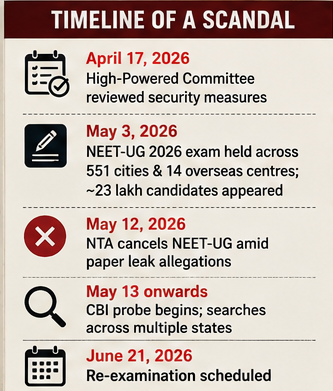
The NEET-UG examination was conducted on May 3, 2026 across 551 Indian cities and at 14 overseas centres, with nearly 23 lakh candidates registered. On May 12, the NTA cancelled NEET-UG amid allegations of paper leak. A re-examination has been scheduled for June 21. The CBI, which is probing the case, has conducted searches across the country. So far, 13 accused have been arrested from Delhi, Jaipur, Gurugram, Nasik, Pune, Latur, and Ahilyanagar.
The NTA’s own affidavit to the Supreme Court confirms the sequence: a High-Powered Steering Committee reviewed preparations for NEET-UG 2026 on April 17, recommended extensive pre-exam, during-exam, and post-exam safeguards — and the exam was still leaked. GPS-tracked vehicles, AI-assisted CCTV, biometric verification, 5G jammers — the entire security apparatus failed because the leak happened before question papers ever reached an exam centre.
The IAF Will Guard the Question Papers
The government’s response to the re-examination security challenge is unprecedented in Indian educational history.
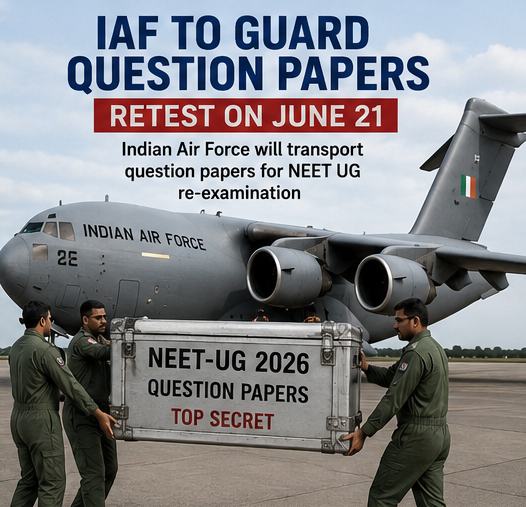
Union Education Minister Dharmendra Pradhan announced that the Indian Air Force will be deployed to transport question papers for the upcoming NEET UG re-examination on June 21, citing logistical challenges and unpredictable weather conditions in June.
India is deploying its Air Force to protect a medical entrance exam question paper. That sentence alone tells you how completely the NTA has lost the country’s trust — and how seriously the government is now taking the threat of another leak.
The Supreme Court’s Key Demands
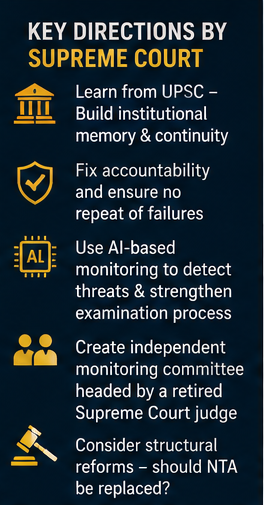
The Supreme Court stressed on the need to create institutional memory of continuity within the NTA, referring to its ad hoc nature as a core problem. The bench said that unless clear accountability is fixed, the problems will recur.
The court also urged the government to collaborate with IITs and leading institutions to establish a permanent AI-based monitoring mechanism capable of detecting emerging threats and strengthening the examination process continuously. The oversight panel had submitted 35 long-term and around 60 short-term recommendations, most of which had already been implemented — yet the leak still happened.
Petitioners sought the creation of a high-powered independent monitoring committee, preferably headed by a retired Supreme Court judge and including experts in cybersecurity and forensic science, to oversee the examination process until structural reforms are implemented. They also urged that the NTA be replaced with a more autonomous and credible institution.
Should NTA Be Abolished? The Core Legal Question
The petitions before the court argue that recurring examination controversies demonstrate a breakdown in institutional safeguards rather than isolated security breaches. The litigation raises a fundamental question: Can a national examination body continue functioning without substantial restructuring when repeated controversies undermine public confidence in its integrity?
The medical associations are unambiguous in their answer. The Federation of All India Medical Association argued that repeated incidents of alleged paper leaks and systemic failures in NEET-UG have resulted in a direct assault on the fundamental rights of more than 22.7 lakh students appearing for the medical entrance examination.
A direct assault on fundamental rights. Not a bureaucratic failure. Not a security lapse. A constitutional violation — and the Supreme Court appears to agree.
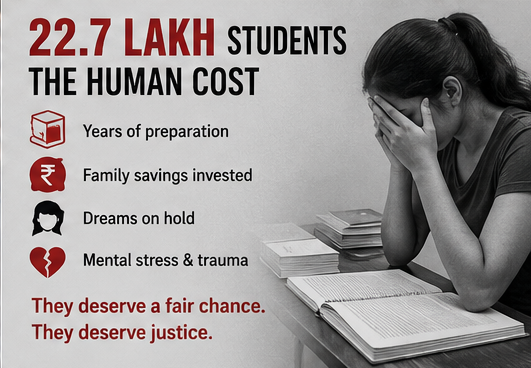
22.7 Lakh Students: The Human Cost Nobody Is Counting
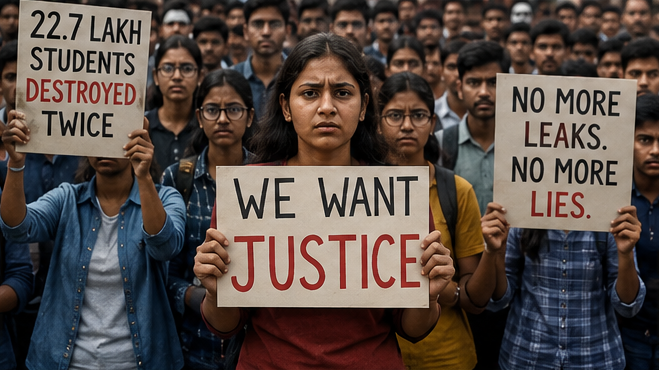
Behind every legal argument, every affidavit, every Supreme Court bench observation — there are 22.7 lakh human beings. Most of them teenagers. Many of them from small towns and villages across Bihar, UP, Rajasthan, and Maharashtra. All of them having spent years, and often their family’s entire savings, preparing for an examination that was supposed to be the gateway to a doctor’s life.
They gave up childhoods for this exam. They studied through heatwaves and power cuts and family crises. They sat for five hours on May 3 — and then watched it get cancelled nine days later because someone, somewhere in the distribution chain, sold the question paper.
The retest is June 21. The Indian Air Force will carry the papers. The CBI is investigating. The Supreme Court is watching.
For 22.7 lakh students, the only thing that matters now is one question: will June 21 finally be the fair exam they deserved in the first place?
All information sourced from ANI, LiveLaw, Madhyamam Online, LawBeat, Legal Services India, and India.com as of May 28–30, 2026.


