


SPECIAL REPORT | May 28, 2026 | National Affairs
They Nearly Started a Nuclear War. Now — Quietly, Carefully — They Are Talking Again.
Exactly one year ago today, the guns fell silent between two nations that had spent four terrifying days exchanging missiles, drones, and artillery fire. On May 10, 2025, India and Pakistan agreed to a ceasefire. Today, May 28, 2026 — eighteen days past that anniversary — something remarkable and deeply fragile is beginning to emerge from the silence: the first whispers of dialogue.
How It All Started — The Attack That Changed Everything
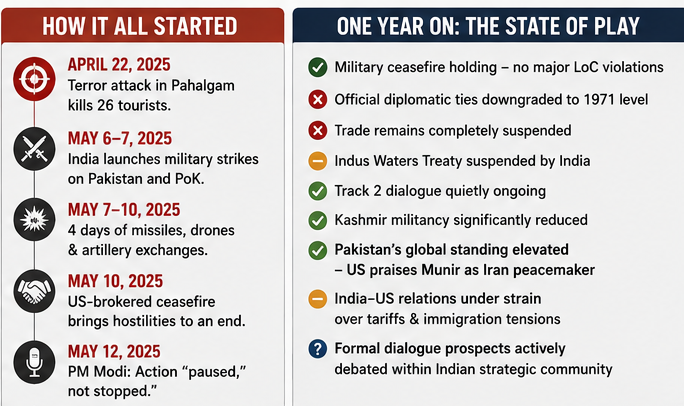
On April 22, 2025, a terrorist group opened fire against tourists in Pahalgam, which led to 26 casualties — a shock to the authorities, as in almost 40 years of dispute, the targets had largely not been everyday passersby. India’s first response was to immediately close its borders with Pakistan, suspend all trade, and threaten to halt the Indus Water Treaty. It was on the night between May 6 and 7, 2025, that India conducted its first military strikes against Pakistan-administered Kashmir and Pakistan’s internationally acknowledged territory.
India and Pakistan stepped back from the brink of catastrophe on May 10 after a US-brokered ceasefire brought rapidly escalating hostilities to an end. Indian Prime Minister Narendra Modi said on May 12 that India had only “paused” its military action against Pakistan and would “retaliate on its own terms” to any future attacks.
Those words — “paused, not stopped” — set the tone for the eighteen months that followed.
A Year Later: The Guns Are Silent, But Nothing Is Normal
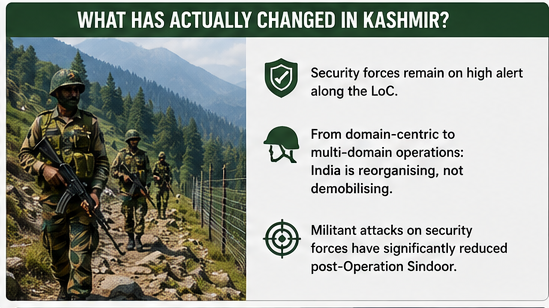
A year has gone by since the deadly terror attack in Pahalgam claimed the lives of 26 civilians, setting off a four-day escalation between nuclear-armed neighbours India and Pakistan before a ceasefire was reached on May 11. Since last year’s war-like confrontation — when India and Pakistan exchanged heavy artillery fire and launched drone and missile strikes — militant attacks on security forces have largely ceased.
The diplomatic staff has been downgraded to the level of the 1971 war. There is no engagement at the official level. But Track 2 discussions are going on — and the effort is to resume trade and ensure that working relations between the two countries begin to normalise.
Track 2 diplomacy — back-channel conversations between retired officials, academics, and business leaders — is the quiet machinery of peace that operates when governments cannot officially talk. That it is happening at all is, given what transpired a year ago, nothing short of remarkable.
Pakistan’s Surprising New Role: Peacemaker to the World
Here is the part of this story that India’s strategic establishment is watching most carefully.
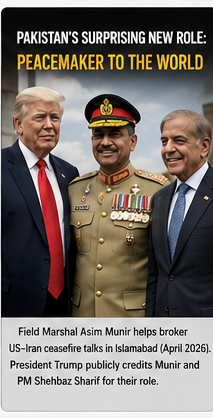
Pakistan’s global standing has changed markedly since the ceasefire. Field Marshal Asim Munir, who commanded Pakistani forces during the conflict with India, was by April 2026 personally brokering the ceasefire between Washington and Tehran. The Islamabad talks held on April 11-12 produced the first direct high-level engagement between the US and Iran since 1979, with President Donald Trump publicly crediting Munir and Prime Minister Shehbaz Sharif multiple times.
Pakistan — the country India struck with missiles less than fourteen months ago — is now being publicly praised by the U.S. President as a peacemaker. For India, which has always sought to keep international attention focused on Pakistan’s support for terrorism, this shift carries enormous strategic consequences.
Meanwhile, India-U.S. relations are under strain over trade tariffs and immigration restrictions, narrowing the space in which New Delhi can count on Washington to defer to its regional preferences on Pakistan. For India, analysts say, that shift carries consequences New Delhi has yet to publicly acknowledge.
The Indus Waters Treaty: Water as a Weapon
Of all the unresolved issues between the two countries, none is more potentially explosive than water.
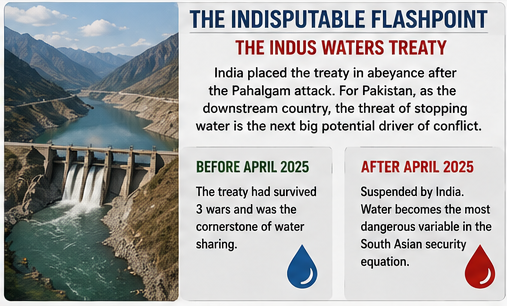
The Indus Waters Treaty, placed in abeyance by New Delhi following the Pahalgam attack in April 2025, remains suspended. India’s Ministry of External Affairs confirmed the treaty has long been the cornerstone of water sharing between India and Pakistan and, before its suspension, had survived three wars between the neighbours.
For Pakistan, as a downstream country, the sudden stopping of water flows — even the threat of it — feels like the next big potential driver of conflict. “The conflict that has transcended across various generations has to do with a fight over land,” said Rajendra Mulmi, Regional Director of Asia for Search for Common Ground. The Indus Waters Treaty suspension may have turned water into the most dangerous variable in the South Asian security equation.
Are They Actually Preparing to Talk?
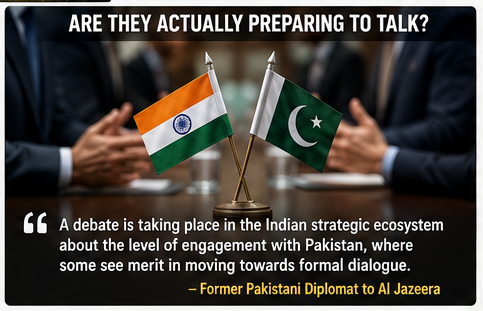
These quiet engagements are unfolding against a considerably shifted backdrop. “A debate is taking place in the Indian strategic ecosystem about the level of engagement with Pakistan, where some see merit in moving towards formal dialogue,” a former Pakistani diplomat told Al Jazeera. The exchange between India’s military leadership and Pakistan’s ISPR was the clearest public signal yet of where relations stand.
A year later, India and Pakistan are technically at peace — in the way that two people who once threw furniture at each other are technically peaceful roommates. You know the world scene is chaotic when we are approaching the first anniversary of a shooting war between two hostile nuclear powers and very few people outside South Asia remember it.
The Washington Post’s characterisation is bleak — but accurate. The world has moved on. For the 1.7 billion people who live in India and Pakistan, however, it is impossible to simply move on.
What Has Actually Changed in Kashmir
Ahead of the Pahalgam attack anniversary, the Chief of Defence Staff General Anil Chauhan reviewed security along the LoC in North Kashmir and commended the “formation’s exemplary operational preparedness, doctrinal coherence, and resolute professionalism.” The Army noted that the character of warfare is undergoing a profound transformation, necessitating a shift from a domain-centric approach to Multi-Domain Operations underpinned by a robust and integrated architecture.
In plain language: India is not demobilising. It is reorganising — building a military architecture designed for the next confrontation, whenever and however it comes.
The Economic Cost of a Year of Hostility
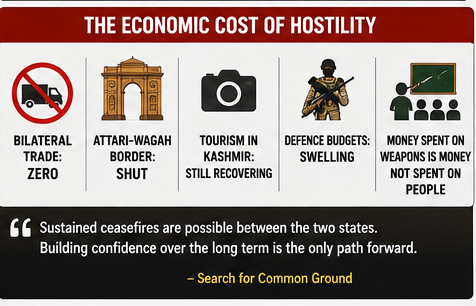
The human cost of the Pahalgam attack and Operation Sindoor is documented in memorials and military honours. The economic cost is less discussed — but equally real.
Bilateral trade between India and Pakistan — which had been recovering cautiously before the April 2025 attack — remains at zero. The Attari-Wagah border crossing, once a symbol of grudging normalcy, stays shut. Tourism in Kashmir, despite efforts to reassure visitors, is still recovering from the psychological shock of the attack. And the defence budgets of both nations have swelled — money spent on weapons is money not spent on schools, hospitals, and roads.
The fact that India and Pakistan were able to agree to a ceasefire as escalations spiralled is reason for optimism. Recent experience shows that sustained ceasefires are possible between the two states. In February 2021, India and Pakistan’s militaries signed a ceasefire to end four months of cross-border skirmishes — and only two violations were recorded across the Line of Control for the rest of that year, dropping to one in 2022. That optimism was shattered on April 22, 2025. Rebuilding it will take years.
One Year On: The State of Play
Military ceasefire is holding with no major LoC violations. Official diplomatic ties have been downgraded to 1971-level. Trade remains completely suspended. The Indus Waters Treaty is suspended by India and still in abeyance. Track 2 dialogue is quietly ongoing. Kashmir militancy has significantly reduced post-Operation Sindoor. Pakistan’s global standing has been elevated with the U.S. praising Munir as Iran peacemaker. India-U.S. relations are under strain over tariffs and immigration tensions. Formal dialogue prospects are actively debated within the Indian strategic community.
Can This Peace Last?
The ceasefire that has held since May 2025 must be protected and built upon through transparent communication and citizen-to-citizen engagement. It is premature to think of this ceasefire as the first step towards long-term peace, especially given the overlapping territorial claims. There is no simple answer to resolving the longstanding conflict — stakeholders must build confidence over the long term by addressing less divisive issues first.
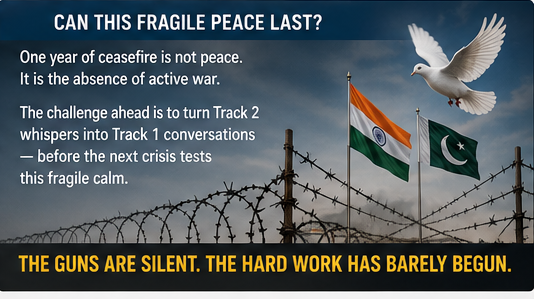
One year of ceasefire is not peace. It is the absence of active war. But in South Asia — between two nuclear-armed neighbours with 78 years of unresolved history — the absence of active war is itself a fragile, precious, and hard-won achievement.
The question for the next year is whether Track 2 whispers can become Track 1 conversations — and whether the Indus Waters Treaty can be restored before water becomes the next trigger for the conflict that both sides say they want to avoid.
The guns are silent. The hard work has barely begun.
All information sourced from Al Jazeera, Outlook India, The Washington Post, The Conversation, Modern Treatise, and newsonair.gov.in as of May 23–28, 2026.
