
TAGS: Strait of Hormuz, India Oil Imports, Gulf Crisis, Oil Prices, Iran US Conflict, Indian Economy, Inflation, Energy Security, West Asia
BREAKING | June 10, 2026 | World Affairs
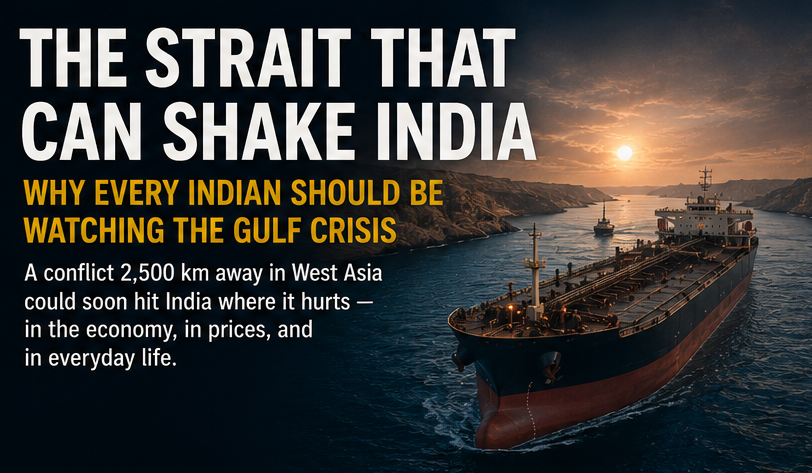
One Narrow Waterway. Twenty Percent of the World’s Oil. A Crisis That Could Reach Every Indian Household.
Most Indians went to work this morning without thinking about the Strait of Hormuz.
They crossed crowded roads, paid for tea with UPI, filled fuel tanks, booked cabs and opened stock market apps. Yet all of those daily activities are connected, in ways most people never see, to a narrow waterway between Iran and Oman.
On June 10, 2026, that waterway is once again at the centre of a geopolitical storm.
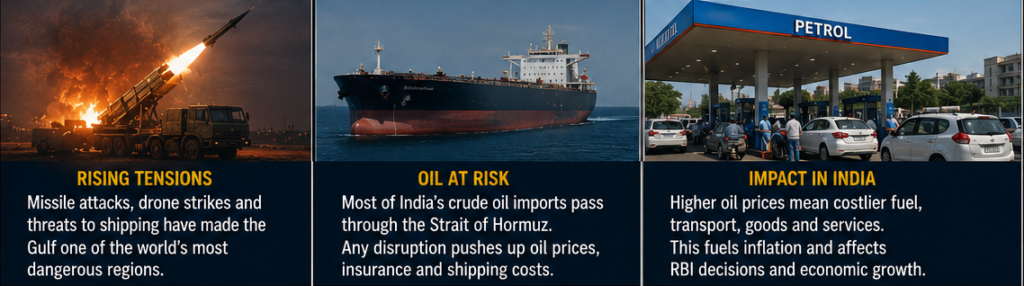
Missiles have flown across the Gulf. Drones have targeted strategic facilities. Oil tankers are operating under heightened security. And with every escalation, one question grows louder in New Delhi, Mumbai and Bengaluru:
What happens if the Strait of Hormuz stops functioning normally?
For India, the answer could be measured not in military terms, but in rupees.
The Waterway That Powers the World
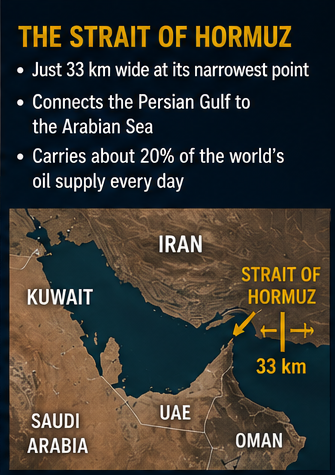
The Strait of Hormuz is one of the most important maritime chokepoints on Earth.
Every day, millions of barrels of crude oil pass through the narrow corridor linking the Persian Gulf to global markets. Energy exporters including Saudi Arabia, Iraq, Kuwait, the UAE and Qatar rely on it to move their resources to customers around the world.
For decades, the strait has served as the beating heart of the global energy system.
Most of the time, ships pass through quietly.
During a crisis, the entire world watches.
Because when Hormuz is threatened, oil prices rarely remain stable for long.
Why India Cannot Ignore It
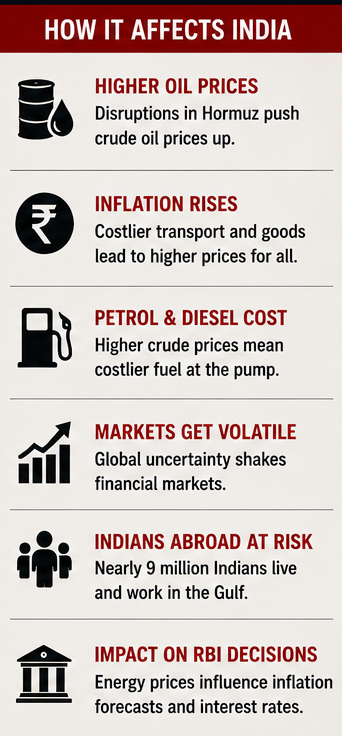
India is the world’s third-largest consumer of oil and one of its largest importers.
Much of the crude oil that fuels Indian cars, buses, factories and airlines originates in the Gulf.
That means disruptions in Hormuz are not distant geopolitical events. They are potential economic shocks.
A prolonged crisis can increase shipping costs. Insurance premiums rise. Oil traders demand higher prices. Import bills grow larger.
The effects eventually reach ordinary consumers.
Petrol becomes more expensive.
Transport costs rise.
Businesses face higher operating expenses.
Inflation becomes harder to control.
What begins as a military crisis in West Asia can end as an economic challenge for Indian households.
The Nine Million Indians Watching Closely
Oil is only part of the story.
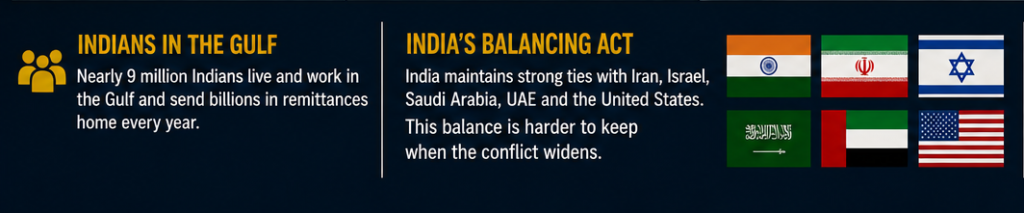
Nearly nine million Indians live and work across Gulf nations.
They are engineers, nurses, construction workers, managers, entrepreneurs and professionals who contribute significantly to the economies of both India and the Gulf.
Every year they send billions of dollars home.
Those remittances help support families, fund education, build homes and strengthen local economies across India.
Any instability in the Gulf therefore carries both economic and human consequences.
For millions of Indian families, developments in the region are not abstract foreign-policy stories. They are deeply personal.
India’s Delicate Balancing Act
Unlike many countries, India maintains important relationships with almost every major player involved in the region.
New Delhi has strategic ties with the United States.
It maintains close partnerships with Saudi Arabia and the UAE.
It has longstanding links with Iran.
It works closely with Israel in defence and technology.
This balanced approach has allowed India to protect its interests while avoiding entanglement in regional rivalries.
But balancing becomes more difficult when tensions escalate.
Every new strike, every new warning and every new disruption tests that strategy.
The Cost of Uncertainty
Financial markets dislike uncertainty.
Investors dislike uncertainty.
Businesses dislike uncertainty.
The Gulf crisis creates all three.
Even if shipping lanes remain open, the fear of disruption can affect prices.
Markets react before shortages occur.
Traders respond before tankers stop sailing.
That is why global energy crises often begin with expectations rather than actual shortages.
And expectations today are becoming increasingly nervous.
A Crisis Far Away That Feels Close
The missiles launched in the Gulf this week were not aimed at India.
The drones crossing regional skies were not targeting Indian cities.
Yet their consequences may still arrive in India through fuel prices, inflation, markets and trade.
That is the reality of a connected world.
A conflict thousands of kilometres away can influence the cost of living in Indian cities within days.
The Strait of Hormuz may appear small on a map.
But for India, its importance is enormous.
And as tensions continue to rise across West Asia, one thing has become clear:
What happens in the Strait of Hormuz rarely stays in the Strait of Hormuz.